Friday, April 7, 2023

A (Virtual) Visit to Rome for “Holy Friday”

In recent years, I have made use of streaming audiovisual media in order to have some share in the liturgies of Holy Thursday and Good Friday. I am glad to make it to my parish church every Sunday (it is sometimes my only “public outing” of the week), as I shall also do on Easter Sunday. For the other wonderful Triduum liturgies, however, I am grateful to be linked through media to these celebrations which would be too difficult in my condition to attend in person.

Nearly 30 years ago, I was living in Rome, and the city will always remain rooted in my heart. Thanks to the Vatican News YouTube channel, I can see and hear the Good Friday liturgy “at Saint Peter’s Basilica.” Although it began a bit early in the day in the USA, the live-stream enriched the whole rest of the day.

After it ended, I “rewound” at my leisure to take some screenshots. Everything here comes “courtesy of” Vatican News (and I’m counting on them to be very courteous indeed, since I didn’t ask for permission—but I am presuming that the educational, edifying, and entirely nonprofit purposes of this tiny blog are sufficient that they would say, “va bene”😉).

If you have not been to Rome, you must go. Until then, here are some images from the service.

Entering Saint Peter’s is stunning even after it becomes familiar. And though it glitters and is filled with masterpieces of art, we must never forget that it’s a church. It belongs to the worship of God and to all the people of the city and the world, free of charge.

********************************************************************************

Here bishops, priests, and people wait for the liturgy to begin.

********************************************************************************

Pope Francis, with concelebrants, deacons, and acolytes, enters from behind the altar. The wheelchair remains necessary for his knee and leg problems, but otherwise he is in good health once again.

********************************************************************************

The first reading is proclaimed, from the “Suffering Servant Song” in Isaiah 52:13-53:12. “He was pierced for our offenses, crushed for our sins; upon him was the chastisement that makes us whole, by his stripes we were healed” (Isaiah 53:  ).

********************************************************************************

The choir chants the Responsorial Psalm 31. “Into your hands I commend my spirit.”

********************************************************************************

Two older (probably European) bishops join in the responses. Behind them are two young seminarians; one appears to be Asian and the other African. The Church gathers the peoples of the whole world into Christ’s Body.

********************************************************************************


The chanting in Latin of the Passion of Our Lord Jesus Christ according to John’s Gospel (chs 18-19).

********************************************************************************


The homily is preached by Cardinal Raniero Cantalamessa, who has been the Preacher to the Papal Household for longer than I can remember. It’s always good to see and hear him!

********************************************************************************


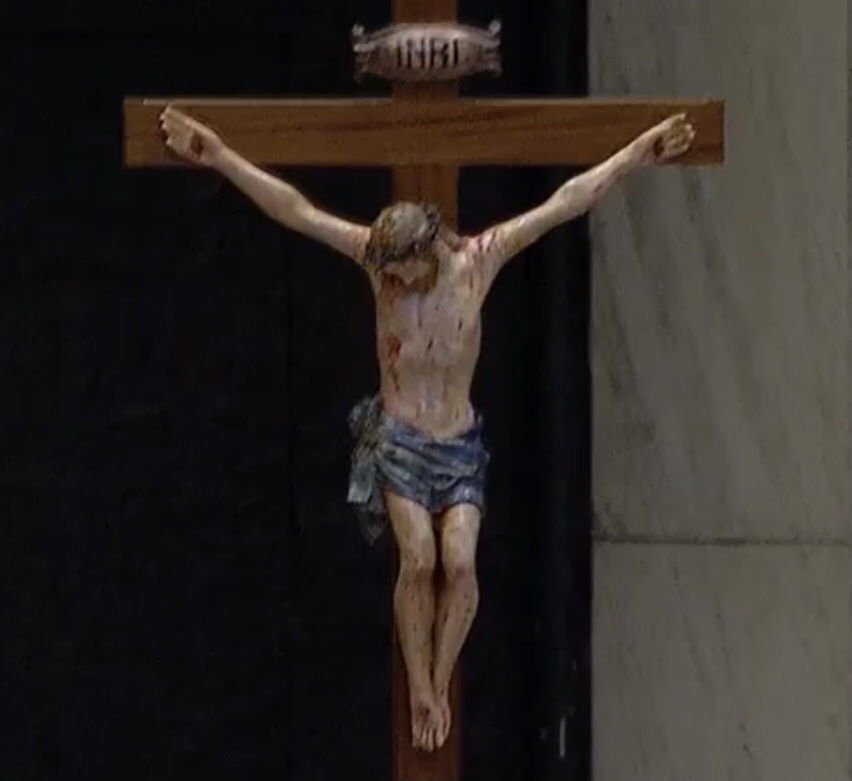
After the Good Friday Intercessions, the procession begins for that very precious feature of the ancient Good Friday Liturgy, “the Adoration of the Holy Cross.” I’m not the only person so struck by this beautiful crucifix to be moved to “take pictures” of it. In the crowd you can see mobile devices everywhere held aloft. More closeups below, from Vatican Media’s top notch videographers:


********************************************************************************

The Cross is brought to Pope Francis.


After the 86-year-old Bishop of Rome kisses the Cross, it is presented to a representative group of the people individually, and then held up once more to the whole congregation for silent prayer.

********************************************************************************


The Cross is placed on the altar. Another procession enters with the Eucharist—already consecrated at the Holy Thursday liturgy (here is the one instance in the restored Latin rite where the ancient practice is followed that has been in use continually—at selected times, including Holy Week—in the Eastern Churches, where it is called the “liturgy of the presanctified gifts”).

I am moved by the profile of our holy and devoted Pope Francis, whose has served Christ his whole life in often difficult circumstances in Argentina, who was often misunderstood, who grappled with many conflicts in society and the Church, and who has now given to the Lord, to Rome, and to the whole world the ardent and tireless service of this past decade in the evening of his long life. Let us continue to thank God for him and to pray for him.

********************************************************************************


After praying the Lord’s Prayer, the priest raises up and consumes one of the “presanctified” hosts—the true Body, Blood, Soul, and Divinity of Jesus Christ our Savior—and the others are given to the faithful as  Holy Communion.

As I have become accustomed to doing (even before the COVID pandemic made this particular gesture familiar and necessary for people everywhere who wanted to participate in the life of the Church), I prayed the prayer of “Spiritual Communion” in front of my television.

It is no small consolation, this great gift of Christ’s love, which has nourished me greatly in these moments. And now, I hunger all the more for the fullness of sacramental Communion on Easter Sunday. Jesus Christ crucified and risen is the strength and hope and the love of my life.

Thursday, April 6, 2023

Walking the Paschal Way in 2023

The days have come in which we celebrate the greatest events—the most mysterious and most revealing events—in all the ages of this vast universe; the events that encompass and ultimately define all of the meaning of the cosmos, of human history, of every nation and people, and of the lives of each one of us. Of course, I mean the events of the death and resurrection of Jesus Christ, the Only Begotten Son of the Father, the Word made flesh, incarnate God, true God and true man, the Savior of the world, the Lamb of God who takes away the sins of the world, the One who has been “lifted up” and is drawing all things to Himself.

The Paschal Triduum comes at a difficult period of time for me personally and for the world, where many momentous human crises are unfolding. We remain on the edge of possibilities and perils, and we know very little of how they will ultimately turn out. 

I was born and grew up in a society in which the 19th-20th centuries’ titanic achievements of human power over the physical world were simply facts of daily life. In the 1960s an intense optimism prevailed in Anglo-American society about the apparently “limitless” capacities of the power of science to make humans the masters of the world, and that this power would be used to “make the world better.” I have lived my adult life to this day in an increasingly complex and troubled period of history, in which we have begun to realize the dangers of our power even as we continue to expand and develop its reach ever more deeply into our environment, our mobility, our modes of perception and the expectations they engender, and even the structure and functioning of our bodies.

We are also slowly discovering—in the face of many complications, failures, and disasters—that there are “limits” to our power, that it bears fruit only as an aspect of the journey of the lives of human persons on the road of the delicate and precious earth that has been given to us. We need patience and wisdom on this path; we need open hearts to embrace its hardships, and trust to discover the possibilities that we don’t “own,” but which nonetheless invite us to a collaboration that engages all of our reason, freedom, and enthusiasm—including our vast technological competence—in the marvelous adventure of being human. 

In fact, the world is a “sign” that points us toward something greater: a limitless goodness and meaning, a loving, all-encompassing and transcending fulfillment that we long for but cannot manufacture by our own power. Nevertheless, many of us try to grasp this fulfillment by our own power, to measure it, control it, hoard it to ourselves or our group as the basis for our claim to “superiority” over others. This presumption begets violence. And we see violence all around us in the world of 2023.

In my life, I have learned a few things about both the possibilities and the limits of the human power, particularly the power of medical science. There is no cure for previously untreated late-stage Lyme Disease, but there is—if not a “cure”—at least the possibility of doctors helping us to put together an idiosyncratic regimen of life (including several carefully monitored prescriptions medications) that has kept me more-or-less physically and mentally “stable” for many years—important years during which we have raised our children. I continue to endure various limitations from my chronic illness and its effects, which means that I’m not planning on running any marathons (or walking any walk-a-thons). 

I don’t know what it might mean in the future, but at present I can still amble about and I can still read, study, and “stay on top of” current events. And I can still write, though it is becoming a bit harder because it requires so much energy (and you never realize how much energy a task requires until your energy is depleted by incapacity or [and!🙄] the process of aging). I feel like I am enrolled in the long school of learning-to-let-go, and I’m very stubborn. There is something deeply ambivalent about my stubbornness, but it’s in some respects a good thing. I want to live intensely the life I have been given, to aim myself at its purpose, to focus on what matters—what has been entrusted to me—and to learn from the mistakes I will inevitably make.

There are times when I feel anxious or perplexed, and I wonder what role (if any) I still have as a force for good in the world, a constructive presence to people near and far. The ongoing explosive transformation of media technology is broadening the ways we become aware all over the face of the earth of one another’s particular identities, hopes, and problems. This can become distorted and disorienting, or shallow and disengaging, so that we are inclined to be cynical or contemptuous of the neighbor who lives so far from us, who appears so “alien” to us, who expresses different opinions that we can so easily lash out against. On the other hand, if we are willing to invest ourselves as human persons on the Internet, there may emerge new possibilities to learn about one another and help bear one another’s burdens. The light of Jesus can shine through the Internet in ways I never would have guessed if I hadn’t experienced them myself. Media technology generates an “environment” within which we interact, and even a kind of personal and interpersonal “space” that so many people—for better or for worse—“inhabit” for significant portions of their day (the late Pope Benedict XVI called it “the digital continent”). It is a space that needs our attention; a space where people can be found and served. But it cannot be the foundational place for the whole human person, the bodily person who dwells in a physical place and time, and who needs companionship and love primarily and immediately in that place where they breathe, hunger and thirst, live and die.

In my own circumstances, there are some basic facts that I must remember. First off—although it’s sometimes hard for me to believe (because of what remains of my depression and all my emotional immaturity)—I really do have value as a husband, a father, and a grandfather. Clearly, I matter to my family. What I do and what I suffer affects them, because relationships are real and when we try to pretend otherwise we do real harm to ourselves and those who have been entrusted to us. I thank God for my family, and I hope and pray that I can serve them, love them, and always be grateful for them.

There is another sphere of human relationships that we engage by our work. I hope my long, laborious studies will form my own mind and heart with a deeper understanding and compassion. In my reading I discover the expressions of so many voices that long to be heard. I want to engage them not merely as a means for gathering information, but first of all to listen to them. Listening is an elusive and difficult task that produces no immediate external, tangible “product.” Our turbulent, rushed, mass-consuming, “results”-oriented, hyperpartisanized society lacks the patience for listening. Still, there can be no dialogue, no true inter-relationship between persons, no real human solidarity in our world, no space for giving and receiving mercy to one another, without listening. I want to take advantage of the special opportunity that the circumstances of my life give me to continue to read seriously (since I can read even while lying in bed, and this aspect of my mind is still full of vitality). I want to read not in a distracted way, not just to “pass time,” but as a real work undertaken with awareness, attention, and discipline, making the effort to listen to the voices of people telling their stories of their joys and sorrows, and to make the “prayer” of their hearts in some sense my own. 

I also have active communications skills, and I hope that my writing and other expressive work serves at least the few people who read, see, or hear it. One reason I write is in order to share with others some understanding of the larger picture of the world in which we live. We must care about what’s happening in our world, and bring to it (in whatever ways we can) the resources of mercy. Often the “works of mercy” are hidden, but they are essential to the Christian vocation in the world. My hope is that we might begin to cultivate a kind of “empathy” (a “seeing-things-from-the-perspective-of-others”) that enables us to respond constructively to the blizzard of information and all the elements of interconnectedness that link us in unprecedented ways to human experiences, human suffering, and human violence all over the world. Through empathy we can discover concrete ways of being-together with greater solidarity and fraternal love.

It may seem easy enough to cultivate empathy for persons and peoples who are undergoing great trials (though it requires attention and persistence if empathy is to become something more than a brief shallow sentiment). But we also must not hold ourselves aloof from some form of empathy (based on the recognition of the wounded humanity we share) even for those who are involved in causing troubles and imposing afflictions on others. This does not mean that we should not struggle against the evil they do, but it means that we cannot fight against their evil without also fighting “for” their humanity, for their change-of-heart and their healing (which we all need, in various ways—which makes us all beggars before the mercy of Christ).

We are all human beings, human persons. We all matter to the One who was crucified for all of our sins and who rose from the dead for all of us, the One who wants all of us to live forever with him. The most difficult position of all, of course, is to actually love and to be willing to forgive those who cause direct harm to ourselves. We know how hard it is to forgive even small injuries inflicted upon us. It is a work of mercy that grows, that must be continually renewed in our hearts so as to fill all the spaces where bitterness and grudges can still be stirred up. Jesus enables us to embrace the willingness to forgive others within the grace and strength of His forgiveness offered to all of us from the Cross. He suffers with us, reveals the Father’s mercy, and empowers us to be merciful, to “love our enemies and pray for those who persecute us.”

There is so much suffering in the world, so much loneliness, so much ignorance of God’s infinite love. Those of us who have encountered the crucified and risen Christ—how can we not want to share the Gospel of His amazing love with everyone? We feel so inadequate, but if we entrust ourselves to His mercy and allow the Holy Spirit to enlarge our hearts, He will make us instruments of His mercy, according to His plan. He will enlighten our path in humble works of mercy that the world needs so desperately. He will teach us to pray, to beg for mercy for ourselves and for all those whose immense needs are crying out within our families, communities, nations, and everyone in this excessive, over-lit, noisy, burned-out, conflicted, exhausted world. He will enable us in our weakness and frailty to suffer-with those who suffer.

Wednesday, April 5, 2023

My Father’s Flowers

These flowers remind me of my father, because they were blooming so brightly in the church garden four years ago, on the day of his funeral (April 10, 2019). 

Holy Thursday this year is the 88th anniversary of his birth.

Monday, April 3, 2023

On the 4th Anniversary of His Death, Dad is Still Teaching Me

Dad passed away four years ago. They have been “big years”—his grandchildren have grown up, two have gotten married, Mom has joined him, and I am now the “Papa” in the family. I entrust him with confidence and love to the heart of Jesus who has defeated death, who brings eternal life. 

I am more and more grateful for my Dad. As I grow older, I feel like I “understand” him better, in part because I see how I am in many ways resembling him more and more—the “apple [really] doesn’t fall far from the tree”—and I see more clearly how his quiet attention was full of love for us—love that became more “gratuitous” over the years. 

I am not “quiet and simple” the way he was, but I understand more how he saw his family and all of life as a gift. His love, always consistent, was his response and his gratitude for this gift—which he didn’t need to understand completely or to dominate in order to receive it and engage himself in the effort, responsibility, and creativity it required. 

The gift of life, his family, and his work drew him all through his years, embodying and signifying the embrace of Love that was always present as his sustenance and his destiny—greater than the terrible wounds of the deaths of his own parents when he was a child, greater than the mistakes and failures and limitations that came every day, full of forgiveness and renewal, embodied and signified, too, in our own poor love for him and our “suffering with him” (at his bedside and in our own hearts) in his final days. 

Dad is still teaching me to grow in patience and peace of heart, and gentle, consistent fidelity to the gift of everything (even now, while I continue to be noisy and ambitious and anxious—although *less* so as time passes). The Gift is greater, remains with us, carries us through our failures and incomprehension and even our betrayals. 

As I become older and remember my Dad’s affection and tenderness toward us and his grandchildren in his older years, it strikes me that older people often live with a greater and deeper attention than we give them credit for in our youth. They look upon us with a kind of serenity that is akin to wonder, recognizing all the goodness in our being and growing, more easily forgiving our inattentiveness and superficiality because they’ve seen so much of that through the years; it doesn’t surprise them or disappoint then much anymore, but what does surprise them is the tenacity of the goodness of reality, the promise of fulfillment that endures in all the persons and all the positiveness of reality that are given to them in the present moment. 

I think older people look upon us with immense gratitude and compassion, even when they seem to be grumpy—and Dad was never grumpy before his mind failed, and even after that it was more confusion and frustration than grumpiness. I’ll always remember how he would see Josefina and burst into a huge smile (even after he had forgotten her name). That smile, ultimately, was meant for all of us. 

So many elderly people are lonely and they suffer greatly from it. But they have so much to give, and we who neglect them are perhaps the ones who are more impoverished. We hold back from their love because we are “too busy” or too distracted or too afraid. We are preoccupied with desperately trying to manufacture an artificial, broken, distorted, cheap imitation of the happiness that is offered to us every day as a gift. We ignore the gift, or we don’t trust it. We think our happiness depends on our own plan, our own ideas, our own power. But we don’t know what we want. 

The elderly have passed through all of this, and now their plans are few and they have lost their power (some even lose their “ideas” or ability to think). They are tempted to bitterness and discouragement. But they can also be surprised to encounter anew the beauty and goodness and promise of the gift of life, the gift of being human, that has never abandoned them, that is still offered to them, and the Giver who is the depths of all gifts; indeed, the Giver who has *become the gift* and shares their powerlessness in the Love that “wants to” stay with them, always: the Love we all desire, the Love that alone can give us peace.

Thank you Dad, for everything. May the Lord fulfill you in His eternal embrace, where—I hope and pray—we will all be together again in the end, with every tear wiped away, forever.

Sunday, April 2, 2023

Palm Sunday: The “Reckless Love” of Jesus

Palm Sunday 2023. Holy Week begins in a world full of violence, suffering, and “every form of loneliness and isolation.” Our hope in the midst of all this overwhelming misery is in the “reckless love” of Jesus Christ. Pope Francis urges us to “implore this grace: to love Jesus in His abandonment and to love Jesus in [those who are] abandoned”—those who are “rejected and excluded,” who are therefore “living icons of Christ” in His “forsakenness,” and who are “all around us.”


Friday, March 31, 2023

Rough Month for the Forsythia

Having visited the forsythia bushes in my neighborhood (not just my own), the consensus seems to be that they have had a rough month. 

Crazy March 2023 –– “wow, it’s warm, let’s open up!” … “woah, freezing, we’re shriveling!” … “it’s HOT now, how nice…no, COLD!…oh, blustery cold, close everything up, pull in the petals, retreat, retreat, retreat!…sheesh… ah, is that sunshine?” 

Our favorite yellow flowers look a bit tired this Spring. They have muddled through, but I don’t think they “feel” very pretty.🌼🌿🌦☁️🌥🌾

Wednesday, March 29, 2023

And The Winner is… China?

Allow me, for a moment, to engage in a bit of “fantasy-politics,” to make some sweeping generalizations about recent political events. They are connected to the ongoing war in Ukraine, and the increasing desperation and intransigence of the Kremlin in Moscow. We know much about the Kremlin’s tragic, self-inflated ambitions and the consequent injuries they continue to inflict on invaded Ukraine and Russia itself. But recently another agent appears to be entering the scene whose motives are more obscure. Therefore, I will employ rhetoric that paints a picture with a broad brush, in fantastic colors. We live in strange times, and we can hardly make them stranger by giving space to the imagination as we wonder about the optics of what happened last week.

First let us recall that, for centuries, nations and their proud leaders have tried to conquer Moscow. The Poles. The Swedes. Napoleon. Hitler. They have all failed, after lengthy and terrible battles.

Yet last week a very ordinary looking man in a business suit took the great Russian city and put it in his pocket in only three days. He did it without firing a shot. In fact, he didn’t even have to invade, because another man—who fancies himself the Tsar of “all the Russias” (including those who deny being part of Russia, who are internationally recognized independent nations)—invited the conqueror to come.

Ah yes, “the man in the business suit.” He seems like such a nice man.

I do not know what he wants for his country, other than power—stupendous power. He speaks about his desire to build a harmonious, moderately-prosperous society in a harmonious, interdependent world. He may have some very interesting ideas (remember, we’re still doing fantasy-politics here). Sometimes he seems like a “visionary,” a man with a Dream—a new proposal not only for his own people[s] but for the entire world order. Soon (if not now), he may be able to claim to be most powerful man on earth. He has ruled over one-fifth of the world’s population for over a decade (with no end in sight), and he has endured some crises during that time that would have defeated other less-focused, less self-confident leaders.

Of course, there is a “Dark Side” to this new political “Force.” He certainly prefers persuasion and consensus with willing allies for the growth of his dream. But since humans can be stubborn, he is willing to let the multitudinous forces under his command use other means: there is plenty of the ancient bureaucratic corruption and bribery, along with innovative 21st century techniques such as technological theft and social surveillance. Above all, his minions enforce obsessive restrictions on any kind of information (and people) that might disturb the existential slumber of 1.5 billion “patriotic dreamers” and/or others who go-with-the-flow while pursuing their own personal dreams of upward mobility and wealth. Groups who cause trouble are “re-educated,” using what one might call vigorous pedagogical techniques that our “man-in-the-business-suit” prefers not to share with the rest of the world. He is, after all, making enormous omelets in an unprecedentedly gigantic and unwieldy frying pan. Lots of “eggs get broken” in this messy process: large eggs, huge eggs, eggs as big as entire cultural, linguistic, and religious minority groups—into the Brave New Omelet they go… or into the trash.

The Russian Tsar Vladimir “Vlad-the-Bad” Putin is placing more weight on what he thinks is an alliance of sorts with the man-in-the-business-suit. But our man has a plan, a very, very big plan, and he regards Putin and Russia as a useful part of his plan. He has proven to be a brilliant opportunist whenever it becomes possible to integrate other nations into his plan (all for the sake of “harmony,” of course). Most people in the West don’t know his name, or—if they have seen it—they can’t pronounce it.

China’s current claimant of the Mandate of Heaven (“Leninist Heaven,” ironically) is Xi Jinping (SHEE jin-PING), and he is not a stupid man. That much can certainly be said. He has maneuvered himself into a lifetime grip on all the most important offices in China’s complicated and obtuse PartyState. Head of the Party, head of the “State” it controls, head of the Peoples Liberation Army, Xi has monopolized power in China in a way not seen since Mao Zedong. Yet he is very different from Mao; Xi is a ruthless practical idealist whereas Mao was an inflexible (and simplistic) ideologue, a tenacious guerrilla war leader and an ingenious manipulator of his collaborators, while also being a colossal megalomaniac prone to vast impractical visions—catastrophically so for countless millions of Chinese people who suffered under a quarter-century of his dysfunctional rule. The “beliefs” of Mao and Xi also seem to differ. Mao believed in Communism, revolution, and—above all—the quasi-divine status of himself. Xi is more humble (though it doesn’t take much to be more humble than Chairman Mao, the Great Helmsman, the Red-Sun-Rising-in-the-East).

Xi wears “Communism” lightly. He advocates for socialism, but what he really wants is a kind of “National Socialism” (of course, he doesn’t use this Nazi-tinged term, nor the similarly discredited “fascism”). Instead he calls it “Socialism-With-Chinese-Characteristics.” There is little left here of Lenin’s class-struggling, world-revolutionary Marxism led by an international Communist Party “vanguard.” What remains, however, are Lenin’s techniques for seizing and holding onto a kind of political power that invades every aspect of human life, and the multi-layered pervasive political organization (the Party) that “plans” the direction of national life, enforces a unified “party line,” and uses fanatical surveillance to crush—or at least marginalize—any kind of wider examination and discussion, sincere “constructive” criticism, and certainly dissent from the party line. 

Another Leninist standard that remains is utter lack of transparency regarding intra-Party activities: decision-making in secret. This doesn’t help us to understand what Xi’s real program is all about. We are required to distill some ideas from his actions, public speeches and writings, and propaganda. Xi is not looking to “conquer the world.” What he aspires to—it seems—is to reconstruct in the 21st century the legendary China as the center of the world, a China of widespread “moderate prosperity” for all its citizens that will be exemplary and honored everywhere, possessing powerful “influence” and connections in the development and economic endeavors of many nations, receiving gratitude and “given face” (this particularly East Asian sense of visible stature) from the rest of the world. And, of course, doing unhindered and lucrative business everywhere.

This is what many China-watchers surmise about Xi Jinping’s China Dream. The steps to achieving the dream require us to speculate, or else to listen to the Chinese Communist Party’s explanations of what it is trying to do. The problem here is that we are far from confident that in this realm the CCP has given up one of the most fundamental Leninist principles: LYING. Of course, every government lies when it deems it “necessary.” But history has never before seen anything like the systemic structure of lies that are woven into the very fabric of Communist parties. Xi Jinping is a creature of this structure. His words are subtle, to say the least.

This is why I think Xi’s most recent diplomatic visit to his struggling Russian “friend” Vladimir Putin in Moscow was a big win for the advancement of the China Dream. Notwithstanding China’s verbose “peace plan” (which distracted the West but scored leadership points with the many unaligned nations of the global south), the visit had little to do with the war in Ukraine. It was a publicity visit, large on glitter and show by the Russian host but small on perceivable content offered by the Chinese guest. The two countries have been trying to build a “comprehensive partnership” in recent years (especially since 2014, when Russia fell out with the West over the invasion and annexation of Crimea from Ukraine).

Obviously, Putin needs his new Asian partner more than ever these days. He needs to build back credibility with the Chinese, who are annoyed by this war that was supposed to take five days but is still raging after a year. The Chinese want global stability. They will not help Putin escalate a war that has exposed Russian military incompetence by giving him more weapons that will only make things worse. They wince at Putin’s nuclear threats. China also wants a stable, functional Ukraine to trade with and include in its future plans to connect with the rest of Europe. Making peace between Russia and Ukraine (and the West) is probably beyond China’s mediating powers at present, but it looks good for them to at least make a show of trying. 

Putin has more pressing needs from Xi right now. Sanctioned by the West, Russia needs to sell its abundant natural gas and China is buying it—at bargain prices. China is also stepping in to provide consumer products to Russia which will help make up somewhat for the absence of Western trade. Then the two countries have “common projects” in Eastern Russia as well: projects to tap into natural resources there. These were all matters of discussion that filled up pages of common statements at the most recent meeting. Putin was grateful that Xi was willing to stand with him on the global stage and treat him like something more than a disgraced world leader. For his part, Xi made no special promises other than glowing affirmations of “special friendship.”

All these circumstances have added up to Xi and the Chinese getting “lots of face” in the global village.

Xi wants to play (or at least appear to play) the role of peacemaker, a role China apparently carried off with such recent success in brokering a deal between Saudi Arabia and Iran. Indeed, Xi aspires to make China a global diplomatic powerhouse, which complements well his plans to continue constructing the “new Silk Road” linking China across Central Asia to markets in Europe and Africa. This includes massive building and infrastructure projects in Central Asia (including several former Soviet republics), and Xi wanted to make it clear that these countries do not have a place in Putin’s hopes to restore a “Greater Russia” such as that which prevailed during the Soviet-era rule in those nations. Putin may mourn the collapse of the Soviet Union, but he cannot bring it back. Indeed, it is being clarified that Central Asia is no longer part of the wider Russian “sphere of influence.” The Chinese now have not only the claim and the investments, but also the leverage against their weakening Russian partners. China is the new influencer in the region.

Then, to the north, lies Russia’s access to ports on the increasingly navigable Arctic Ocean. Xi wants more freedom to use those arctic ports, and stake a few [or more than a few] claims on the vast riches of the region. Russia and China have been collaborating on a project to access liquid natural gas in Siberia, focusing on the arctic port city of Yamal. China has built a large (controlling?) presence in Yamal, but at their recent meeting Xi had to inform his friend Vladimir that the Chinese would have to “suspend” plans to help build a Siberian natural gas pipeline (which doesn’t prevent shipping Yamal’s LNG all over the world, which the Chinese would be glad to do). Working on a big infrastructure project with Russia right now is “problematic.” This is because Xi’s grand plans also require collaboration with Western friends (or, at least “frenemies”) and he cannot afford to brazenly ignore Western sanctions against Russia. Since their friendship is so “special,” Xi is confident that Putin will understand the delicate position that China is in right now (or if not, Putin will just have to swallow it—and he might as well get used to it, because he’ll have to take what he can get in the future from China).

The shift in Putin’s position of influence here is subtle. But one could see it as an example of “losing face.”

The Russia-China partnership is evolving in such a way that Russia increasingly finds itself the “junior partner” that may be required to depend even more on China if the war in Ukraine goes on.  That’s not exactly what one would call a “conquest,” but it is a material advantage that—in the increasingly wild world of the 21st century—may prove more efficient and lucrative for an ancient land that dreams anew of being “the center of the world” in the near future.

Tuesday, March 28, 2023

“Play Ball!” 2023

A new baseball season begins on Thursday. I watched the final exhibition game of Spring Training, with the Nationals (just returned from Florida) playing the Yankees.

Put on a baseball game, and I forget I’m 60 years old. There is some kind of “magic” about those players in uniform, even if some of them are younger than my son (and even if they’re the 2023 Nats😜). There is something “contemplative” about watching them make this subtle, precise, multifaceted physical-and-mental game unfold on the field. It seems to “connect me” to all the periods of my life.

Baseball is still the same game, with all its fascinating particulars, with all the “sounds” and motions and combination of skill and luck that I remember when I was 10 years old (and when John Paul was 10 years old). God willing, I’ll be able to enjoy it with Maria and/or other grandchildren in the future (just as I did with my grandfather and my father).⚾️

And it always comes with the beginning of Spring, which is starting to bud and bloom all around us.🌿🌸


Sunday, March 26, 2023

He Restores Life to Us

From Pope Francis’s Angelus Message, with regard to the Gospel for the Fifth Sunday of Lent—the “Raising of Lazarus.”

Saturday, March 25, 2023

Annunciation: Celebrating the “Yes” of Mary

Happy Feast of the Annunciation!!!

Today marks nine months before Christmas, and is a SOLEMNITY in the midst of Lent. The Church’s liturgy in the Roman rite uses white instead of purple, the “Gloria” is sung, everything! (except the “A**lu*” that waits for Easter). Tomorrow, with the raising of Lazarus, we begin the journey with Jesus toward his public entry into Jerusalem and the great events of His suffering and death and resurrection. Today, we rejoice in Jesus in His wondrous human origin: in the unimaginable outpouring of God’s gratuitous love, in the silence of Mary’s Immaculate Heart, in her unlimited assent through which God gave us the fullness of the gift of Himself. 

The Word became flesh in the womb of a woman who said "Yes." So CELEBRATE on this beautiful day. 

(“Annunciation Scene” from the materials of the Montessori-inspired Catechesis of the Good Shepherd.)

Friday, March 24, 2023

Saint Oscar Romero, Archbishop and Martyr (March 24, 1980)

Today is the 43rd anniversary of the martyrdom of Saint Oscar Romero, the archbishop of San Salvador in the small but greatly afflicted Central American nation of El Salvador. The world has changed in so many ways since that day, yet his witness and the hope he inspired are more relevant than ever, not only for “the Americas”—North, Central, and South—but for the whole world. St Oscar Romero, pray for us.

From a homily of Archbishop Romero in 1979: “The voice of the Church continues to be known and wants to be the voice that preaches the eternal message of the Lord. Despite the distortions and ill-will and slanders and defamation the voice of the Church wants to be that voice that from the heights of heaven draws all things unto herself so that we can speak about the meaning of death and life, the meaning of government and the struggle for just demands, the meaning of well-being and misery and living on the margins of society and the meaning of sin. The Church wants to speak about all these realities so that, illuminated with the vision of eternity, we make this earth what it was meant to be, a foretaste of heaven and not a war zone or a place where passions run wild. Indeed, as sisters and brothers, as children of God, we are all on a journey toward heaven, toward [Christ] the head of the body.”

Wednesday, March 22, 2023

“He Removes Our Transgressions…”

"As far as the east is from the west, so far he removes our transgressions from us" (Psalm 103:12).


Monday, March 20, 2023

Joseph May Not Have Thought What We Think He Thought

This is one of the most widely read (or at least “visited”) posts in the long history of the Never Give Up blog. Since the content never gets old, I like to run it again from time to time, especially when we read the one text in the New Testament that gives us some idea of the perspective of Saint Joseph when he was first called to play his unique role in God’s plan of salvation. 

This text from the first chapter of Matthew was the Gospel reading for today’s feast. How are we to understand it? Clearly, in the beginning, Joseph is… well… “perplexed” by the fact of Mary’s pregnancy. But what was actually his difficulty, and why was he “afraid”? I always have preferred (and used to teach in my classes) one ancient way of reading this text that was not the predominant interpretation, but which casts the whole series of events in a much different light. Many features of the original Greek favor this theory, moreover, and it is steadily gaining popularity among biblical exegetes. 

In this interpretation, Joseph never has the slightest doubt about Mary’s total innocence, nor of the miraculous origin of the child she is bearing. So, what is he thinking? What actually troubles him? And what exactly does the angel indicate and clarify in Joseph’s dream? The text may in fact be giving an account that is much more wonderful than the “standard” one that so many of us have assumed in the past. The account we will set forth seems more fitting to the greatness of this singularly important saint, and more connected to his specific vocation within the Holy Family.

Thus once again I present, for your reading (or rereading) consideration, this bloggy "digest" of some of my old undergraduate lecture material, entitled "Joseph May Not Have Thought What We Think He Thought." Happy Saint Joseph’s Day!

___________________________________________

Everyone is familiar with the Gospel reading from today's liturgy. It was all about Jesus being conceived by the power of the Holy Spirit in the womb of the Blessed Virgin Mary... from the perspective of St. Joseph. We think we know what is going on in this passage, but perhaps we assume too much:
"When his mother Mary was betrothed to Joseph, but before they lived together, she was found with child through the Holy Spirit. Joseph her husband, since he was a righteous man, yet unwilling to expose her to shame, decided to divorce her quietly. Such was his intention when, behold, the angel of the Lord appeared to him in a dream and said, 'Joseph, son of David, do not be afraid to take Mary your wife into your home. For it is through the Holy Spirit that this child has been conceived in her. She will bear a son and you are to name him Jesus, because he will save his people from their sins'" (Matthew 1:18-21).
Ah yes, that "touchy" little situation.

Thus we are introduced to St. Joseph, and the testimony of Divine Revelation to this greatest of saints after Mary herself is largely contained in these first two chapters of Matthew (along with some references in Luke 1-2). Indeed, this is one of his most important moments; it is the moment upon which his vocation is founded. What do we learn about him in this passage?

Perhaps it is something a little different from what we initially think. For a person like me, this story might enter into my mind and get mixed around and end up sounding something like this (note well -- the actual words of the Scripture are in bold type; the rest is JJ's imagination coloring in the details):
Joseph her husband, when he realized that Mary must of been... well... unfaithful to their betrothal (which really surprised him since Mary had been so completely, astonishingly, immaculately good up until then) since he was a righteous man, yet [YET?] unwilling to expose her to shame, (in other words he was "righteous" but he wasn't like "crazy righteous" -- the Law said an adulterous wife should be stoned to death [see Deuteronomy 22], but he decided to ignore the Law and let it slide because he was a nice guy,) decided to divorce her quietly. (Mary had this story about an angel and a miracle and the Holy Spirit, but as Joseph himself said in Zeffirelli's movie Jesus of Nazareth [and he must have said it, because we saw it], "That's too much for any man to believe!" But still, he was a nice guy so he was willing to break it off quietly.)Such was his intention when, behold, the angel of the Lord appeared to him in a dream and said, "Joseph, son of David [why did he call him that?], do not be afraid to take Mary your wife into your home. [PERIOD! That means the angel finishes his sentence here. Then he takes a deep breath and continues with the next sentence...] For (in other words, after have taken his deep breath, the angel proceeds to explain to Joseph what really happened, setting the record straight that Mary was telling the truth after all) it is through the Holy Spirit that this child has been conceived in her. She will bear a son and you are to name him Jesus, because he will save his people from their sins." At which point Joseph goes <FACEPALM> "If I had known, O angel, that Mary was really bearing the Messiah, the Son of God, in her womb by the power of the Holy Spirit, I would never have 'divorced her quietly'! Oh no, I would have taken her into my home and taken upon myself the earthly responsibilities of fatherhood for... you know... God Incarnate...."
Okay, JJ... enough snarkiness. What's the point? Well, the point here is that if I step back and examine what seems to be the common sense interpretation of this text, it starts to raise all sorts of problems. There's not a whole lot of bold type in that long paragraph. I have to make a lot of assumptions, which is not unreasonable since these assumptions are generally made even by theologians (generally, but not universally, and -- as we shall see -- there is good reason for a different reading).

The interpretation fills in details that are precisely not mentioned in the text, but that seem necessary to make sense of it. The thinking is that Joseph is divorcing Mary for infidelity, and he is assuming that her pregnancy is a result of that infidelity (maybe she tried to explain it and he didn't believe her, or maybe she said nothing because of humility, in which case he still must have been somewhat flustered). He is a "just man," so he's not interested in getting revenge against the perpetrator, nor does he want to "press charges" according to the Law, but he also has no intention of covering the whole matter up by taking her in as his wife and presenting himself as the child's father. Then the angel appears to him and tells him not to be afraid to marry Mary because she is innocent and the child has been conceived by a miracle. The child, in fact, is the Savior. Problem solved. The marriage is back on.

Problem solved? On closer inspection, maybe not. Actually we have several problems here. The underlying problem is that we interpret this whole event based on a presupposition that is not in the text. In fact, a closer look at the text reveals that our presupposition (that Joseph is divorcing Mary because he thinks she's pregnant by human agency) is not supported; indeed, the implications lead in another direction entirely.

What I'm presenting here is theological and exegetical opinion, which has been much more precisely expressed by theologians and biblical exegetes (such as, for example, John McHugh, in his fascinating book The Mother of Jesus in the New Testament [1975] and Giorgio Buccellati, longtime professor of Ancient Near Eastern studies at UCLA [see e.g. "The Prophetic Dimension of Joseph," Communio, Spring 2006] -- just so you know that my ramblings here are backed by scholarly heavyweights). Scott Hahn refers to the two opinions on this text as the Suspicion Theory (Joseph thinks Mary committed adultery until the angel reveals otherwise) and the Reverence Theory (which is... well, let's see). Scott himself doesn't "take sides" here, but (to my reading) he also leans in the direction of the latter theory (see The Gospel of Matthew, Ignatius Catholic Study Bible, p. 18).

That will have to suffice for scholarly "apparatus" in what is a decidedly non-scholarly blog post. JJ just wants to outline why he now sees this event in a different light, not only because it makes more sense, but also because St. Joseph is his homeboy. (Really, I don't know where I'd be without him.)

Let's take a closer look at this text. Mary "was found with child through the Holy Spirit." What does this mean? Exactly what it says (also in the Greek). Before Joseph took Mary into his home, she was found with child through the Holy Spirit. Once again, note well that does not say that she was "found with child and claimed that the child was conceived by the Holy Spirit." We might assume that the point here is that Mary was "found with child" and that Matthew just adds the Holy Spirit parenthetically. Is this assumption warranted? Let's examine further and see if we really need these invisible parentheses.

Clearly, Mary is with child and Joseph wants to end the relationship. He has no choice but to divorce Mary, since the betrothal is already a binding legal commitment. But he doesn't want to "bring shame" upon her (stoning to death and all that), so he decides to do it "quietly." And all of these assumptions hinge on Joseph being a "just" or "righteous" man, which means that he is a man devoted to the Law (hence divorce) who is simultaneously a man willing to set the Law aside (hence "quietly").

Hmmmm.

The quiet divorce is something of a head-scratcher. Our lectionary translation gives us something that is appropriately bumbling: "Joseph her husband, since he was a righteous man, yet unwilling to expose her to shame, decided to divorce her quietly." Since? Yet? He was righteous, but...? And while we're at it, let's look at this term that Matthew decides to toss in here: dikaios. This is Greek for the Hebrew saddiq. Such a title is not awarded lightly in the Scriptures. This is a profound and full sense of righteousness, such as is attributed to Noah and Abraham. This is the kind of "justice" out of which radical foundations can be made. Here is Joseph the Righteous.

And Matthew has introduced this term to explain to us (while also confusing us further) the reason why Joseph decided to be kind and merciful to his adulterous wife? Assuming that there's some wiggle room in the Law for this kind of arrangement (and we all assume this, of course), it would seem that a decent man could take this road without much heroic virtue. It hardly requires the righteousness of Noah or Abraham to walk away from an unfaithful spouse, without obligations and with a spotless reputation. The betrothed woman is allowed to live. We assume (again) that the "quiet" will succeed in smoothing over the situation for everybody, whereas in fact it refers only to refraining from filing a public charge. In such circumstances, the woman is still socially disgraced and even cast out of home and family, shamed for the rest of her life. It's not like she can go abroad for a year, have the baby, and then come back with nobody knowing anything about it. This is not the Hamptons. This is a Palestinian village. In 4 b.c. Everybody knows everything. As for Joseph? Not his problem anymore.

But, Matthew tells us, Joseph is not the average man who wants to cut his losses and get out of town. He is saddiq. He is just. He is righteous. The angel in the dream does not rebuke him nor cause some great moral conversion. Joseph is already the quintessential steadfast man. Still, given what we assume to be his understanding, he's not doing anything "wrong." (Or is he being shifty with the Law? Isn't there a better way? Oh gosh what a mixup!)

What's wrong with this picture?

Perhaps we can keep all these human assumptions (as many, but not all, church fathers and many, but not all, interpreters have) and still squeeze it all together and make it fit. It's all a big misunderstanding that the angel clears up, to our great relief, by telling Joseph the truth.

If only Joseph had known from the start that Mary had conceived by the Holy Spirit, then it would have been.... ? What "would it have been"? What if?

Consider this possibility: What if Mary told Joseph about the Annunciation, and Joseph did believe her? What if Joseph, the righteous man, totally, totally believed her?

Here also, we are assuming (or hypothesizing) something that the text doesn't come right out and state. But why do we assume that it didn't happen this way? There is nothing implausible about this communication between these particularly extraordinary betrothed spouses. I would think that Joseph would be the first person she would tell. What we do know of Mary from the Gospels indicates that she was humble and obedient, yes, but not timid. She was also practical.

This was something Joseph needed to know. I see no reason why Mary would not have told him the whole thing, right away.

And how far have we really departed from the text in "assuming" this? Matthew 1:18 says "she was found with child through the Holy Spirit." Matthew is giving us Joseph's perspective here (is any other person mentioned?). So who "found" out that she was "with child"? Joseph. And how did he find out? Mary told him. Is it possible that what Joseph "found" was that Mary was "with child through the Holy Spirit"?

"But, but..." we might say, "if he had known, there wouldn't have been any thought of divorce, right?"

On the contrary. In these circumstances we have precisely what we need to make sense of the "quiet 'divorce' of the 'just man'" -- this is where lots of pieces fall into place in a way that I find compelling. It is precisely at this point that Matthew tells us that Joseph is saddiq, that he is righteous with that sense of awe and wonder at the mystery of God; in fact he is one in a million, the man to whom the Lord had already entrusted His most magnificent creation: the Immaculate Virgin Mary. But what has Mary just told him? She has been "overshadowed" by the Most High and has now become, in a new way, the dwelling place of the Holy One. (When Mary asked the angel, "How?" in Luke 1, she got a very clear answer.) Both Mary and Joseph recognized in these terms the references to the Shekinah, the Glory of God who descended upon the Ark of the Covenant, who dwelt in the Holy of Holies in the temple.

Only those called specifically by God to the Levitical priesthood were allowed to pass beyond the veil and enter the Holy of Holies. But what was this that had happened to Mary? The Glory dwells in her. It is precisely because Joseph is "Just" according to God's own heart that he would never presume that a human betrothal gave him the right to take the New Ark of the Covenant by his own authority into his home. (I know, I'm coordinating Matthew and Luke here, but I'm one of these people who actually believes that whatever literary genres are being employed in these narratives, their purpose is to convey to us stuff that really happened.)

Joseph learns that Mary is "with child through the Holy Spirit" and that she has received a new, divine vocation. But he has had no revelation from God, no new vocation that corresponds with Mary's. What can he do? He is a "righteous man" and is able to understand that Mary has become a bearer of God's Glory. Surely, the Lord will make His will known for Mary and this extraordinary child. The Lord will assure that Mary is protected, no doubt by someone worthier than Joseph himself. The only role Joseph sees for himself here is to release Mary from the obligations of the betrothal (yes, the word for "divorce" can be understood in this way) to make room for whomever God chooses. Of course, Joseph will do it "quietly," secretly, because it would be manifestly more than unjust to expose Mary to shame. It would be wicked. "Joseph, since he was a righteous man" (1:19) would never do such a thing. He will release her right away, and keep her secret to himself.

For his own part, Joseph is filled with awe and humility. He is full of that eminently righteous gift which is the fear of the Lord. No doubt he wonders about many things, and is probably confused and "afraid" in the emotional sense. But above all, he is surrendering Mary to the mystery and the freedom of God's plan.

This is his intention when the angel appears. And here more things start to make sense. The angel says to him, "Do not be afraid to take Mary your wife into your home." The "fear" indicated here is the kind that the human person has before the mystery of God. The "Suspicion Theory" has no way to explain this fear. If Joseph thinks Mary's pregnancy is ordinary, it's hard to see what he would be "afraid" of even in a purely human sense. He would be opposed to taking an adulteress into his house, not for any reasons of fear, much less the fear of the presence of God. He would be concerned for her dismal future. He would have no fear about himself; he has done the right thing.

But the angel invokes that fear in the presence of God and relates it directly to Joseph taking Mary into his home. That would make perfect sense if Mary in fact has the presence of God within her in a wholly new and unimaginable way.

But how do we account for the angel giving Joseph the news of Mary's miraculous conception in a way that seems "fresh" if he already knows about it? Isn't there a divinely inspired PERIOD that divides 1:20? "Do not be afraid to take Mary your wife into your home. For it is through the Holy Spirit that this child has been conceived in her." These two sentences do sound like the angel is relieving Joseph's "fear" by informing him that Mary's child is in fact of the Holy Spirit. But we've seen that this fact is the only meaningful reason for Joseph's fear in the first place.

Here's where we must realize the limitations of translation. The New Testament was written in the common Greek of the first century, with no word spacing or punctuation. Many terms that have various possible renderings get standardized by translators for a variety of reasons. Frankly I'm not a New Testament scholar or a Greek scholar. But here I'm relying on John McHugh (see above) who is both. McHugh says that it is legitimate to read this verse in a different way, pulling out the punctuation that isn't there in the first place and using some unwieldy clauses which don't sound great in English but render the sense more accurately.

The result is that the angel's words to Joseph actually emphasize that Joseph's knowledge of the miracle is the cause of his fear. What we should read here goes something like this: Do not be afraid to take Mary your wife into your home on account of the fact that it is through the Holy Spirit that this child has been conceived in her. Now that makes sense.

And there is a hint here too of what the angel's real purpose is in this vision: "Joseph, son of David..." he says. It's interesting that this narrative begins at verse 18. Last week we read the first 17 verses, which are a genealogy from Abraham through David (the King to whom the promise of God is given) to Jesus. When I hear the genealogies being read, I am tempted to zone out. I am even tempted to open Matthew's gospel and just start at verse 18. But this genealogy does catch my attention (and might cause consternation) because after all these carefully recorded names we arrive at "Jacob the father of Joseph the husband of Mary, of whom Jesus was born" (1:16).

Wait! If Joseph is not Jesus's biological father, then what good is the genealogy? In fact, it's a lot of good, and it sets the stage and indicates the focus of the narrative that follows. Kingly inheritance passes from father to son in the Hebrew tradition. Mary's lineage has no legal significance and it is the legal claim to be a descendant of David that is necessary for Jesus to inherit the Davidic kingship and fulfill the promise. But there was no human father! The inheritance can only be handed on if a descendant of David steps in and acts as father to Jesus (we say that Joseph "adopts" Him, but I'm not sure that we have an entirely adequate term to describe the sui generis role that Joseph is called to play).

"She will bear a son and you are to name him Jesus" (1:21). Now we know what this angelic visit is all about. The angel is giving Joseph his specific vocation; he is conveying God's authorization (indeed His command) that Joseph enter into a unique service to this new Shekinah, this new presence of God in the world: that he take his wife into his home without fear, because he, Joseph, is the one called by God to take on this responsibility. And he is called to this because he is a "son of David" and he therefore passes on the earthly line of the Messianic king to Mary's son, to whom he gives the name of Jesus.

Personally, I'm convinced. This has gotta be it. Remember that Scott Hahn called this the Reverence Theory, and I think we understand why. It's simple. It makes everything fit together. It's consistent with the details Matthew gives us and fits better into the context. It explains Matthew's statement that from the beginning Mary was "found to be with child through the Holy Spirit." It accounts eminently and in every respect for Joseph's title of saddiq, right in the place where Matthew introduces it (without resorting to casuistry about the Law, or a murky sense of what Joseph was up to or what human problem he was afraid of, or having to posit this odd, tense, and mistrustful beginning of the Holy Family).

The "Reverence Theory" corresponds to the singular sanctity of the man, St. Joseph -- always obedient, always steadfast, always following God's will and trusting in His wisdom. That is the St. Joseph I know, and I have no reason to believe he was ever otherwise.