Tuesday, October 11, 2022

Sixty Years Ago: Saint John XXIII Opens Vatican II

October 11, 2022 was a day worth celebrating for more than one reason. It is the feast day of the Pope we know today as Saint John XXIII. I can certainly claim him as one of my patron saints, since I was not only born during his pontificate, but named “John” by my parents in his honor (I was also named for my maternal grandfather, but my parents had the Pope specifically in mind as well). I don’t see any reason why I shouldn’t pick up on his canonization and “make it retroactive” for his patronage.

But there is a further point of significance to this date. It’s connected to the whole reason why John XXIII’s feast day is October 11. Usually, a saint’s day is on (or as close as possible to) the day of his or her death. Sometimes, however, a saint’s life has a special connection to an important event in history. In the case of Saint John XXIII, his feast day corresponds to the opening of a singular historical event in the life of the Catholic Church - an event that began as an inspiration, a special grace, within his own heart - an event destined to bear tremendous fruit in the Church and the world.

60 years ago this day, on October 11, 1962, Saint John XXIII solemnly convened the Second Vatican Ecumenical Council, an unprecedented assembly of nearly 2,500 bishops from all over the world. It was (among many other distinguishing features) the first Council to include bishops from sub-Saharan Africa and East Asia. It also had in attendance many (non-voting) observers from other Christian communities, and it was surrounded by media coverage that was new in its day for an ecclesial event, but that we have since come to take for granted.

Pope Francis marked the anniversary with a special liturgical celebration. His homily was right to the point of the wonderful gift of the Holy Spirit given to the Church in the vision of the Council, and the need of the whole Church to remain focused on it.

I present the text of the homily below, from the Vatican website.
  
“Do you love me?” These are the first words that Jesus speaks to Peter in the Gospel that we have just heard (Jn 21:15). His final words are: “Feed my sheep” (v. 17). On the anniversary of the opening of the Second Vatican Council, we can sense that those same words of the Lord are also addressed to us, to us as Church: Do you love me? Feed my sheep.

First: Do you love me? It is a question, for Jesus’ style is not so much to offer answers as to ask questions, questions that challenge our lives. The Lord, who “from the fullness of his love, addresses men and women as his friends and lives among them” (Dei Verbum 2), continues to ask the Church, his Bride: “Do you love me?” The Second Vatican Council was one great response to this question. To rekindle her love for the Lord, the Church, for the first time in her history, devoted a Council to examining herself and reflecting on her nature and mission. She saw herself once more as a mystery of grace generated by love; she saw herself anew as the People of God, the Body of Christ, the living temple of the Holy Spirit!

This is the first way to look at the Church: from above. Indeed, the Church needs first to be viewed from on high, with God’s eyes, eyes full of love. Let us ask ourselves if we, in the Church, start with God and his loving gaze upon us. We are always tempted to start from ourselves rather than from God, to put our own agendas before the Gospel, to let ourselves be caught up in the winds of worldliness in order to chase after the fashions of the moment or to turn our back on the time that Providence has granted us, in order to retrace our steps. Yet let us be careful: both the “progressivism” that lines up behind the world and the “traditionalism” – or “looking backwards” – that longs for a bygone world are not evidence of love, but of infidelity. They are forms of a Pelagian selfishness that puts our own tastes and plans above the love that pleases God, the simple, humble and faithful love that Jesus asked of Peter.

Do you love me? Let us rediscover the Council in order to restore primacy to God, to what is essential: to a Church madly in love with its Lord and with all the men and women whom he loves; to a Church that is rich in Jesus and poor in assets; to a Church that is free and freeing. This was the path that the Council pointed out to the Church. It led her to return, like Peter in the Gospel, to Galilee, to the sources of her first love; to rediscover God’s holiness in her own poverty (cf. Lumen Gentium 8c; chapter 5).

Each one of us also has his or her own Galilee, the Galilee of our first love, and certainly today we are all called to return to our own Galilee in order to hear the voice of the Lord: “Follow me”. And there, to find once more in the gaze of the crucified and risen Lord a joy that had faded; to focus upon Jesus. To rediscover our joy, for a Church that has lost its joy has lost its love. Towards the end of his life, Pope John wrote: “This life of mine, now nearing its sunset, could find no better end than in the concentration of all my thoughts in Jesus, the Son of Mary… a great and constant friendship with Jesus, contemplated as a Child and upon the Cross, and adored in the Blessed Sacrament” (Journal of a Soul). This is our view from on high; this is our ever-living source: Jesus, the Galilee of love, Jesus who calls us, Jesus who asks us: “Do you love me?”.

Brothers and sisters, let us return to the Council’s pure sources of love. Let us rediscover the Council’s passion and renew our own passion for the Council! Immersed in the mystery of the Church, Mother and Bride, let us also say, with Saint John XXIII: Gaudet Mater Ecclesia! (Address at the Opening of the Council, 11 October 1962). May the Church be overcome with joy. If she should fail to rejoice, she would deny her very self, for she would forget the love that begot her. Yet how many of us are unable to live the faith with joy, without grumbling and criticizing? A Church in love with Jesus has no time for quarrels, gossip and disputes. May God free us from being critical and intolerant, harsh and angry! This is not a matter of style but of love. For those who love, as the Apostle Paul teaches, do everything without murmuring (cf. Phil 2:14). Lord, teach us your own lofty gaze; teach us to look at the Church as you see her. And when we are critical and disgruntled, let us remember that to be Church means to bear witness to the beauty of your love, to live our lives as a response to your question: Do you love me? And not to act as if we were at a funeral wake.

Do you love me? Feed my sheep. With that second verb, feed, Jesus expresses the kind of love that he desires from Peter. So let us now reflect on Peter. He was a fisherman whom Jesus made a fisher of men (cf. Lk 5:10). Jesus assigns him a new role, that of a shepherd, something entirely new to him. This was in fact a turning point in Peter’s life, for while fishermen are concerned with hauling a catch to themselves, shepherds are concerned with others, with feeding others. Shepherds live with their flocks; they feed the sheep and come to love them. A shepherd is not “above” the nets – like a fisherman – but “in the midst of” his sheep. A shepherd stands in front of the people to mark the way, in the midst of the people as one of them, and behind the people in order to be close to the stragglers. A shepherd is not above, like a fisherman, but in the midst.

This is the second way of looking at the Church that we learn from the Council: looking around. In other words, being in the world with others without ever feeling superior to others, being servants of that higher realm which is the Kingdom of God (cf. Lumen Gentium 5); bringing the good news of the Gospel into people’s lives and languages (cf. Sacrosanctum Concilium 36), sharing their joys and hopes (cf. Gaudium et Spes 1). Being in the midst of the people, not above the people, which is the bad sin of clericalism that kills the sheep rather than guiding them or helping them grow. How timely the Council remains! It helps us reject the temptation to enclose ourselves within the confines of our own comforts and convictions. The Council helps us imitate God’s approach, which the prophet Ezekiel has described to us today: “Seek the lost sheep and lead back to the fold the stray, bind up the injured and strengthen the weak” (cf. Ezek 34:16).

Feed: the Church did not hold the Council in order to admire herself, but to give herself to others. Indeed, our holy and hierarchical Mother, springing from the heart of the Trinity, exists for the sake of love. She is a priestly people (cf. Lumen Gentium 10ff.), meant not to stand out in the eyes of the world, but to serve the world. Let us not forget that the People of God is born “extrovert” and renews its youth by self-giving, for it is a sacrament of love, “a sign and instrument of communion with God and of the unity of the entire human race” (Lumen Gentium 1). Brothers and sisters, let us return to the Council, which rediscovered the living river of Tradition without remaining mired in traditions. The Council rediscovered the source of love, not to remain on mountain heights, but to cascade downwards as a channel of mercy for all.  Let us return to the Council and move beyond ourselves, resisting the temptation to self-absorption, which is a way of being worldly. Once more, the Lord tells his Church: feed! And as she feeds, she leaves behind nostalgia for the past, regret at the passing of former influence, and attachment to power. For you, the holy People of God, are a pastoral people. You are not here to shepherd yourselves, or to be on the climb, but to shepherd others – all others – with love. And if it is fitting to show a particular concern, it should be for those whom God loves most: the poor and the outcast (cf. Lumen Gentium 8; Gaudium et Spes 1). The Church is meant to be, as Pope John put it, “the Church of all, and particularly the Church of the poor” (Radio Message to the faithful worldwide a month prior to the Second Vatican Ecumenical Council, 11 September 1962).

Do you love me? The Lord then says: “Feed my sheep”. He does not mean just some of the sheep, but all of them, for he loves them all, affectionately referring to them as “mine”. The Good Shepherd looks out and wants his flock to be united, under the guidance of the Pastors he has given them. He wants us – and this is the third way of looking at the Church – to see the whole, all of us together. The Council reminds us that the Church is a communion in the image of the Trinity (cf. Lumen Gentium 4.13). The devil, on the other hand, wants to sow the darnel of division. Let us not give in to his enticements or to the temptation of polarization. How often, in the wake of the Council, did Christians prefer to choose sides in the Church, not realizing that they were breaking their Mother’s heart! How many times did they prefer to cheer on their own party rather than being servants of all? To be progressive or conservative rather than being brothers and sisters? To be on the “right” or “left”, rather than with Jesus? To present themselves as “guardians of the truth” or “pioneers of innovation” rather than seeing themselves as humble and grateful children of Holy Mother Church. All of us are children of God, all brothers and sisters in the Church, all of us making up the Church, all of us. That is how the Lord wants us to be. We are his sheep, his flock, and we can only be so together and as one. Let us overcome all polarization and preserve our communion. May all of us increasingly “be one”, as Jesus prayed before sacrificing his life for us (cf. Jn 17:21). And may Mary, Mother of the Church, help us in this. May the yearning for unity grow within us, the desire to commit ourselves to full communion among all those who believe in Christ. Let us leave aside the “isms”, for God’s people do not like polarization. The people of God is the holy faithful people of God: this is the Church. It is good that today, as during the Council, representatives of other Christian communities are present with us. Thank you! Thank you for being here, thank you for your presence!

We thank you, Lord, for the gift of the Council. You who love us, free us from the presumption of self-sufficiency and from the spirit of worldly criticism. Prevent us from excluding ourselves from unity. You who lovingly feed us, lead us forth from the shadows of self-absorption. You who desire that we be a united flock, save us from the forms of polarization and the “isms” that are the devil’s handiwork. And we, your Church, with Peter and like Peter, now say to you: “Lord, you know everything; you know that we love you” (cf. Jn 21:17).

Monday, October 10, 2022

Christina Grimmie’s Advice About “Bullying”


Remembering Christina Grimmie, six years and four months later. This simple piece of advice is good advice. It’s not as easy as it sounds, but it’s worth the effort.💚💚

Teenagers are particularly vulnerable to bullying, but it happens in many forms, and on many levels, bringing suffering to people of all ages. We must not let bullying define us. We each have unique dignity and value as human persons because we are created in God’s image. God loves each one of us immensely. Knowing that we are precious to Him, we can respond to bullies and haters *with love* (as Christina did). 

Thus, we will grow in confidence in the truth about ourselves (as persons loved by God); and - we hope - the bullies who try to intimidate us and the negative people who try to drag us down will experience that they are also LOVED. Perhaps one simple gesture from us will contribute to a change in their hearts, so that they will come to know the truth about their own humanity - that they too are uniquely precious to God - and will begin to experience healing.💚💚

Friday, October 7, 2022

War and Peace and the Rosary

The Mother of Jesus, the Mother of the Person of the Word who took flesh in her womb, the Mother of God the Son and the Mother of all of us whom He has claimed as His brothers and sisters in His redemption, is the Queen of Peace.

She brings peace to those who call upon her, and that can entail helping to protect us from the oppressor, from men of violence who want to bring ruin and destruction to our land and make us slaves. When we are required to defend ourselves and our country from ruthless invaders, Mary will help us not only to prevail, but also to remain lovers of peace in our hearts, to be free from lust for vengeance, to fight honorably, with justice, and with love - hoping for the enlightenment and conversion of our enemies, and (as Chesterton put it) fighting not out of hatred for the enemy in front of us, but out of love for all that is behind us: our homes, our families, our culture, identity, freedom as a people, and especially for the most poor and vulnerable of our communities who are already suffering violence from the enemy’s attack.

Even in legitimate self-defense - which ought not to be called “violence” because it is by nature resistance against violence - there is nevertheless the danger that the use of force might degenerate into unjust actions, using unjust and dehumanizing means as more expedient ways (or hate-filled, revenge-filled ways) to attain otherwise legitimate purposes, to “do evil so that [a ‘greater’] good may come from it.” Alas, the history of armed conflict is riddled with injustices on all sides (as is the history… of pretty much everything else). We hope, however, for a preponderance of discretion and proportion in the defensive use of force, humility and repentance for failures, and prayer for perseverance in the cause of protecting one’s own people and restoring peace and security against the aggressor.

On October 7, 1571, the pope called on all Catholics to pray the Rosary for the protection of Western Europe from a brutal and overwhelming invasion by the “Islamic State” of that time, and the world-absorbing aspirations of its powerful “Caliphate,” the Sultanate of Ottoman Turkey. On that day, a much-outnumbered European naval force turned away a massive Turkish invasion at Lepanto.

In this month of October 2022, we are once again praying the Rosary for peace. For the past seven months, Ukraine has been robbed of its peace by a monstrous invasion of Russian military forces that have been compelled to play out the grandiose and paranoid imperialistic fantasies of Vladimir Putin. The Ukrainians have a right to defend themselves, and their persistence - against all odds - has earned the admiration of the world.

Ukraine has understandably turned to the enormously wealthy and technologically advanced Western democracies (in Europe and the U.S.A.) for help. And Ukrainian defenders have received a continuous flow of highly sophisticated and otherwise-unthinkably expensive weapons. They are rolling back the Russians with a “counter-offensive,” but Putin and his regime don’t show any intention of withdrawing peacefully. On the contrary, the recklessness has only increased, as the Russian regime has annexed occupied Ukrainian territory, initiated a military draft to muster hundreds of thousands of additional soldiers, and threatens to employ more dangerous weapons (not excluding “tactical” nuclear weapons). 

The United Nations condemns Russian aggression in vain. The West appears to want to “help” in technocratic and fiscal ways, and its leaders express a remarkably unified and robust enthusiasm (at least verbally, but also to some extent in their policies) for Ukraine’s rights as a free nation. We who live in Western countries are glad for this, but - aware of the strange, troubled, deeply ambivalent condition of our own societies - we are also “concerned.” We look on with multifaceted apprehension, not knowing what our politicians are trying to accomplish or where the “line” is between a prudent assistance that seeks justice and peace, and a risky gamesmanship that has at least one eye on what benefits our own oligarchs. (Really, let’s not kid ourselves, we have “powerful interests” in the West too, even if they’re more sophisticated and less obvious than Russia’s heavy-handed, bling-adorned robber barons.)

To be fair, it’s hard to see any human means to resolve this crisis or prevent it from becoming an even greater mess. The realpolitik of the moment seems to dictate more economic sanctions against Russia, and more weapons for Ukraine. The Euro-American alliance seeks (dreams?) that Western nations can avoid ever becoming “co-belligerents” if they just use money (strangling the Russian economy) and money (buying more and more weapons for Ukraine) to enable the Ukrainians to win (“by themselves”) what can only be a long, ugly war. Or, at least, the West hopes Ukraine can hold out until Russia experiences some magical “regime change” to instant “democracy” (have we noticed yet that this doesn’t seem to happen, like, ever?).

Please forgive me for my cynical tone. I should add the qualification that many good people (including government officials) are making great, even heroic, efforts to help Ukraine in prudent and courageous ways. They deserve our appreciation and gratitude.

But no one should have any illusions about “the West” (as perhaps too many of us had back in the 1990s). Ukrainians are not getting weapons “for free,” and if they do succeed in driving out the Russian invasion, they will soon learn that the embrace of Western alliance has its own kind of muscles and its own ways of “squeezing” its friends. From their perspective right now, it’s understandable that the Ukrainians feel less threatened by a future in the West than a future in “Greater Russia.” But the former will come with its own costs. One can only hope that Ukraine won’t have to pay too high a price for Western “support” and weapons in the future, in terms of the Ukrainian people’s own freedom to shape their country’s social and economic life.

So, “what can be done” to end this nightmare? I have no strategies, except for praying the Rosary. In temporal affairs, this is neither easy nor illuminating, but its all I can offer at this time. We are living through momentous events, and I have no special information or political power. But I believe the Rosary is more “practical” than we realize.
..
Where else can we place our hope in the face of these events? “Negotiations” need to be more than just an abstract symbol, and at this point compromise is nothing but appeasement. Does anyone think that the mendacious thug-ocracy that rules Russia can be trusted to play a constructive role in Ukraine’s future? Many things must change, starting with respect for the borders recognized by international law and guaranteed by Russian treaty obligations. Of course, we hope for greater things. We are praying (especially since the March 25, 2022 Consecration) for the “conversion of Russia” through Mary’s intercession. This will only happen by God’s grace, but what a magnificent grace it would be for Russia and for the world!

While we’re at it, let us continue to pray for the “conversion” of the uber-affluent, corrupt, insatiable, agnostic, deeply confused Western world. The West today is hardly more trustworthy, in the long run, than the Russians. No one can imagine where the “dominant mentality” in the West is headed in its pursuit of money, power, distraction, and licentiousness, nor how big a hole it will dig in the earth as it rages in search of impossible satisfactions. We pray for the conversion of the West, which - for many of us - includes the conversion of ourselves.

We are also praying for the conversion of Ukraine, which - along with Russia - was specially consecrated to the Immaculate Heart of Mary this past March. Something like a miracle is needed for the survival of Ukraine and the avoidance of a longer, vastly larger, and potentially cataclysmic war in the whole region and beyond it. Thankfully, miracles are possible. October 13 marks the 105th anniversary of the miracle of Our Lady of Fatima, who has promised a period of peace for our poor world.

Dare we hope - through the intercession of Mother Mary, the Virgin of Tenderness - that these momentous and tumultuous events in Ukraine (since 2014) are the beginning of something new? Are they the unavoidable “heat” that might help forge a great nation in the future - a nation of “integral human development” and real progress, of genuine democracy and solidarity - a nation whose people move forward, but who are also unafraid to draw from the riches of a millennium of history, from the hidden fruits and the memory (healed through a responsive forgiveness) of the terrible suffering of the past century, and from the vitality of the Christian inspiration that has always at least grounded the Ukrainian people, even if they haven’t always been faithful to it? In merely temporal terms, this is impossible. But conversion can make it possible (at least in some measure). Ukraine needs a renewed Christian inspiration, purified from past prejudices and extreme ethno-nationalist pretensions, and freed to be true to its heart as an evangelical love that vivifies the whole of Ukrainian society while respecting the freedom of everyone.

We should keep all these needs and hopes in our hearts this month, and beyond, when we pray the Rosary. Mary wants to bring us to her Son and His saving love. She is also a tender mother to us. She knows that our lives are difficult and laden with many burdens. She wants to bring peace. She wants all her children to love one another, to respect and appreciate one another, to help and live in solidarity with one another. 

Mary is the Queen of Peace, of every kind of true peace, and she brings us hope in these violent times.

Thursday, October 6, 2022

Wednesday, October 5, 2022

The Lord Hears Our Cries, and Answers With His Mercy

In times of crisis, prayer may seem particularly perplexing. Sometimes God seems to be "remote," and we may think we don't "deserve His attention" because of our guilt, or our conflicted emotions, our lack of courage, our lack of faith, our lack of even beginning to know how to approach Him or what to ask of Him. The time of crisis is so totally beyond our power that we don't even know where to begin, how to bring our acute brokenness before the silence of God. Crushed in spirit, the question "Why?" arises within us. The human heart—made for the Infinite—struggles especially in relating to God when faced with circumstances that seem closed off, when human understanding sees no way forward or no way out.


"I have often listened to people who are experiencing difficult and painful situations, who have lost a great deal or feel lonely and abandoned and they come to complain and ask these questions: Why? Why? They are in upheaval against God. And I say, 'Continue to pray just like this, because this also is a prayer.' ...It is prayer in times of darkness, in those moments of life that seem hopeless, where we cannot see the horizon" (Pope Francis).

There is no human person in the world who cannot pray, somehow. So often that desperate question— that apparently angry or frustrated interrogation that asks, "Why?"—is really a kind of plea, a begging of the heart for radical help. The human heart is searching for the mercy of God.

No human predicament is beyond the reach of God’s mercy. His mercy is working in us during the most terrible sufferings, and His mercy seeks to empower each one of us to bear those sufferings and offer them out of love for Jesus, and with Him for the salvation of the world.

We can't imagine what this profoundly personal mercy "feels like," or how it is transforming the depths of our lives. We may experience relief and consolation insofar as the good Lord knows we need it on this mysterious road toward our perfection in Him. But the anguish we bear and the incomprehension we sometimes express are full of His presence, and He is changing us even through these moments of "darkness" (especially through them), if we let Him.

Of course, we can resist Him. We can try to run away and hide amidst superficial distractions and shallow comforts, but these evasions can never satisfy us. In the disappointment they inevitably bring, we find that once again our hearts are raising the awful question. Once again, we are provoked by our need for the Infinite and we wrestle with the question, "Why? Why?" Resentment and yearning clash within us, but there is also grace at work.

This is a question that lives on the edge of human freedom, fraught with the temptation to give up entirely on God, but also drawn by a hope—however incoherent it may be—that wants to ask God for mercy.

No human predicament, no degree of moral and spiritual disgrace, is beyond the reach of God’s mercy.

Perhaps you may object, even vigorously, that you don’t want God’s mercy.

There are some people who really don’t want God’s mercy. Generally, they don’t even think of it, because they don't think they need anything beyond themselves. We need to pray especially for these people.

Then there are people who say to themselves, “I don’t think I want God’s mercy!”

But if you are roused to consider God's mercy at all, it is because His call is provoking you in the depths of your heart. When you recognize the possibility of God's mercy, it is because you have already begun—somewhere within yourself—to desire it.

Are you angry with the Lord? Bitter? Are you shaking your fist at God? But He looks upon you in all your fury and frustration like a parent patiently caring for a small child. Look at your little fist, that fist made up of human fingers. God loves that fist of yours. With an infinitely more profound tenderness than any human mother or father can ever begin to have, God looks upon you with radically unconditional love. God is your Father—He made your fist. He knows every line of every finger.

He wants so much to uncurl those stubborn fingers and open your hand.

“But I don’t know how to ask God for mercy!” Well, in that case, ask Him to enable you to ask Him for mercy. From wherever you are, right now, you can cry out to Him; you can begin to ask Him to show you His mercy and give you a heart that wants His mercy. Everything good comes from Him.

So even if you look at yourself and say, “I am totally evil,” you can turn to Him and ask for a little drop of His goodness, and He will give it to you. If you don't think you even want that little drop, ask Him to give you the desire for it. “Ask and you shall receive”—what a simple promise!

In the face of our total incompetence and unworthiness, He loves us. He doesn't wait for us to ask, even, before He draws near to us. God sent His Son Jesus into the world "while we were still sinners" (before we even had a thought for Him). Jesus loved us first, He died and rose from the dead for us, He wants to be with us.

The Lord showers upon us His mercy, not to the demand of our measure and expectations, but because He loves us. We are made for Him, and we need Him. He draws us through the journey of life to ask for and to receive His love, so that we might freely love Him and share in His unending life. He gives His mercy beyond all measure, long in anticipation of our awareness, and then in response to our recognition that we really do need Him.

Sometimes He seems to "delay," but this is only because He wants us to keep asking; in this we touch upon one aspect of the mystery of our irreplaceable personal vocation. Jesus accompanies us on every step of that vocational journey, no matter how difficult. We can be confident that He wants us to experience our total need for Him so that we can grow greater in the love He gives us.

Ask, keep asking, and never give up. You shall receive… it is a promise from God.

Tuesday, October 4, 2022

Saturday, October 1, 2022

“To Die of Love…”

October 1: The incomparable Saint Thérèse! Pray for us.

“To die of Love…to die of Love, this is my hope” (Saint Thérèse, during the last stages of her fatal illness).


Friday, September 30, 2022

Francis on the Prayer of “Ciao”

Here is the Instagram post from Pope Francis’s most recent Wednesday Audience, screen-to-screen pictures of the video in which the Pope spoke in Italian and subtitles were provided. In case they’re too small on your device, here is the text from this clip:

“Let us ask for this grace:
to live a relationship of friendship with the Lord,
as a friend speaks to a friend.
I knew an old religious brother 
who was
the doorman of a boarding school,
and every time he could, he would approach the chapel,
look at the altar, and say, ‘Hello,’ [“Ciao” in Italian]
because he was close to Jesus.
He didn’t need to say blah blah blah, no:
‘Hello,
I am close to you and you are close to me.’
This is the relationship we must have in prayer:
closeness, affective closeness
as brothers and sisters, closeness with Jesus.
A smile, a simple gesture,
and not reciting words that do not reach the heart.
As I said,
talk to Jesus as a friend talks to another friend.


Thursday, September 29, 2022

Saint Michael, Help End this Horrible War!

Today is the feast day of the Archangels: Saint Michael, Saint Gabriel, and Saint Rafael. We really need their help in the grave moments that are coming upon so many peoples in this world.

The picture here is a detail from a UKRAINIAN Byzantine icon of Saint Michael. The suffering that continues in Ukraine after seven months of invasion is staggering. Now there are new perils and unimaginable dangers that might result from the Russian leadership's desperate escalation of the stakes in their own disastrous and largely-failed invasion. Prayer is especially necessary in these days.

Holy Archangels, pray for us. 
 
Saint Michael, protect us from the wickedness and snares of the devil…

I beg you to protect Ukraine, and help deliver Russia from a tyrannical regime that endangers its own people as well as its neighbors. Help deliver all people in this conflict and throughout the world from the machinations of those in power who think themselves to be "gods" and authorize themselves to crush the dignity of human persons under their feet.

Protect and give courage especially to Russian young men who are now being drafted into the military, that they will refuse to kill their brothers in this unjust, horrible war of aggression. 
 
Holy Archangels, protect our poor world from the scourge of war, and pray for the conversion of every heart to the One who's coming was announced by Saint Gabriel.

Wednesday, September 28, 2022

September 2022: Artistic and Musical “Notes”🎶

This is a long one. So sit back, relax, and prepare yourself for a good read.🙂

Nearly 13 years ago, I began this peculiar chronicle (on a format that was once known as a "web log" - hence "blog" for short - and I wonder if people have even heard of that original term). In those days, the content was frequently focused on "the Janaro family" - which consisted of five fun energetic kids, the oldest of whom was 13 at the time. I could always count on at least two readers: my mother and father ("Grandma" and "Papa" to our kids).

All those years are still in the archives of this site, and I'm glad I wrote about them. Now, of course, the life-situation (or, as German literary scholars say, the sitz-im-leben) of these blog posts has changed in ways that, every once in a while when I really think about them, astonish me. 

I am going to turn 60 years old in three months. For whatever reason, I am still a "Blogger" (I don't think many of us are left anymore). I have social media (predominantly Facebook and Instagram, which are both instances of what was once called a "microblog") but I don't do much writing there anymore. I don't have the mental energy to spare for something as bewildering as TikTok. (😳) I am, therefore, a Blogger. And "blogging" remains a still-developing literary genre (or, I should say, multimedia platform). There are many approaches to using it, and surprising new possibilities are always cropping up.

I frequently post examples of my efforts to use new (and ever-expanding) digital graphics technology with digital photographs, not for the sake of "tricks," but rather as a search for a visual medium that I can work with artistically. I have always had a "creative side" of my personality, and as I grow older I find myself more drawn to take up once again the "physical creativity" of my youth in areas besides literature. This means not only the "digital sculpting" of images, but also music. I am more engaged with these activities now, and - of course - I also have a need to write about them.

Basically, this blog has always been my "Workshop" (primarily for writing, but more recently for photos and digital art as well). Among other things, I have allowed myself the freedom to "tinker around with" many of my interests here, without necessarily polishing up the final form or content of what I wished to express. I have done everything from celebrating saints' days to drafting articles to "thinking out loud." I have pondered the mysteries of faith, the fundamental questions of life, and the interesting things that are happening around me. Sometimes I have tried to think through problems, or just express my struggle with them (which can be therapeutic, if nothing else). Sometimes I have drafted poems (and then gone back to revise them). I will continue to do these things, as well as post cute pictures of our granddaughter every so often (😊). But I may also bring more of my reflections on culture, music, and art as I perceive it "from the inside" - not simply as a critic but also as an artist myself.

In any case, what you get here is me... somewhat unfiltered. I am a proud man, a broken man, desperately trying to hold onto God who is present here and now in my life through Jesus Christ (who "holds me" even when I forget His mercy, and I am forgetful ... most of the time). I am also trying to look at the world and my own various interests objectively, which is to say, according to the glory of Christ who has overcome sin and death, and the Holy Spirit who is at work in my life as a member of Christ’s Body, the Church, and who also works mysteriously in the heart of every human person. I try to find the good wherever it may be stirring to life, even in strange circumstances, and to foster that small flame if possible. In certain instances, I think something good is there, but it is not really there after all. Still, I think it's worth a try.

This is why I have written from time to time about music and artistic creativity since this blog began. It’s inevitable that the pursuit of “Media Studies” crosses paths with lots of creative people. But that's not the only reason. These interests are personal for me. I empathize with the experience of artists as artists, with their efforts to create works of beauty - even if those efforts are flawed, or mixed up with elements of the vulgarity that is hard for any of us to avoid in this society. Often there is good seed growing amidst many weeds, or (to use another image) real gold hidden in a lot of mud. Sometimes the oddballs and the freaks have their fingers pointing toward important things, and if anyone can accompany them it's me (since I myself am an oddball and a freak who has yet to find a "box" that he fits into).

Music is a big part of my life. Up to around the age of 20, music was a potential career path. I was classically trained in cello with a private tutor and played in various orchestras and ensembles beginning at the age of 9 (see cartoon of JJ as a young man, playing the cello). A bit later, I taught myself to play guitar and bass, and I played in a rock band (a loud rock band) as well as a jazz orchestra and a dance ensemble. I played gigs with them, and even toured a little bit. 

I also "wrote" (composed and played from memory) a series of original instrumental pieces for nylon-stringed "classical guitar." They were carefully crafted, and widely appreciated by those who heard them. I performed them many times in public during my college years, but always "by memory." Though I am fluent in reading and writing standard music notation for piano, cello, and orchestral instruments, I never learned how to play from sheet music for guitar. I knew the names of some chords, but otherwise I played guitar entirely by ear. I'm not even good with a chord chart.

Therefore, I never wrote down any of these somewhat complicated instrumental pieces, thinking - as young people do - that I would "always" remember how to play them. But a lot of life has come since them and taken me in different directions, and - though I haven't entirely abandoned my guitar - I no longer remember how to play any of my old songs. 

Actually, I did make some provision for preserving my music way back in the early 1980s. At some point - somewhere in the neighborhood of 40 years ago - I recorded many (perhaps all) of these guitar pieces on a cassette tape (that was the only sort of productive media we had in those days). If I could listen to the recording of these songs, I probably would remember (or relearn) how to play them, although my hands are not as agile as they used to be. But I could remember them, at least. That would be great. The only problem is that (of course!) I don't know where the tape is.

I did try written music composition as well (with music sheets, a pen, and a piano to guide the musical notes) but not much ever came of that. And where is that sheet music today? Who knows!

I had some talent. Music could have been my life's work, but when I came to that proverbial "fork in the road" I chose the intellectual path, while keeping my creativity alive by writing poetry. (I have a substantial collection of poetry written over the course of more than thirty years; most of it is decidedly third rate, but there may be a few pieces worth passing along.) Pictorial arts were part of my childhood, and I have taken them up again using digital tools, along with photography, in recent years. Here I am still experimenting.

I am rusty with playing my instruments, but I still love music and have not forgotten my education. I love all kinds of music (which is not to say that I think all forms of music are on the same level). Music, fundamentally, is the crafting and arrangement of sounds so that they express an artist's creative intuition in an original, structured, interconnected sonic form. Sound is a mysterious thing. It has its own intrinsic proportions that are rooted in mathematics; the artist usually chooses to build upon these proportions. They are free to choose apparent dissonance in their work, but they better know what they are doing. It's always possible to construct more complex forms and open up new perceptions of beauty. But since music is communicative - since it presupposes the relationship with the listener - it is appropriate that it be accessible to others (unless, of course, a composer is simply "playing with sound" for himself). Thus, music tends to emerge from traditions and styles, which musical artists take up as part of the "material" of their craft, which they reproduce or perhaps develop by marking it with their own original perception and skill.

But enough theory.

I still play my guitar, but it has been a long time since I have picked up my cello (yes, I do own a full-size cello, still in good condition, which might be the most expensive thing my parents ever bought for me when I was a kid). I am very much aware that "making music" (composing, recording, and even writing notes on paper) has ridden the new wave of technological explosion in media just like so many other things. As high school students, my friends and I used to pour over the pages of music store catalogues and discuss, admire, and dream about all the sophisticated (and usually big) gear that we would never be able to buy.

I had a second-hand electric guitar (an Ibanez Les Paul copy, pretty nice for a copy) and a second-hand (awful!) steel string acoustic guitar. I also had a second-hand amplifier that was huge. Today you can buy these little things that practically play the music for you, but my old amp could only do one thing, amplify. It did that very well and very loudly. I had a second-hand fuzz box and a second-hand wah-wah pedal, along with several tape recorders that by today's standards were poor quality (there weren't much even by 1980 standards). I paid for this stuff with money from a part-time job washing dishes in a local restaurant.

I was serious about my guitar playing; and I continued to improve my playing through college. Acquiring a classical (nylon string) guitar took my music in new directions. Meanwhile, I still had my very nice cello. I played the cello consistently through the days and weeks, the months and years of my life between the ages of 9 and 18. I was mostly an ensemble player, and I loved it. All through this time there were orchestras to play in (schools, community centers, even the "junior" city orchestra). But university shifted me into a different environment, with other opportunities. Meanwhile, I began to pursue seriously the academic life.
Music took a back seat, but it never disappeared entirely. In my teaching years, I acquired various instruments, but played them very seldom. When the kids reached a certain age, I passed many of them along to them. By the time I took up my "Media Studies Project" in earnest, the tech revolution was shifting into high gear. There were music programs (and, later, apps) like "Garage Band" that provided you with your own "studio" and all the instrumental sounds you had ever heard (and some that you hadn't heard). On the internet there was YouTube, of course, for everything, but more specifically for music there was SoundCloud and Bandcamp. Musicians were collaborating "remotely." We never saw these things coming forty years ago. Kids (including mine) took up these new modes of expression, but they all seemed too complicated to me. All these options, sheesh it's overwhelming!

The world in general has become a blizzard of easily accessible choices that can make our lives swell up and explode. Possibilities are good, but people also need criteria for focusing, so that they can commit themselves to certain possibilities and work for their realization. Otherwise, we are paralyzed by all the options. Perhaps we might turn into distracted observers, skimming over the surface of reality, overstretched by too much stuff - none of which we love in a meaningful way - and becoming jaded and cynical as time moves on.

It's very hard to be a young person in today's affluent world. No wonder people are so confused about "who they are." When "freedom" is defined as "having unlimited possibilities," how can freedom ever commit itself to love? Can freedom choose persons and tasks in such a way that freedom focuses us, that it secures decisions as commitments, not only in the face of external threats, but also as an anchor against the winds and waves of our own whims, urges, distractions, and emotional states which are shifting all the time inside us? Instead, people are told that they should commit themselves solely to "keeping-their-options-open" so that they will always be open to "the next new thing." For young people, this might seem alluring, because they haven't yet discovered that they can't construct their own material infinity that will guarantee that the energy of their still-newly-emerging desires can keep running on its own strength, without growing. The thrill of the search makes us never really want to find anything. Thus, we don't find anything.

The media explosion certainly feeds on this (lack of) dynamic. As in so many other facets of life, it becomes more chaotic as we become diminished; but it ensures that we keep buying stuff even as we become more and more exhausted by everything.

But if we have encountered the meaning of life, or at least if we are searching for it in earnest, then we do have criteria that focus us. We have commitments and relationships that focus us. If we remember the meaning of things in this world, we can take them up in constructive ways. We may get distracted, lost for a bit, forgetful, stupid. We may even wipe out. But we can find our way back, we can be drawn back; indeed, we have others who are looking for us. We don't need to do things alone.

Speaking of "distraction," I'm getting too broad (and too long) with this post, and I want to wrap up the "arts and music" topic that I hope to visit more often in this blog in the future. People have seen plenty of what I'm trying to do artistically with digital graphics. I have begun a project to once again write music using musical notation. I'm looking at a very simple beginning here: drawing out some melodic themes for solo cello (that are within my range of competence). There are some apps that allow you to use limited functions that are nevertheless very helpful for bringing together and storing needed materials in one compact "space" (i.e., the size of an iPad). That's something I can use.

I had forgotten how much I really love composing music, letting melodies and sonic frameworks take shape and develop.

And, of course, I am listening to plenty of music. Sometimes I find new music, but generally I don't wander too far from the eclectic (many people might say "enormous and strange") constellation of styles I appreciate. Right now, I will comment on two of the things I've been listening to lately. First, there is a new recording of the Symphonies of Franz Schubert. The pared-down sound of a chamber orchestra probably gives us a more authentic rendering of the composer's original early-19th-century idea. Recall that Schubert was a younger contemporary of Beethoven. He died at the age of 31, only one year after Beethoven whose music had such a powerful influence on him (and everyone else who came after).
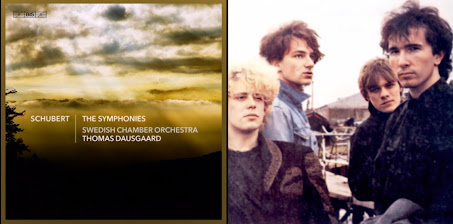
Schubert composed an enormous amount of music, and his talent was recognized during his lifetime, though he came to be appreciated as one of the "greats" only some years after his death. I always gravitate toward Symphonies, and the last two of Schubert's are especially grand. It's common to think that the two movements of the famous B Minor Symphony are a symbol of his tragic early demise (to typhus). The "Unfinished Symphony" is magnificent in what it gives us, and therefore understandably evocative of "what-might-have-been," but we can't let this distract us from its overall grandeur. This Symphony (generally numbered as the 8th) brings Schubert the orchestral composer decisively "out" from behind the long shadows of Beethoven and Mozart. Or, to put it another way, sometimes Schubert seems squeezed between Beethoven and Brahms, but his distinctive lyricism fills this work. It also fills the unusually long and very much "finished" 9th Symphony in C Major. These are the standouts, but I have enjoyed all of them. I find melodies from my childhood in the 3rd, the 5th, and the 6th Symphonies.

The recording pictured above is newly released (and thus it caught my attention). The Swedish Chamber Orchestra presents a consistent and competent rendering of the collection, demonstrating how the varied dynamics of orchestral works from this historical period can be performed and heard vividly and vigorously without requiring the massive orchestras that once dominated symphonic recording. Schubert, especially, deserves this more “intimate” presentation. 

So much has been made possible by the tremendous advancement of recording technology in my lifetime. Even in classical music, studio production has begun to “move beyond” the effort to simulate a “live” performance, and has begun (perhaps only subconsciously in this genre) to realize that it contributes, in subtle ways, its own “interpretive artistry” to the recording. A recording is more that a mere “neutral medium” of music; it stands as a particular work-of-art in its own right - a collaboration in creativity that involves many contributing artists in various and diverse ways. On vinyl LPs and digital CDs, it was (and is) still possible to find that long printed list of contributors. I don’t know of anything similar in the streaming format, which is a problem that needs fixing. People appreciate being acknowledged for their work, even if its only in “the small print.” In any case, “bravissimi” to everyone who contributed to this lovely Schubert recorded presentation.

I have paired with the Schubert recording, in the picture above, something very... different. During my time in high school, there was something in music called "New Wave." The implication was that it was the latest "wave" from the U.K., but these Irish boys and their band got lumped into the category. Do you recognize who they are?

In 2022, there are two, maybe three, generations that take U2 for granted. They've just always been around, it seems. In the past decade, people started to get a little fed up with them (like "Why is this U2 album on my iPhone?" etc. if you even remember that). This is understandable, of course. These guys are, after all, older than me. What we must not forget, however, is how remarkable it is that they have stayed together and stayed creative for so long. What a catalog of innovative recorded music over the course of 3+ decades! I don’t like all of it, but I like a surprising lot of it. My "U2 Faves" playlist on Spotify is huge. But I have been rediscovering the particular quality of their earliest albums, Boy, October, and War. There are hints of the signature sounds to come, of that virtuoso simplicity placed so perfectly by The Edge's guitar, of that expansive dramatic voice that made Bono the best male pop singer in a long time (and one of the best ever). Generally, I prefer the higher ranges of the vocal register in popular music; which means I prefer female vocalists. There are not that many men who can credibly sing "up there," although - thanks to the microphone - "falsetto" is a more accessible vocal technique for some singers. Bono stays mostly within his "natural" range; he doesn't overdo higher notes, but uses them only when nothing else will do. 

All in all, the Irish boys were still very young in these early albums. Edge starts a primitive form of rattling and humming in War. Bono's voice is developing into the convincing crooner he will become. In retrospect, early U2 sounds a lot like "New Wave" as I remember it in general. It's also quite good, with thoughtful if at times awkward lyrics. If you remember those days, you won't mind revisiting then. If you don't, you can educate yourself.😉

I didn't like the "New Wave" when it hit North American shores in the late70s/early 80s (I think I appreciate it a lot more today than I did at the time). In those days, I played mostly blues and rock on electric guitar, but the music I listened to was "Prog" - My friends and I particularly appreciated popular music that was way beyond our playing capacities (though I did eventually learn how to play Steve Howe's "Mood for a Day"... and have long forgotten how to play it). It was a special form of appreciation, I think, when you had some understanding of the inspiration, the energy, and the techniques of the music, but could also just be blown away by it, amazed by it. My headphones were full of the music of bands like ELP, Genesis, and Yes. Especially Yes. They had/have a kind of synthesis of rock and classical styles that sometimes goes over the top, but other times really works. By the way, this year marks the 50th anniversary of an album that was one of the definitive achievements of “Prog”: Yes’s epic masterpiece Close to the Edge. I will speak about that anniversary before the year ends. This album was a watershed not only for Prog as a genre, but for the whole future course of electronic recorded music. If you own a cheap electronic keyboard, let me tell you something: many of the colorful sounds that you can make on that keyboard with a simple presetting were laboriously invented by the creative blending of gigantic and unwieldy pieces of analog technology by these English lads fifty years ago. But even more importantly, I single out CttE because the music is beautiful.

Anything else? Well... shifting gears again, I want to shout out to Avril Lavigne, whose birthday was this week. She's 38 now. I already wrote about [click here] the twentieth anniversary of her terrific debut album Let Go. Still celebrating that! And I posted this on social media for her birthday, especially because I thought what she did here was fun. This could be called "the Twenty-Year Challenge."

Oh my, this musical journey has taken us from Schubert all the way to "Na-na-na-na, na-na-na-na, yeah!" The analogous variety and scope of beauty is as diverse as the differences in the universe of being itself: the differences are not in conflict with one another, but rather in harmony - just as a variety of flowers, shrubs, trees, and plants make up a forest or a garden. The “hierarchy of being” (and beauty) does not negate the unique qualities of different beings. There has never been anyone like Schubert. There is definitely no one like Avril.

I have also had a chance to catch up with what Avril is doing these days. She has moved away from the mellow look (and style) of her post-Lyme-Disease recovery album Head Above Water and has revived a different version of her mid 00s "punk-pop" look, complete with lots of leather, black boots, and orange streaks in her hair. She has been touring all over the place for her new album, which is entitled Love Sux. That doesn't sound very "encouraging," neither for love nor for the English language! (I'm laughing, actually.) Avril can go overboard in a number of directions, but her sense of humor, her feeling for the ironic, and her sincerity are very often in play. We must factor these into any effort to consider and appreciate what she’s trying to do.

At first glance, this album appears to be a set of mostly brief, loud, drum-and-guitar-driven, up-tempo songs in which Avril sings "eff you" to guys who have hurt her (and in one sense it is, quite literally, that). Drums and real guitars, I can go for that. They had begun to look like endangered species in pop music, where everything seems to be done by (often tedious) electronic tricks. The songs on this album are musically "catchy" (they stick easily in your mind, but pleasantly rather than annoyingly). They are not profound (nor are they intended to be). On closer inspection and listening, some of the songs are humorous, or are parodies on one's own or other people's dysfunctional behavior. Others express anger at what are, sadly, the stinky ways that so many men treat women in relationships. There are a couple of songs on another level, however, that have struck me. "Kiss Me Like the World is Ending" is a glowingly positive song where, once again, that implacable search breaks through for something that lasts forever, really forever. Again, something compelling in Avril’s vocalization takes it deeper than the words. The other song is "Avalanche," and it concerns me because I relate to the desperate feelings it expresses only too well: "Honestly, I can't shake it, shake it, shake it / Yeah, honestly, I can't take it / I say that I'm just fine, but I don't feel alright on the inside / I say that I'm okay, but I don't feel okay right now, no..." (that’s “nooo-ooo-hooo-woah”🎶).

I'm hoping this is a song based on past experience fighting the Lyme Disease dragon, and it may well be drawn from there. But it probably still comes back from time to time. So, Avril, just know that we hear you, sister. No shame, no surprises, we got your back, remember that. And you have my prayers.

Below is some digital portraiture of Avril, based on details from recent photographs and internet posts. She's one of the celebrities (I only work from images of ubiquitously public people, or - of course - myself) who is fun to present in this format of "digital sculpture" (which is what I'm inclined to call my attempts at these portraits) because she brings a lot of detail and color: all the hair and the highlights and the signature black eyeliner and the classic, prominent French-Canadian nose. I don't know if you notice this, but singers often have "prominent" noses. The nose is part of what makes the resonance of the voice, peeps.

In November, Avril goes to Japan for a week to perform five big concerts. They love her like crazy over there. She's like royalty in Japan. That week will be full like I can't imagine. It's going to be intense. Dear Avril, take care of yourself, please.🙏


Sunday, September 25, 2022

Goodbye Summer, Hello Fall!🌴🍁

The weather is beginning to change. Autumn is a mild, lovely, and long season around here. It has just begun, and the leaves are still green but you can feel Autumn’s arrival in the cooler air, and of course in the decrease of daylight hours.

Here are two digital art pictures I call “Goodbye Summer, Hello Fall.”


Saturday, September 24, 2022

Following Jesus Christ Changes the Way We See Reality

For Christians, baptism is the beginning of a new life; it is the event in our own history when Jesus Christ first “takes hold” of us in a decisive encounter with each of us as persons. Baptism unites us concretely with the death and resurrection of Christ, frees us from original sin and previous personal sins, and makes us children of the Father and heirs to the kingdom. 

Nevertheless, even after this great, foundational gift of new life in the Spirit, we Christians are still... kind of a mess. It’s all too easy to get “stuck” in this mess, and - even if we don’t abandon our faith and Christian identity - just muddle along, giving little attention to our baptismal vocation, keeping it buried beneath the multitude of distractions that pull us in every direction: our self-image, social status, work, money, ambitions, or whatever else we perceive to be our more immediate preoccupations and more urgent concerns.

Yet the God who gives himself to us in Jesus Christ wants us to “invite him in” to every aspect of our lives. He wants to change our lives.

We must remember Jesus, who is present in our lives now: remember him, stay with him, and open our hearts to the grace that comes to us through our relationship with him, our crucified and risen Lord who wants so much to be with each one of us. He has embraced our entire life on the cross, so that our whole humanity might be healed and transformed. The work of becoming conformed to his total self-giving death-and-resurrection continues throughout our lives, as we "take up our cross" (that life-giving cross) and follow him. Our life of discipleship will face many obstacles, and endure many burdens and hardships, but we must persevere in hope, with confidence that God is good, and that he carries us through it all in his love.

We certainly can't become obsessed with our own ideas and schemes of what is entailed in the "project" of making ourselves perfect. God knows all the particular and inexpressibly peculiar ways we need to be healed and changed. He is our Father, who loves us far more dearly and intimately than we love ourselves. He has given so much, given totally - he has given us his Eternal Son - and he loves us immensely. He wants us to “open up” our freedom and let ourselves be loved by him. 

Our path of growth is through cooperation with the grace of the Holy Spirit, through prayer, spiritual guidance, and the powerful grace of the sacraments - especially frequent encounters with Jesus who heals and strengthens us through Confession and gives us himself, substantially, in the Eucharist. We also have companions on this journey: brothers and sisters we are called to love and encourage, and from whom we also receive love and solidarity, and experience the mercy of the embrace of Christ through sharing the needs and challenges, the sorrows and joys of our lives. 

Together, we will find the Holy Spirit stirring us to a greater compassion, a courage, a greater awareness of our own need to see the face of Jesus and love him in the poor and marginalized, the suffering and burdened, the lost, forgotten, violated, discouraged, lonely people who are everywhere in this poor world. They hunger for love, for food, for shelter, for a sense of purpose, for respect as human persons, for understanding, for education, for so many human things, but in all these things they hunger for God. In Christ, we share that hunger. The Holy Spirit engenders and fosters the compassion that sends us forth (in countless different ways) as missionaries of mercy, “workers of mercy” who give and receive mercy in ways beyond anything we would have imagined in our own thoughts.

Living our Christian vocation slowly changes the way we see reality; it is a life given to us that empowers us to recognize the presence of our loving God in every circumstance. We change more profoundly when we begin to recognize, concretely, that the gift of God in Jesus Christ is the heart of all reality, the meaning and value of everything. In recognizing him, we begin to want him and to love him more than our foibles and insecurities and our anxious attachment to ourselves and our own limited perspective.

In Christ we discover the reality of belonging to God, participating in his infinite life even now as we journey toward our fulfillment as adopted sons and daughters of the Father and heirs to his Kingdom of unending love. We also become more aware of the preciousness of every moment of life, more filled with passion for living vividly and joyfully all that is good, with a greater desire to seek the truth of all things, more patience and peace even in enduring the deepest wounds of sorrow and pains of suffering - which we know serve God’s mysterious purposes by giving us a share in Jesus's sufferings, but which do not thereby cease to be deep and painful and difficult.

In being Christians, we do not cease to be human. On the contrary, in following Jesus Christ we become more truly and fully human.