Thursday, September 22, 2022

Maria is “On Her Feet”


I think we can officially declare these as “steps”!

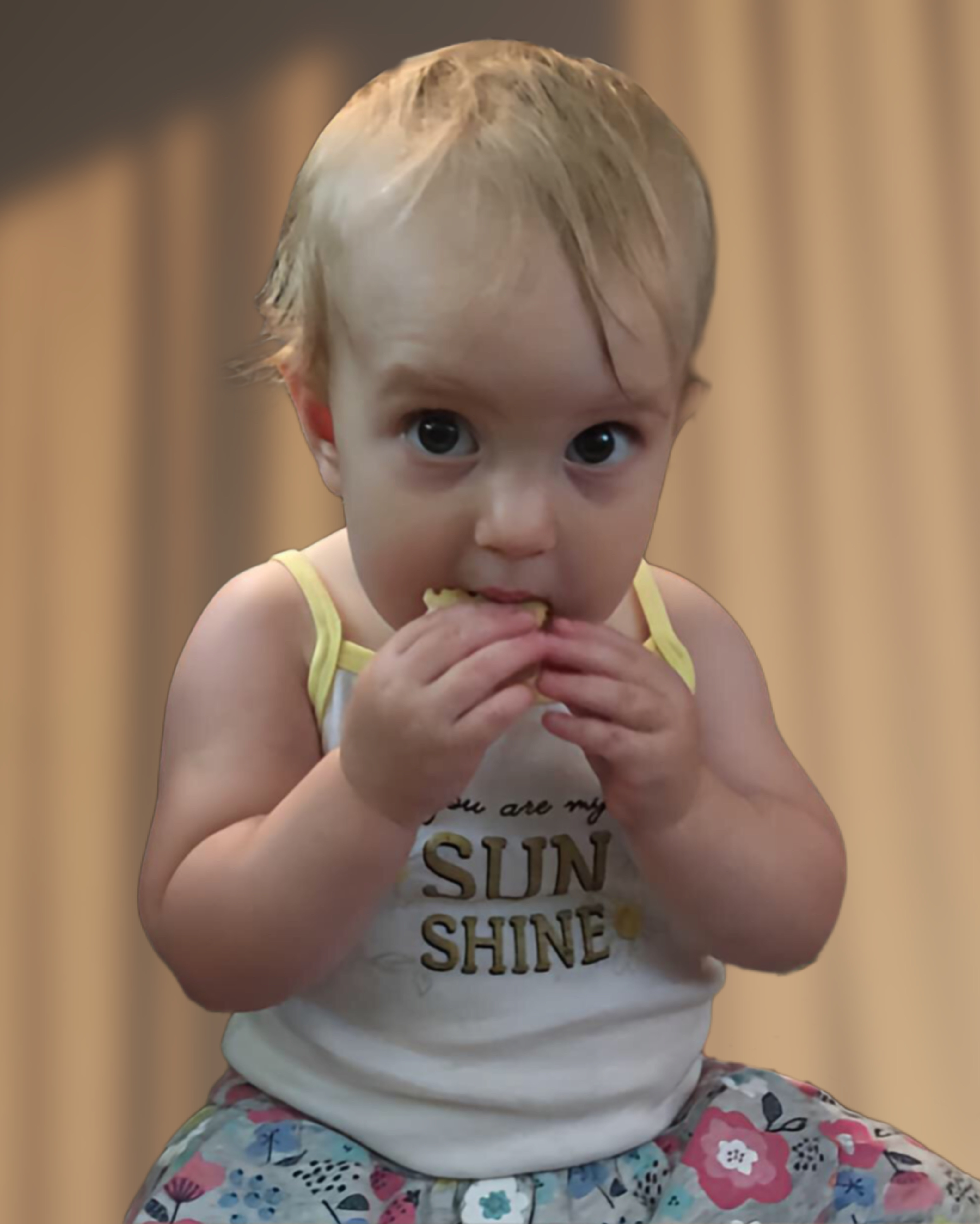
Maria is a champion crawler, which is still her preferred way of getting around (although that may change by the time you read this). The other day I was finally able to get a few video clips of her on her feet.

Hooray for Maria!☺️🌟 She’ll be running all over the place before we know it!

There should be a video link below.🙂 See for yourselves:

Wednesday, September 21, 2022

The Vocation of Saint Matthew

“As Jesus passed on from there, he saw a man named Matthew sitting at the customs post. He said to him, ‘Follow me.’ And he got up and followed him” (Matthew 9:9).

This account of Matthew’s conversion and apostolic vocation from Matthew’s own gospel is presented in similar words in Mark 2:14 and Luke 5:27 (except they give “Levi” as his name, but clearly it was the same man). Notwithstanding their brevity, these references to Matthew’s vocation are presented in a way that reveals the depths of his conversion.

The first thing that is clear is that Matthew was a public sinner in the judgment of his own people. He was an official within the complicated and corrupt bureaucracy that the Roman Empire had imposed upon Galilee by means of the “client state” of the tetrarch Herod Antipas. He was a representative of Roman imperial power, and he wielded this power in Capernaum on behalf of a puppet king installed by
this foreign government. He also used it to his own advantage.

Why would anyone in Israel want to be a tax collector? The compensation for being ritually cut off and generally hated by the people was the accumulation of significant wealth. Matthew was officially responsible for providing the government with a fixed sum of money periodically from his region. In order to acquire this sum, however, he was free to set his own tax fees, collecting as much as he could get from the people. The tax collector’s position was virtually defined as the opportunity to practice unlimited graft and extortion. Above and beyond the required government sum and a fair wage for his own efforts, the tax collector used the force at his disposal to rob the population and enrich himself.

Matthew was, in fact, a thief and a criminal.

Then Jesus saw him. Jesus looked at the Mafia boss of Capernaum, who was in his “business office” (so to speak) doing his sordid work of squeezing people for money and keeping records of these “transactions.” A tax collector in Galilee (unlike the fishermen who followed Jesus) would have been literate in both Aramaic and Greek.

Jesus saw Matthew, the person, and loved that person. No doubt he also perceived that after Matthew ceased keeping records of his own extortion racket, he could begin an altogether different sort of record keeping. He could record the words and deeds of the Teacher in writing, and see that they were passed on.

Jesus saw Matthew and spoke to him: “Follow me.” Matthew had probably heard of Jesus from the people, and may have even watched his ministry. Before this moment, however, he had not conceived any hope that his life could be different.

The encounter with Jesus in this moment changed everything.

Matthew’s response was simple but had rich implications. Our text says he “got up” and followed. The Greek term used here, however, is the same word used to express Jesus’s “rising” from the dead. The power of Jesus’s gaze and his words had a miraculous effect, achieving something even more amazing than when he later “raised” Lazarus from the tomb. Jesus “raised” Matthew from the deeper deadness of sin, and invited him to become his companion. So also Jesus looks upon each one of us, and calls us to
do the same.

*************************************************

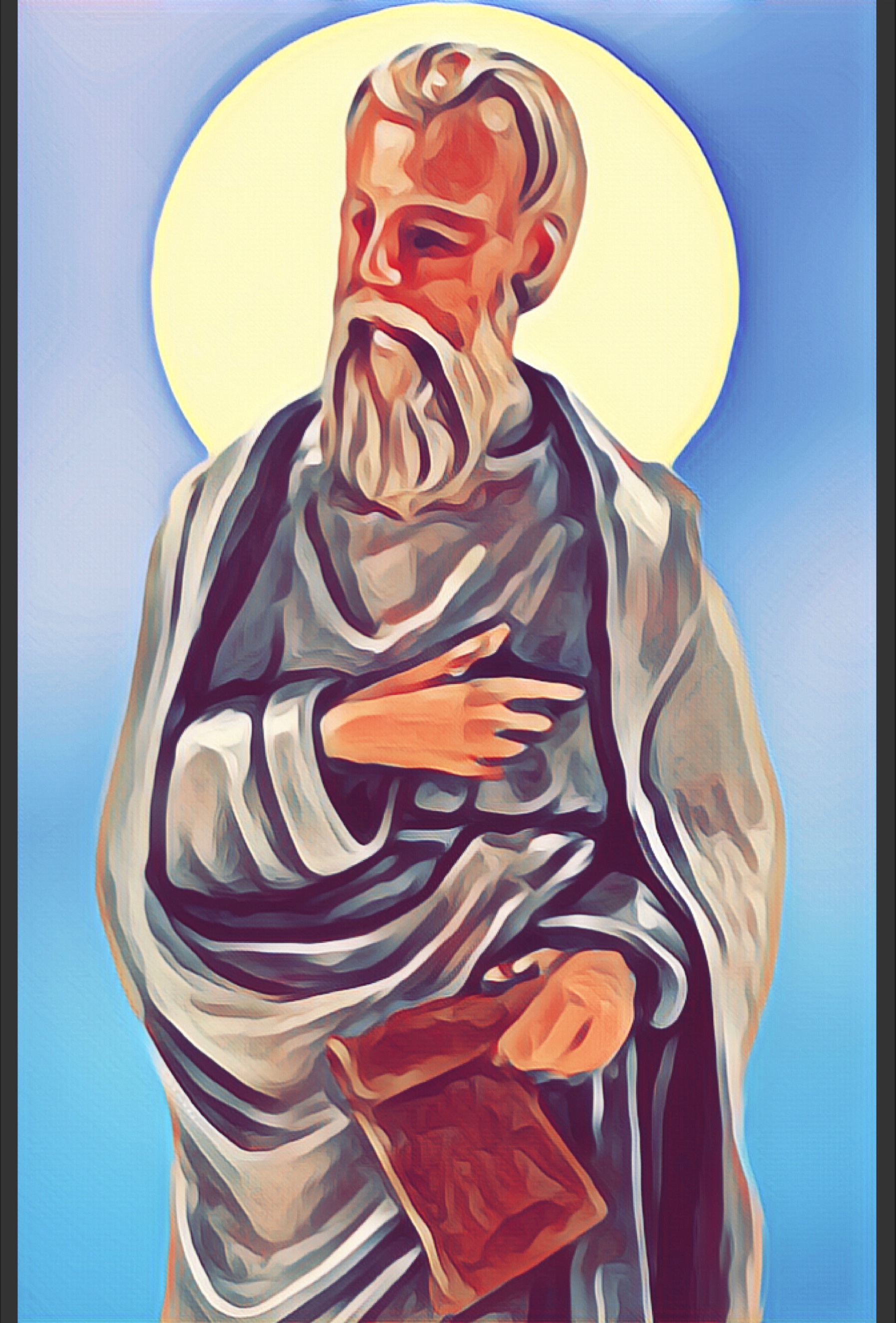
The picture above is my own digitally artistic rendering of Matthew the Apostle, rendered from a base of a black-and-white photograph of a statue. It was a good project for me on this day.

But the limits of my own poor artistry, in whatever media, are also clear, because we can’t have “Saint Matthew’s Day” without gazing at the work of The. Incomparable. CARAVAGGIO! This painting below (c. 1600) of “The Call of Saint Matthew” changed the course of the history of Western religious art.

No one ever painted like this before. Or after, for that matter (although many have tried). Light and shadow (and their contrasts) display their powerful illustrative potential in this work. Artists continue to “learn lessons” from Caravaggio.

And I remember a time when the original was just a brisk walk away from where I lived.

In the Church of San Luigi dei Francesi in Rome, I fed many many 200 Lira coins into the machine that turned the lights on for two minutes in that dark corner chapel where this painting makes its home. Remember the 200 Lira coin? I lived in Italy in the ‘90s, long before the “Euro” replaced all those peculiar, fun, and sometimes inconvenient and complicated old currencies of European countries. 

Old folks like us remember…😉


Tuesday, September 20, 2022

Korea Yesterday and Today: Martyrs, Heroes, and Challenges

On this feast day of the 103 Korean Martyrs canonized by Pope John Paul II in 1984, I want to draw attention to the beautiful ancient land of Korea (and also refer to my column in Magnificat for the month of October 2022). Today is an important day for the Korean Catholic Church, which has a significant and growing presence in Korean society today (in South Korea, Catholics make up 11% of the population).

The Korean peninsula is homeland to a great distinguished people with a united history and culture for more than a millennium. It was Koreans themselves who first acquired the Chinese writings of Jesuit missionary Matteo Ricci, studied them on their own, and then approached priests in Beijing in 1784 and asked to be baptized. These lay people – led by Blessed Paul Yun Ji-chung – began sharing the Gospel with others in Korea, so that by the time the first Catholic priest arrived from Beijing a few years later, there were already 4,000 converts! The new church endured a series of persecutions beginning in 1803, in which thousands of Catholics gave their lives for their faith.

Two groups of Korean martyrs have been documented by name and raised to the honors of the altar. Today we celebrate the group of 103 martyrs from the anti-Catholic persecutions of the middle of the 19th century, including the first native Korean Catholic priest, Saint Andrew Kim Taegon, and a leading lay person, Saint Paul Chong Ha-sang (who was himself the son of one of the original lay Catholics who were martyred in the previous generation). There is also a second group that represents Korea's earliest Christian community: they are 124 martyrs (including Blessed Paul Yun Ji-chung, mentioned above, and Blessed Augustine Jeong Yak-jong, the father of Saint Paul Chong), who were beatified by Pope Francis in 2014.

Korea continues to endure the consequences of their national tragedy in the 20th century, which began with the Japanese conquest and colonization in 1910. On August 8, 1945, the Soviet Union entered the Pacific Theater of World War II with a massive invasion of Manchuria. One and a half million Soviet troops swept down from Siberia into Japanese held territories before the second atomic bomb was dropped on Nagasaki. They entered the northern regions of the Korean peninsula and occupied the area after Japan's surrender, and after agreeing with the United States to "divide" the administration of newly liberated Korea at the 38th parallel (latitude, north of the equator).

There is more about modern Korean history in the article below. While present-day "North Korea" has no Catholic population, the Church has grown remarkably in "South Korea," gaining many contemporary converts who have played important roles in the complex public life in the South. I have written about the conversion of South Korea's first Catholic President, whose full name was Thomas More Kim Dae-jung. The whole story of "D. J. Kim" is a long one, and not lacking in heroism and inspiration in itself.

As always, I only tell the beginning of the story here. During and after my work on this article, I read the entire 1000+ page memoir of D.J. Kim (who died in 2008), which was recently translated with the title Conscience in Action. It is very long, and requires some understanding of the complex history of post-war South Korea. It's not the first book I would recommend to someone who is not already familiar with Korea, its history, and its recent crises. For me, however, reading five years into my still-immersive East Asian Studies Project, D.J. Kim's memoir was a fascinating resource, shedding much light on the significance of Korea today, and allowing me to hear in his own words the dramatic story of the man who has been called "the Asian Nelson Mandela," who was a devout Catholic democratic political activist, prisoner under a repressive South Korean dictatorship, freely elected President at the age of 75, and winner of the Nobel Peace Prize in 2000 for his efforts to draw North Korea into a constructive relationship through prudent and practical interactions. He cannot be blamed for the fact that his efforts did not bear immediate enduring fruit.

Korea is historically, ethnically, and linguistically one country, one people. The "demilitarized zone" (DMZ) at more-or-less the 38th parallel remains like a kind of 21st century "Berlin Wall." North of it are Koreans who suffer in poverty under the domination of a reckless totalitarian State, born from Soviet Communism and now a criminal, bizarre, militarized regime with increasingly dangerous nuclear weapons and enigmatic intentions. In the South, Koreans live with democratic institutions and political freedoms, great wealth, information technology and their own multimedia "brand" of pop culture that is influencing the whole world, but also with many facets of a sterile secularism learned from the West.

Korea is a dramatic and important place, sure to be prominent in the future of the 21st century. But more on that another time. Here below is the article on Kim Dae-jung appearing in October 2022 Magnificat.

Monday, September 19, 2022

Happy Janaro Day 2022!😉

Once again it’s "Janaro Day"! Buona Festa di “santo patrono” della nostra famiglia!
.
Today is the Feast Day of the Original Janaro, Saint Januarius, the fourth century bishop and martyr. I don’t really know anything in the way of cold hard facts that would prove this assertion, but I decided years ago to initiate the “legend” that he is, somehow, related to us. I base this on the regional traditions of Benevento and Naples (from which many of my ancestors came). He could be an ancient “cugino” (cousin). Why not just run with it?

Today, of course, he is known as San Gennaro, but our family name ("Janaro" with the "J") may be a variant in old Neapolitan dialect of the name "Januarius." There is probably at least some common connection between the names. My great uncle Gerry (the oldest Janaro I knew personally, God rest his soul) insisted that our name was not a spelling mistake made by some overworked Anglo-American clerk at Ellis Island. In fact, the four Janaro brothers came to the U.S.A. in the 1880s, before the great Italo-American migrations at the end of the century. 

Back then, Ellis Island was still a naval fort, and the unified federal immigration system didn’t yet exist. Moreover, the Janaros were professional artisans (tailors and “interior decorators”) who had some sort of "pre-approved" immigration status. In any case, they immigrated in (relative) style, sailing across the Atlantic in second class cabins, with all the authorizations and paperwork completed before the ship docked in Manhattan. (Some of my immigrant ancestors had rough experiences coming over, but not the Janaros).

In any case, “Janaro” is an antiquated spelling drawn from the cross-cultural, pre-standardized, peculiar regional dialect of Naples. More importantly, the etymology of both “Janaro” and “Januarius” traces back to the mythical Roman god "Janus," the "guardian of the gateways" and all places where people come in and go out (note that "January" is the first month, the end of one year and the beginning of another).

Perhaps the ancient Janaro ancestors were “gate-keepers,” though my life as a Janaro has not been characterized by mastery over any “gates.” I have spent a lot of time trying to convince various modern gate-keepers to admit me into the realms they guard. Occasionally I have been successful. Perhaps Saint Januarius has assisted me and our family to obtain admittance to places we really needed to enter. For this, I am grateful, especially today.

All things considered, and based on these indicators, hypotheses, and some good-old-fashioned stretching, I feel I can claim him as the patron saint of the Janaro Clan. Saint Januarius (San Gennaro), pray for us all.

[The image above is a detail from a larger work, Il martirio di San Gennaro (15th c.) by Neri di Bicci.]

I celebrated today’s feast by spending some quality time with the youngest person among us (thus far) to inherit the Janaro name, our rapidly growing granddaughter Maria.

Sunday, September 18, 2022

The Responsibility to be Fulfilled

Words for our time, and all times. (And the JJ “avatar” says “👍” but don’t let that distract you.) 


Saturday, September 17, 2022

"The Great River of Mercy"

"Let us allow God to surprise us. He never tires of throwing open the doors of his heart and repeats that he loves us and wants to share his love with us. The Church feels the urgent need to proclaim God’s mercy. Her life is authentic and credible only when she becomes a convincing herald of mercy. She knows that her primary task, especially at a moment full of great hopes and signs of contradiction, is to introduce everyone to the great mystery of God’s mercy by contemplating the face of Christ. The Church is called above all to be a credible witness to mercy, professing it and living it as the core of the revelation of Jesus Christ. From the heart of the Trinity, from the depths of the mystery of God, the great river of mercy wells up and overflows unceasingly. It is a spring that will never run dry, no matter how many people approach it. Every time someone is in need, he or she can approach it, because the mercy of God never ends. The profundity of the mystery surrounding it is as inexhaustible as the richness that springs up from it" (Pope Francis, Misericordiae Vultus 25).

Wednesday, September 14, 2022

“God Greatly Exalted Him”


September 15: The Exaltation of the Holy Cross


“Christ Jesus, though he was in the form of God,
did not regard equality with God something to be grasped.
Rather, he emptied himself,
taking the form of a slave,
coming in human likeness;
and found human in appearance,
he humbled himself,
becoming obedient to death,
even death on a cross.
Because of this, God greatly exalted him
and bestowed on him the name
that is above every name,
that at the name of Jesus
every knee should bend,
of those in heaven and on earth and under the earth,
and every tongue confess that
Jesus Christ is Lord,
to the glory of God the Father.”
.
~Philippians 2:6-11
________________________________________________
 
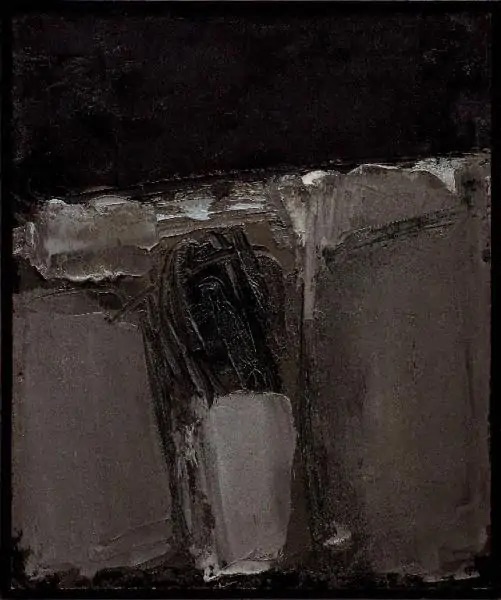
Jesus is exalted "in a total gift of himself on the Cross, and on the Cross itself—the supreme act of love—he is glorified because love is the true glory, the divine glory" (Benedict XVI). [Painting from “Crucifix” series by William Congdon.]

Sunday, September 11, 2022

Friday, September 9, 2022

Queen Elizabeth II, Rest in Peace

Queen Elizabeth II has died at the age of 96, three months after the celebration of her “Platinum Jubilee” marking an extraordinary 70 years as constitutional monarch of the United Kingdom, as well as Canada, Australia, New Zealand, and ten smaller independent nations formerly of the British empire that still retain the British monarch as Head of State.

This has struck me in a personal way. Everyone from my generation knows "the Queen" (no further specification was necessary). English speaking peoples in particular - regardless of whether or not they were her "subjects" - were aware of her as a kind of cultural institution. I remember her from my childhood. There are very few established public figures from my childhood that are still alive today. But the Queen and her royal family have lived very much "on the stage" of the latter half of the 20th century and the 21st century thus far. She was a consistent presence in everything from global politics to gossip. She was "around" and "in the background," like a mountain. As the years went by, she didn't seem to change very much. So many things were changing, wildly changing, in my younger days, but the Queen remained statuesque, a living "monarch" who was pictured on Canadian money and associated with so many English traditions that were familiar to all of us. We knew that she didn't have any "real power" and yet somehow she "mattered" in the U.K., and that sense echoed throughout the English-speaking world.

The "British Invasion" of popular culture in North America was (and remains) a formative influence for anyone who listened to music or watched television in my lifetime. I have never considered myself an "Anglophile" - I have no ethnic connection with the British, and their stiff-upper-lip ways are decidedly different from my own. But the English language does create a certain kind of common bond. The waves of British cultural influence have affected that bond during my life. It wasn't only the Beatles and all the subsequent music; it was also Shakespeare on television, and the quality of British actors in various dramas and comedies that were an inseparable part of the Anglo-American experience (from Brideshead Revisited to Fawlty Towers). And Her Majesty the Queen was always on the horizon.

In 1981, I watched the wedding of Prince Charles to "Lady Diana Spencer" on television, because back then there weren’t so many live broadcasts of internationally significant events, much less something as colorful and unusual as a royal wedding. I knew some things about Prince Charles too. I knew that "someday" he would be King, though I expected it to happen much sooner than 41 years into the future. (I also knew that Charles played the cello, which interested me because I also played the cello. Little details about the royals - not anything shocking, in those days - were always popping up in magazines and such.) Charles was "preparing" to be King in the 1970s, then in the 1980s, and then everything fell apart with Princess Diana and it began to appear that it would be better for Charles live out his life quietly in some corner and never become King. Into the 21st century, Prince William entered the scene with Kate Middleton, and Williams’s father seemed more or less on the shelf, a retired heir, while the Queen looked like she would just go on forever. Now, suddenly, in 2022, she is gone from this world, and he is King Charles III.

May God grant eternal rest to Queen Elizabeth II. Now, for the first time in my lifetime, the British are once again singing, “God Save the King.” In the whirlwind of fresh turmoil that seems inevitable to me in the near future, the King is not the only one who will have to grapple with new and difficult challenges. The English, for the moment, are holding back their worries over the future of their monarchy, but in the long run it’s hard to envision how that future might unfold.

I can’t say it’s the highest on the list of my worries. After all, my country declared independence from the British monarchy 246 years ago. Part of what shapes the imagination of people in the United States of America is that we don’t have any kings or queens here. Right? As a native citizen of the U.S.A., I’m expected to view any form of monarchy as antiquated at best and tyrannical at worst. But I have studied too much history to dismiss the potential for monarchy - in certain nations - to be a constructive, organic element among interrelated political institutions that serve the common good of persons in society. For example, many democratic countries today have some kind of more-or-less symbolic "Head of State," who is not involved in the political or legislative process, but who serves as a "ceremonial" leader: someone who presides over national celebrations, bestows honors, receives diplomats, and represents "national unity" from a perspective "above" the often-contentious political fray. 

This public figure is often an "elder statesman" of some wisdom and good judgment who does not have effective political power to initiate government action, or to make, veto, or enforce laws, but who does have some measure of "soft power" as master of ceremonies, ambassador-at-large, mediator, advisor, and point of reference for continuity in the midst of changes in the actual government. He or she may exercise a formal constitutional role in appointing ministers and approving legislation, but the constitution itself prevents him or her from changing decisions of the democratically elected legislature. 

This office is effectively the equivalent of a "constitutional monarch," and in a Republic is often styled as "President" (e.g., the "President of Italy" is one example that comes to my mind). Government institutions vary in particulars from one nation to another, but this type of ceremonial/symbolic presidency is particularly suited to nations that are structured according to the "Westminster Model" of parliamentary democracy (which is, of course, the British model in its broad elements), in which the leader of the majority political party - or governing coalition - in Parliament is the de facto head of government, with the title of "Prime Minister." In such a system, the quasi-monarchical "President" is elected directly or indirectly for a long - though usually not unlimited - term of office. Such Presidents serve as the custodians of the dignity of public life in their countries, and in relation to other countries.

It is not difficult for new nations to design an office of this kind, and provide for a ceremonial Head of State who serves a definite term in this “presidential office” practicing the valuable art of “political diplomacy” as his or her contribution to building up the common good. But the particular type of hereditary monarchy that acquired its distinctive style in medieval Europe is by its very nature an institution with centuries of heritage, and if it exists in any form today in some European countries it is because it has retained consistent popular approbation.

Generally, kings and queens in a constitutional monarchy fulfill many of the roles of "Presidents" described above. The hereditary feature, however, allows a royal family to also serve as a vital link to the past, the achievements of previous epochs, and the historic and natural beauty of the land itself where the citizens dwell.

It’s hard to imagine how a new nation could set up a useful hereditary monarchy “from scratch” in the world today. The rituals, customs, and popular deference that give such monarchies the supportive context for carrying out their national roles are not things that can be manufactured. They must emerge from many generations of history, and they endure by balancing consistency with flexibility that allows them to adapt in the face of historic changes. But if a country already has an ancient monarchy that has adapted itself to remain vital within the participatory and representative democracies of our time, I think they would lose an important component of their national life and cultural patrimony by simply getting rid of it.

The British monarchy has had its ups and downs over the course of more than a millennium, to say the least. Its greatest tragedy remains its role five centuries ago in the violent separation of Anglican Christianity from the Catholic Church shepherded by Christ through the Successor of Saint Peter. Ironically, while distancing itself from Christ's sacramental presence in the Catholic Church, the British monarchy preserved (but also to some extent “petrified”) many of the outward forms of monarchical ritual, solemnity, and pageantry from the Middle Ages. It is hard to see much real value in these unique features of the British monarchy except insofar as they remain echoes of the Catholic people who once recognized their significance. Today, of course, the U.K. is a society of many ethnicities and diverse religions. It is also a troubled and divided society. At the same time, the Catholic Church has been undergoing a small but persistent renewal ever since the conversion of the great Saint John Henry Newman in the mid-19th century. We must continue to hope that the monarchy will set itself aright once again, at least regarding its claim to “rule over” (even symbolically) the Anglican communion as England’s official, “national form” of Christianity. A secularized Britian with a monarchy entering into a period of lower profile may create conditions in which this long and necessary process of healing and reconciliation can flourish and grow in new ways. May Jesus and His Holy Mother grant that it be so.

Queen Elizabeth II was probably “existentially ignorant” of the real meaning of the destructive rupture that took place when her predecessors imposed (sometimes brutally) upon their realms and peoples a separation from the fullness of Catholic unity in the 16th century. She was also hindered by other limitations of perspective, and yet she accomplished much that was admirable in her long reign. The fact that the British monarchy has survived to 2022 (and has a chance at continuing to be valuable in the future) owes much to the long years of dignity, persistence, and dedication that Queen Elizabeth brought to her seven decades of service in the midst of so many changes and so much immense material growth as well as dizzying upheaval.

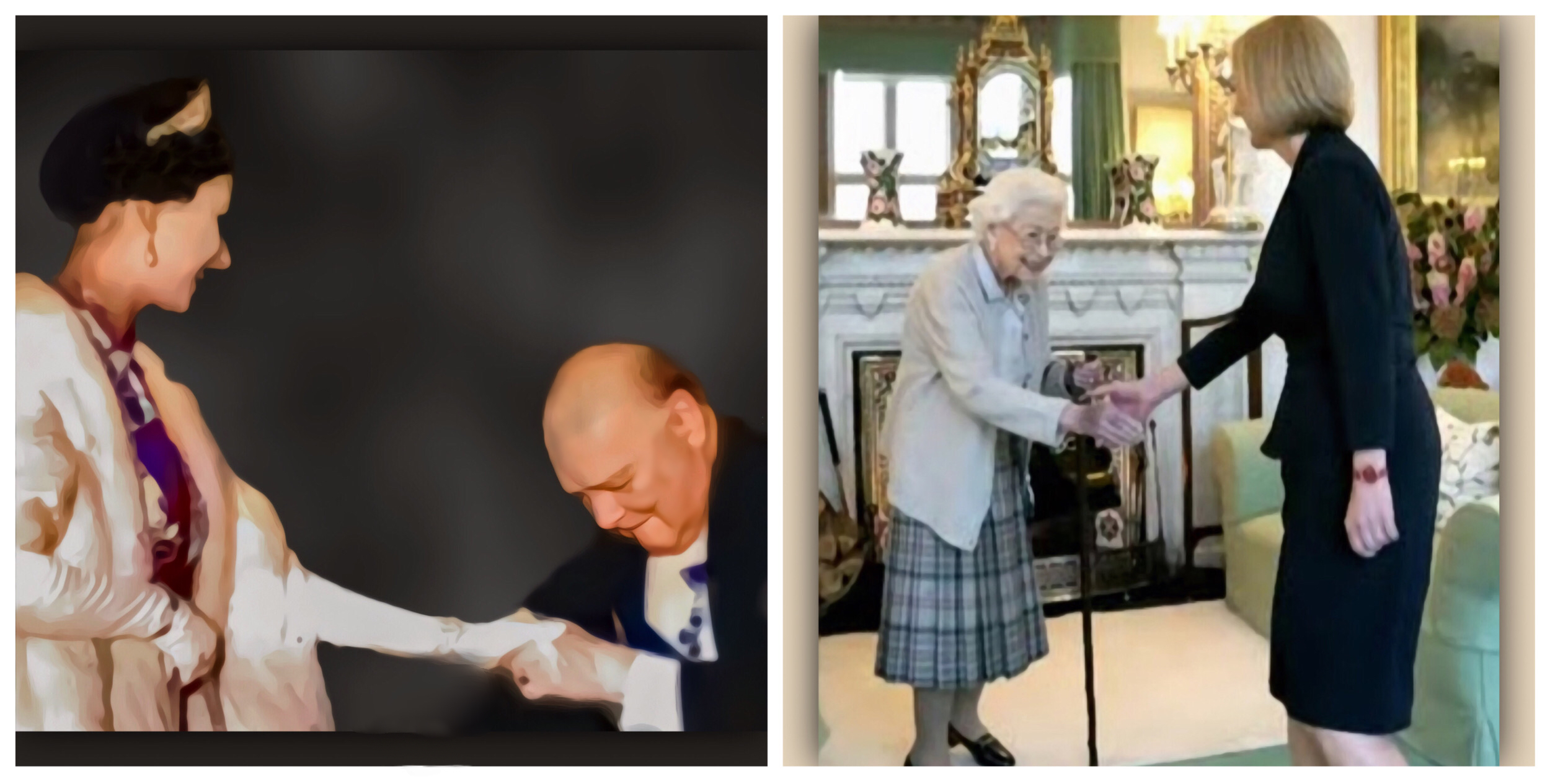
The two pictures below give us a sense of how remarkable and how historically extensive the quiet work of the Queen was during her 70-year reign. As Queen, Elizabeth II was served by no less than 15 Prime Ministers. In the picture on the right, we have the last public photograph of the Queen, who formally received the newest British Prime Minister Liz Truss on September 6 at Balmoral Castle (two days before her death). In the picture on the left, young Queen Elizabeth greets her first Prime Minister in 1952. His name was Winston Churchill.


Wednesday, September 7, 2022

September Rains and Rolling Valleys

So far in September 2022 we’ve had some stormy skies, some much-needed rain, and some lovely weather in the rolling fields of the country. Summer is still very much with us.


Monday, September 5, 2022

Mother Teresa Watches Over Us

This year marks the twenty-fifth anniversary of Mother Teresa’s death (which came a week after the fatal accident of her friend Princess Diana). 

Today’s generation knows people like her and John Paul II as “historical figures” (which they are), but I hope they also turn to them with confidence in the present moment as loving and attentive spiritual friends and intercessors who remain with us in the communion of saints, in the super-vitality of Christ’s Mystical Body.

Things she spoke about 30-40 years ago are still meaningful for us today:

"There is a terrible hunger for love. We all experience that in our lives - the pain, the loneliness. We must have the courage to recognize it. The poor you may have right in your own family. Find them. Love them."

"Smile at each other. Smile at your wife, smile at your husband, smile at your children, smile at each other - it doesn't matter who it is - and that will help to grow up in greater love for each other."

Sunday, September 4, 2022

The Mystery We Seek Has Come and Dwells With Us

Life is a search for the Mystery that gives meaning to everything.

And there is Someone who has come, who has revealed the ‘answer’ to the ‘need’ that constitutes the human heart, the core of the identity of every person - Someone who makes us exist, who loves us, and who calls out to and awakens our longing for fulfillment. The things of this present world are a wonder to us in the many ways they suggest, point toward, and hint at the promise of an Ultimate, inexhaustible Goodness beyond themselves, a Goodness wherein all things find their purpose and where we find the meaning of our lives. Our hearts are made to search for the paths toward this mysterious fullness.

And this is the good news: Someone has come who is this fullness in His person, who is the Mystery we long for, who is the way to the fulfillment for which we are created. It is Jesus Christ, who is present, who dwells with us, who accompanies each one of us and proposes Himself - relationship with Himself, belonging to Him and following Him who has been sent from the Father in the Holy Spirit - He is the “permanent,” the Infinite One, the source and fulfillment of all the desires that are awakened in our hearts by life, of all the longings for the Mystery for which we have been made. He is Love, Infinite Love, given to us, made flesh, who offers Himself, who wants to be loved by us. 

"Christ is so correspondent to what I am that when I encounter Him I can finally understand Whose presence I long for: that of One who tells me, 'I am the Mystery that is missing in every thing you enjoy, in every promise you live. Whatever you desire, try to attain, I am the Destiny of all that you do. You seek Me in all these things!'" (Luigi Giussani).

Friday, September 2, 2022

Twenty Years Ago: Avril Lavigne, the Millennial Teenage “Rebel”

At the beginning of Summer 2002, a diminutive 17-year-old Canadian singer named Avril Lavigne released her first album, Let Go.

[Yes, my dear “Millennial” friends, it was twenty years ago. You are just beginning to discover that life really is “short,” and that youth is just a blink-of-an-eye in a normal human lifespan.]

Readers of this blog know that Avril Lavigne holds a special place in my heart because of her openness about her harrowing experience with Lyme Disease. I don’t endorse her lifestyle (which, as rock stars go, is “relatively tame”) or her views (whatever they are) or her preoccupation with using the “eff-word” in so many songs and in practically every “effing” interview she gives (nearly always as an emphatic term rather than as an obscenity, but still…). I have come to appreciate her unique qualities as a singer and songwriter, an artist who gives compelling vocal shape to a wide range of raw human emotions. She has been amazingly resilient in grappling with the problems of adolescent fame and ongoing success, as well as the fickle attention of the spotlight, the notorious unfairness of music critics, and a lot of personal problems and suffering.

Avril is one of those people who are artists because they can’t help being artists, who communicate through their craft the good, the bad, and the ugly inside themselves and all around them. Their talents are relentless natural forces that push them in contrary directions, provoke attention (and crave it), and invariably tend to express the “mood of the moment.” They can inspire others or drag them down, and technological media has the power to amplify them into generational (or multi-generational) “icons” in ways we still don’t much understand, ways that are fascinating and disturbing and dangerous.

I’ve gotta love Avril Lavigne. Her life is (and was) hard enough even without Lyme Disease. She’s one of the artists I especially pray for (n.b. I have long had a practice of “spiritually adopting” artists, especially musicians who have troubles that I can relate to - it’s not something I take lightly, either). Avril has a lot of struggles. She’s also kinda crazy, and plunges recklessly through certain things in life without caring who’s watching. At the same time, she has some kind of “compass” (artistic? moral? religious? a combination of all of them?) that guides her and keeps her from moving completely “off the map” as she continues to search for her identity and purpose. Most importantly, she’s a human being. She's a mess but doesn't pretend to be coherent. 

Avril is also on the threshold of dramatic and perplexing human changes that everyone must undergo if they live to the age of 40. The tricks used to evade, postpone, or ignore middle age don’t really work - not even for rich people or rock stars. This is not ultimately a problem, because the passage of time is one of the great mercies granted to human beings that provoke us to face reality, which can allow us to rediscover reality as a gift and grow along the directions it indicates. Avril can still dream of her future, but she’ll never be young again. I hope she doesn't get tangled up in trying to preserve something that is not meant to last. There are plenty of people who are willing to take advantage of that kind of desperation, making money by fostering illusions that only engender more desperation and greater difficulties moving forward in life. Celebrities are especially prone to being made fools of in this way. The rest of us are prone to follow them.

In the year 2022, Avril Lavigne is an established member of the celebritocracy. Just last week, she got her “star” on the Hollywood Walk of Fame. Even though she is not yet 38 years old, she is generally referred to in the past tense, though she has many facets to her artistry, and I hope she will be able to develop some of them, especially those that stretch her beyond her vast natural talent and her still-irrepressible charisma. Lyme Disease took several years out of her career, but it also inspired her creativity in new ways. Lately, however, she hasn't said much about her illness. I can't blame her for that; when Lyme is in remission, you don't want to think about it. You feel fabulous. You want to put the nightmare behind you. Still, you know it could come back. I understand what this whole experience is like.

But we are looking back twenty years, to a time when Avril's life was less "complicated," back before Lyme Disease and the crazy decade of global superstardom that preceded it, back to the first album, where Avril didn't use any cuss words (even if it was only to please her mom) and acted like the kid she sang songs about: the small-town girl from Napanee, Ontario who played hockey, mowed lawns, fussed with her hair, hung out at the local pizza joint, felt out of place in high school and awkward with boys, sang all the time, and struggled to find words for the large intuitions that resonated within her. 

The result was an album that catapulted her to massive pop star heights in 2002-2003. Nobody saw her coming at the beginning of 2002. Here was this teenager wearing baggy pants, some “punk” accessories (because they looked “rock-n-roll”), and then whatever tee-shirt she happened to pull out of her bag, and—of course—a loose-hanging necktie that looked like she stole it from her dad… which she probably wore just because it clashed with everything else. But she was a terrific singer, who also had heaps of natural charisma. And she was in “right place at the right time.” Teenagers went crazy for her all over the world.

Suddenly, Avril was a celebrity. But in those days, she didn’t seem fazed by it. She remained remarkably free of the protocols of celebrity-dom, sticking her sneakers on Jay Leno's chair, sitting cross-legged on Oprah's stool, and not caring that she looked 17-years-old during an interview, which included looking bored or perplexed sometimes. She was unselfconsciously surprised by the insane level of fame that rained down on her in a single year. She never dreamed that her album would sell upwards of seventeen million copies (and counting). Let Go remains the biggest selling album by a Canadian artist in the 21st century, and there are a lot of Canadians in the business these days (Justin Bieber, Drake, etcetera). 

Of course, what it means to "sell an album" has completely changed since 2002. Back then, we're talking millions of CDs that sold all over the world. Clearly, a chord was struck that resonated with lots of people (and not just kids, by the way). I think the explanation for this phenomenon is the simplest one: Let Go is a pop music masterpiece, and the main reason is that Avril sings every song like a boss! She makes even the corny tracks sound convincing and earnest, because she meant them to express her honest self: she aspired to be cool, but she was not afraid to lay on the table her growing up as a Canuck redneck, a dreamer, an old-fashioned romantic girl, a gritty troublemaker, a kid who really liked skateboarding, who was driven to make music, and who was searching for something really awesome in life and was determined to find that awesomeness even though she didn’t know what it was or whether she should grasp it like a conquest or let it lead her to “somewhere new.”

Just listen to this album. Yes, there are the signature hits that everyone still associates with Avril: “Complicated” and “Sk8er Boi” (“ouch!” says the English language to this funky spelling, not realizing that English is gonna take a huge beating over the next 20 years at the hands of texting and Twitter). But every song on the album is a keeper, and Avril displays mastery over a whole range of song styles: there’s plenty of straight-up rock (starting with “Losing Grip,” the roaring guitars and soaring vocals of the first track), but also beautiful ballads, slow, reflective pop songs, and even one song that has a kind of rap (by 2002, everyone was rapping, or trying to). Avril makes it work in “Nobody’s Fool,” playing the rhythmic diction off against her now famous melodious “la-la-la-la-la-la” (if you know her music, you know what I’m talking about). The whole album is just a blast. It brought the fun of rock-and-roll back into pop music.

The songs are meaningful too. I’m not a big “lyrics” person. I’m a guitarist, and when I was young I composed some “songs” for acoustic guitar, but they were all instrumentals. I performed them many times in public. They are not written down (I read music and had nine years of classical training for cello, but I have always played guitar by ear only). Alas, I can’t remember how to play any of those songs. Long ago, I recorded all my songs on a cassette tape. It was about a half hour of music. Unfortunately, I don’t know where the tape is. Anyway… growing up in the 1970s, we generally trained ourselves to try to “ignore the lyrics” which were either “not edifying” or else - in the case of a band like Yes - just basically meaningless. Since those days, unfortunately, many lyrics have become even less edifying and also more difficult to ignore. But on Avril Lavigne’s first album, she had a lot of interesting things to say. Critics called it “teenage drama,” basically dismissing her words. But they were missing a critical factor: adolescent “drama” is human drama - it is the dawning of self-awareness and of the need to engage the complexities of life, to ask big questions, to experience wonder. Avril, through her creative intuition, expressed the connection between being a teenage girl in 2002 and being human at any time, in any place, at any age. For example, “Anything But Ordinary” is a remarkable song. What is it about?
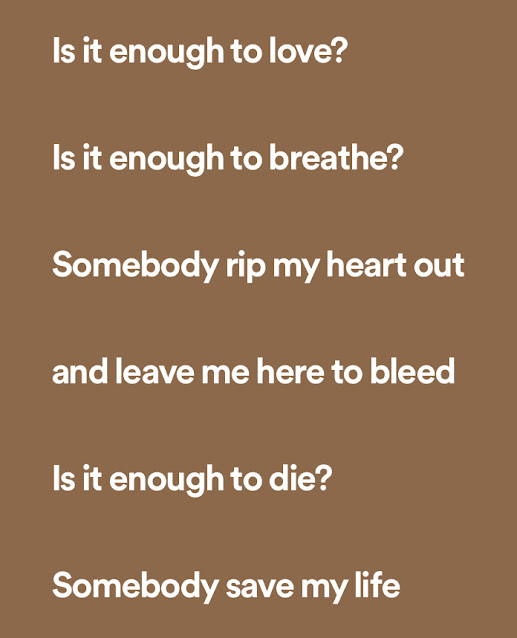
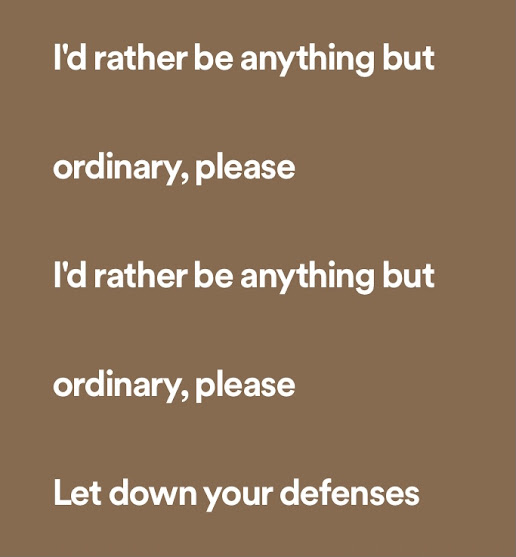

Um, wow! The whole world provokes this “weird” desire for… what? Something not mundane, something beyond “common sense,” something amazing, something worth dying for, but also not an alienating abstraction; something we long for and that we seek through the mysterious promise of the world and our lives. What is the urgency of this “desire” she is trying to describe? It is a desire: “I wanna taste it” even if I have to “rip my heart out.” What is this deep need for something I can’t name? I can only throw adjectives at it until I arrive at “permanent, no way.”

Avril doesn’t know what her desire is, but she feels its urgency (and you really have to hear her sing these words - they hit you in the gut). She tries to follow this desire by living dangerously, but that’s not the answer. She’s desperately attempting to resist becoming numb to the fascination of reality which she can only describe as “anything but ordinary.” The song becomes an effort to dialogue with “somebody” (who?) and she’s asking, begging: “c’mon now give it to me / anything to make me feel alive” - then more words addressed to “somebody” in the refrain above, “rip my heart out… save my life… I’d rather be anything but ordinary, please…” Please.

Our dominant culture wants us to believe that teenagers don’t have this desire. They just want sex and parties and stuff that costs money (and that turns into profits). But at the turn of the millennium, the “iconic” teenager - Avril Lavigne - cries out, “is it enough?” She uses “kid” terminology: “to walk within the lines / would make my life so boring.” Hmmm… what are “the lines” and who draws those lines for kids in the twenty-first century? 

And, yes, “boring…” The ultimate complaint of the adolescent, which we are so easily inclined to dismiss as simply immature (and often it is - as I know well, having raised four young adults and currently still raising one pretty extraordinary teenager). But we don’t ask ourselves, “Why are adolescents ‘bored’ all the time?” It’s not “natural” for them to be bored. What’s natural is for them to be passionately engaged in human life in all its facets, which they are in the process of discovering for the first time. Their boredom is a sign of something missing. The dominant culture draws the lines and we - their parents and teachers - walk within them, distracting ourselves, spending money, forgetting our own desire for life, for greatness, for the “permanent, no way” that would draw us out of our comfortable apathy, provoke us, “freak us out” indeed, because it is a strange and dramatic thing to be a human being. “I freak myself out,” confesses Avril.

The magnificent ballad, “I’m With You,” raises the same powerful intuition that being human is a need, and that we have no course except to search for someone. Avril doesn’t know who this “someone” is, but she hopes they know who she is, and can take her ‘home’ - “it’s a damn cold night / tryin’ to figure out this life / Won’t you take me by the hand / Take me somewhere new? / I don’t know who you are / but I / I’m with you.” But you have to hear how she sings these words, and where she takes them vocally at the end of the song. I’m still “shaken up” every time I hear it.

Here is a collage of 2002 teenage Avril:


Here she shows the face of her generation, the much-maligned Millennials who have grown up blowing in the wind, and who long to find some solid ground. Avril proves that the Millennial kids should not be reduced in the minds of their elders to a bunch of over-privileged, whiney deadbeats. She expresses their starving, searching human hearts.

How are all of you today, my Millennial friends? I had many of you as students 20 years ago. I wish I had understood you better. You now know that your hearts never stop crying out. And now, age forty is approaching and it’s been a bumpy ride through life, with an exhausting array of experiences but not much to hold on to, and not much direction for what comes next. What do you do with all the brokenness and wasted years of your youth? Where do you place your hope? As you approach middle age, you can continue to put off these questions, but it becomes harder. 

As she grew up and became a superstar, Avril made many efforts to play on the surface of life, but she’s too good of an artist to hide the humanity underneath, the aching, longing human heart. Her best songs over the years have touched on this theme in various ways. She may party too hard and too wild, but she hasn’t forgotten that longing - even when she’s driven to anger, frustration, or resentment. This is at least part of the reason why she has always been underestimated by critics while being appreciated and accessible to all kinds of people.

When Let Go came out in June of 2002, it was a historic moment for popular music. Today it’s still a great record, and it will never get “old,” precisely because of the fact that it presents the diverse yet invariable collection of adolescent emotions, questions, and aspirations in one album. 

As the millennium turned, pop culture seemed fixated on the hypersexualization of adolescence. Easy, hedonistic sex was being served up by the entertainment industry in enormous portions. Let Go was an album that refused to walk within those lines. It has plenty of songs about relationships between boys and girls (“He was a boy, she was a girl / Can I make it any more obvious?”), but the album also dares to show the awkwardness, the tension, and even something of the spontaneous modesty involved with the experiences of “coming of age.” And it also addresses other aspects of human life that awaken in adolescence: fumbling through so many perplexing changes, wanting to be taken seriously, wanting to be understood, wanting to do great things, discovering a sky full of stars and wanting to touch the sky, searching for role models and mentors who can take one by the hand and lead one to new places. 

It wasn’t the gimmicks, the punk-pop aesthetic, or any of the packaging that made Let Go a great album. It was “rebellion,” but at its core it was rebellion against the dead end that teenagers had been driven into at the end of the twentieth century; it was Avril Lavigne vocalizing and making music out of the authentic experience of being a kid. And she actually was a kid, which was transparent even in the postures of wearing weird clothes and black eyeliner and trying so hard not to look like a normal kid. There was a kind of raw genius to it all, which made many critics insist that the whole thing was fabricated by adults as a new scheme, a new sales pitch. 

There was a fair share of scheming going on, as well as lots of (excellent) adult contribution to the long and convoluted process of making the album, but it was the kid who kept pushing for what she wanted, and who took ownership of the whole project. Avril was ultimately able to make things go her way because she wanted her art to express a passionate desire for something immense and wonderful in her life. Also, she was a ridiculously talented natural singer. She played some guitar and could write songs too (although Let Go - especially with its hit songs - had a lot more adult “help” than the CD packaging implies). But Avril could sing, undeniably, and it was because of this that her overall artistic vision prevailed. She wanted to sing about her life, her searching, her hopes, her “world.” The Millennial generation found a new voice in her.

A lot has happened since Avril threw the pop music checkerboard off the table and scattered the pieces everywhere in 2002.

Avril’s beautiful voice, her intuitive artistry (along with lots of hard work), and her “iconic face” have blazed some new trails. Of particular interest to me is the fact that she is one of the first Western artists to break through and sustain the interest of audiences in Japan, China, and other East Asian countries. She has her own thing going in these countries that are themselves generating so much of their own media and impacting the West in recent years. There are no known statistics for measuring the depth of her influence there. East Asian pop culture remains enigmatic to me, but it will only grow more pervasive in the future. 

Meanwhile, Avril’s appeal across cultures comes from her being attuned to certain core human experiences that consistently find their way into her music. I think it’s beyond anything she has done to build an image as a rebel, a rocker, a tough chick, an “I-do-whatever-I-want” person, a pink-and-black, skulls-and-roses fashionista. Avril has a disarming “lack-of-filters” that makes it hard for her to hide her basic human need to figure things out, to find real love, to keep kicking things until she finds “something new,” the answer from beyond that “permanent, no way” - the answer that heals the wounds and responds to the “need” of her heart, and that doesn’t end in disappointment.

Wednesday, August 31, 2022

“Grass Gone Wild”

We say goodbye to August with this digital artwork from the famous JJ Studios, entitled “Grass Gone Wild.”

There will probably be plenty of heat around during September, but the rhythm of life changes once again as Eileen starts a new year at John XXIII Montessori Center, and school sessions gear up everywhere.

Before long, we’ll begin to feel the cool air of Autumn again.


Tuesday, August 30, 2022

“Little Maria” is Not So Little Any More

We see our granddaughter several times a week, and she always seems to be getting more adept at more activities, and revealing more facets of her temperament and more advanced modes of interaction with us and other adults.

Since Maria passed the one year old mark in July, this shouldn’t surprise us. We raised five babies (including her father), and we know what babies do: they grow into toddlers. Of course, every child has their own pace and their own endearing particularities. That may partially account for why it seems so “surprising” (and so exciting) to see each child grow.

That includes growing physically. Maria is a giant compared to last year at this time. Now that she’s been on solid foods for a while, she’s a champion eater. Still, I was surprised to see her chowing down on crackers the other day. But she’s become an expert with crackers, along with a wide spectrum of other solid foods. We still have to stay with her and watch her carefully when she’s eating things like this, otherwise she might try to stuff multiple crackers in her mouth at the same time. This kid is always ready to eat, and eat, and eat…😉

Her body is growing a lot, of course. She is also growing in awareness, in rudimentary communications skills, in dexterity and mobility. She crawls like lightning, and she can stand without support, but hasn’t done much yet in the way of “walking” (although that may have changed by the time you read this). She has some cheerful and funny facial expressions and gestures; I’d like to think that she is developing a sense of humor for her Papa’s goofiness. Still, food wins out in any bid for attention (see video below). 

If for any reason the video link is not accessible from this page, it may be down. Check back in a couple of days.


Monday, August 29, 2022

The Head of John the Baptist

With shadow and light, Caravaggio conveys to us the drama of this feast day, “The Beheading of Saint John the Baptist.”


Sunday, August 28, 2022

When We Follow Jesus, We Grow in Life

Here is a segment of the text my friends and I have been working on for this week, from the 2022 Spiritual Exercises of the Fraternity of Communion and Liberation. Abbot Mauro-Giuseppe says these words in particular that strike me:

“The encounter with Christ gives and proposes this; that is, everything. So, freedom faces a choice of Christ that is not limited to His words, doctrine, example to follow, love for the poor, the miracles He can do, and everything that you want. The choice of Christ is the choice of Him in the totality of His Person; that is, the choice of Him present, of Him asking to be present in all of my life, asking to be welcomed….” And “those who agree and begin to follow Him, well or badly, those who want to remain attached to Him at every step of life, grow! They grow in life, in their humanity, in all that the presence of Christ makes different, more beautiful, gladder, more intense, more mature, meeker and humbler, more courageous, more capable of tenderness, peace, and the courage to affirm the true and the just decisively, to affirm Him, even to die for Him. Those who agree and follow Him grow in the holiness that is the fullness of humanity made possible for everyone, in every state of life or condition, by Christ’s presence and love. There is nothing of humanity that Christ did not come to redeem and bring to fulfillment. For this reason, we need only Him.”

Saturday, August 27, 2022

Old Age Shows its Nobility…

“Old age invites us to rejoice in the passing of time.” From a recent General Audience of Pope Francis:


Friday, August 26, 2022

Jesus is Always Worthy of Our Trust

Jesus is always worthy of our trust. Indeed, we must trust in Him, hope in Him, no matter what.

Even when circumstances are shrouded in darkness, we believe that Jesus is the Savior of the world. 

This affirmation is concrete and personal to a vital Christian faith. The Lord leads us through the darkest of dark valleys; He leads us and accompanies us even (and especially) when we feel lost and alone. The life of faith brings consolation, certainly, because God enters into a relationship with us. He is our loving Father, and all of reality abounds in signs, which are really gestures of His steadfast love and tenderness for each one of us. But the fullness of His love is the giving of His only Son to die for us so that we might rise to eternal life in Him.

Our faith strengthens us especially when we endure suffering, as we look to Christ crucified and suffer in union with Him. Suffering (in ourselves and also "with others"—com-passion) is an aspect of the personal path that each of us is called to walk with Jesus.
.
He is our light in the darkness. He transforms suffering into love—into His love, and He invites us to share in this love, the inscrutable inexhaustible suffering love from the Cross that saves the world

Tuesday, August 23, 2022

“Encouragement and Good Hope Through His Grace”

Listen to the Scriptural readings in the daily liturgy. They are God’s Word, given to us. Jesus, present in His Church, living concretely in His “Mystical Body,” speaks to each of us personally and builds up the communion we share with one another in His Spirit.

Jesus speaks to us. He stays with us. He encourages us to trust in the Father’s love. He strengthens and nourishes our minds and hearts in the Scriptures, especially through the gesture of proclaiming His Word in the Church’s liturgy. It is His gesture, His invitation to us, His gift of wisdom for our lives and closeness to us in our daily journey.

“May our Lord Jesus Christ himself and God our Father, who has loved us and given us everlasting encouragement and good hope through his grace, encourage your hearts and strengthen them in every good deed and word” (2 Thessalonians 2:16-17). From the first reading in the Mass of August 23.