Friday, December 10, 2021

Mother Mary, Guadalupe, and “Guadalupanalia”

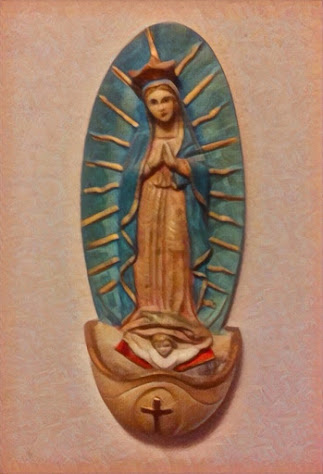
<--- pic 1 (see below)

I have made three pilgrimages to the Basilica of Our Lady of Guadalupe: in January 1999 (at the closing of the "Synod on America"); in July 2002 (for the canonization of Saint Juan Diego); and in March 2003 (with students on a mission trip, working with the Missionaries of Charity in Mexico City). The events of these three journeys would require a whole book to recount (and perhaps I should write that book). Two of my trips corresponded with two of the five pilgrimages that Saint John Paul II made during his pontificate. 

But I treasure, above all, the personal encounters with Mary in her "house" — she was always there "for me," somehow, whether I was relatively alone in the early morning hours or at a Sunday Mass packed in like a sardine with a multitude of pilgrims. The closest I can come to conveying my "sense" of her "presence" is to liken it (obviously it's not the same, it's not substantial) to the impression that surprises one — from time to time — at Mass or in times of silent adoration of the Blessed Sacrament. There are those moments in front of the Eucharist when our hearts are struck by the reality that Jesus is "present for me." Perhaps this is nothing more (in my case, at least) than a pious emotion, but at Guadalupe I have come away with the (surprising) sense of her loving maternal gaze upon me, her probing of my heart, her closeness to me "wherever I am," with no need to pretend or try to fool myself — Mary seems to say, "I love you, tell me the truth, we'll get through it, I know all your pain and I want to help you to heal." The iconography of the image on the tilma indicates clearly that Mary is pregnant (e.g. the black ribbon). What we might easily miss was crystal clear to the Mexica indigenous peoples: Mary brings Jesus, she gives us Jesus.

Mary's maternal love is a kind of "inherent factor" in the grace that enables us to encounter Jesus and recognize Him as our Lord and Savior. She is united with the Spirit who "came upon her" in the moment of the Incarnation, and she accompanies the Spirit with her maternal love in our own rebirth in Christ and growth as children of the Father, little brothers and sisters of Jesus who also call Mary our Mother just as Jesus did (and still does). Mary is the "Mother of God" — the mother of the Person of the Son according to His humanity, of the Word made flesh in her womb. Her heart has plenty of room for all of us.

But at the Shrine of Tepeyac, any "sense of complexity" we may feel about the dogmatic and theological explications of Mary's role in our lives gives place to the vivid impact of her very real (and very practical) concern for us (this, at least, was my impression — for me vivid, striking, unforgettable unless I were to forget my own self). In any case, she is a wonderful, tender, and consoling mother, but she is also a strong and persistent woman and she has no intention of giving up on us, or on any of her children.

Here I want to place some pictures of "little things" I brought back from these visits, ways that we have celebrated this feast here as a family and as a church community, and some of the small signs that help me remember that Jesus and Mary are close to me, that God's love carries me, and that the "sorrows" that I can never entirely escape are seen and understood and are being transformed by a greater love...

Here are the notes explaining the pictures: 

[1] Above (embedded with the text) a ceramic holy water font with La Guadalupana as she is generally depicted in statue form. We've had it for a long time. The remaining pictures are below. 

[2] Statue of Juan Diego with his tilma, which I think I got at the Basilica's gift shop some twenty years ago. 

[3] This postcard photographic reproduction of the image is among the icons at my bedside. The Church has always used "media" to help us "stay connected with" Jesus, Mary, and the saints. I put an image of La Guadalupana anywhere that I spend a significant amount of time, because it reminds me that she sees me and loves me. 

[4] Next to Mary on my little "icon space" is a small, hand-painted holy water font with Mexican design, which I probably bought at a shop or from a market. 

[5] Yes, it's a Guadalupe bed spread! We don't use it, actually (that's an old picture), because it's too nice, but we really ought to find a place to hang it. I bought this from a street vendor who said (if I remember correctly) that it was hand made. In any case, it's well made. It's beautiful.

[6] This is the "big" image that can be framed and enshrined as the focal point of a room — they sell these in the Basilica gift shop, but ours was actually a gift of some Hispanic religious sisters who were my students many years ago. The Queen of America is Queen of our home, and she has always presided over our dining room, as... 

[7] the digital art presentation of that wall shows. Whatever chaos of our lives piles up on that bookshelf, the Madrecita is never overwhelmed by it. 

[8] Here are some memories: pictures from our family meal on December 12, 2011 — i.e. ten years ago. So much has changed in this decade. Look at all five of those kids fitting so easily around the table! 

[9] You can see the fun food along with the then-11-year-old Lucia, who is getting married next July (I still have to write about that). And there's... 

[10] Jojo who has grown so much without losing any of her sense of fun. She's five years old in this picture. Today, at 15, she's the last one we are "still raising" and sometimes we feel a little old to have a teenager, but she is a lovely girl and brings us lots of joy. 

[11] The kids are watching Mommy as she prepares to serve the "fried ice cream" (which, as I remember, was really good!😋). 

[12] Now we dial it back even further, to the previous decade, with a picture from 2004 taken at the parish fiesta with little Agnese, John Paul, Lucia, and Teresa (in Mommy's arms). Jojo would join us two years later. This is life, people. They grow up fast, but it's a beautiful sacrifice to endure change as they grow up and you "grow" (as persons) with them. There's a bit of "dying" in every change, but also a "renewal" that's a sign, that helps us journey on the path to our ultimate fulfillment. The Mother of Jesus understands this like no one else, and she will help us. 

[13] Here is the Fiesta statue in our parish today. Our Hispanic parishioners prepare terrific food in the parish hall every year. We haven't attended recently, but I suspect will be back in a few years (God willing) when granddaughter Maria says, "Papa and Nana, come to the Fiesta." How could we possibly refuse?😊

2

 3
  4
 5
 6
 7
 8
 9
 10
11
12
13

Thursday, December 9, 2021

Juan Diego: Apostle to the Americas

Today we celebrate Saint Juan Diego Cuauhtlatoatzin, and with him we recall the "spiritual founding" of the modern Pan-American experience in the extraordinary first visit of the Virgin Mary to the hill of Tepeyac outside Mexico City on December 9, 1531. 

She came to this hemisphere in the midst of profound turmoil and change, when the gospel of her Son was first being preached here by missionaries from Spain and Portugal (among whom there were many dedicated and holy servants of God). These new European missionaries, however, faced special difficulties. Not only were they ignorant of many of the languages and customs of the people they encountered, but they were also dependent on the power of European compatriots who sought worldly glory, including those who thought little of betraying Christ for silver and gold. There were, indeed, many complex and contradictory motivations that fueled the engines of what turned out to be a rapid and profoundly ambivalent political expansionist project. Indeed, we might say that - unbeknownst to anyone at the time - "globalization" had embarked on its initial phase of historical realization. 

The previous four decades had ushered in a sudden and unexpected "collision of worlds" that brought the emerging modern nation-states of Europe into contact with the various indigenous peoples of the Americas. Too many evils were perpetrated in the rush to conquer territory, seize valuable resources, and gain advantage over rivals as European powers and their agents were inevitably driven to seek their own exaltation and enrichment, to the detriment of the dignity of the persons of the original inhabitants.

The already-challenging task of evangelization may have seemed hopelessly obscured and compromised for early 16th century missionaries who wanted to bear witness to the love of God in Jesus Christ as meaningful for every person - and therefore as God's mercy and salvation reaching out to indigenous peoples in their own sufferings, conflicts, and fears, as well as for the fulfillment of all that was beautiful in their own traditions, all the longings and hopes of their ancestors.

But Jesus and His Mother had a special plan, a miraculous encounter that would "remain" in the midst of these lands to generate a new gift of unity and forgiveness, consolation, reconciliation, and solidarity that would overcome many forms of sin, oppression, and division.

It began with the songs of birds at dawn on December 9, and a poor simple man who at that time was one of the few indigenous Mexicans who had already obtained the grace of explicit faith in Jesus.

In a sense, Juan Diego was chosen to be the "proto-evangelist" of the Americas. But we would be mistaken to regard the great work that began on December 9, 1531 as something that was finished long ago, as if the luminous tilma with the icon of Mary carrying Jesus in her womb is just a curious relic of the past. Guadalupe is a foundation for an enrichment of faith that is offered to us here and now.

Guadalupe is for all of us. We can accompany in our hearts the tens of thousands who are making the pilgrimage in these days to the Basilica on Tepeyac hill in Mexico City to "spend time" with the Madrecita through her 490-year-old miraculous image. The "Queen of America" (North, Central, and South), Our Lady of Guadalupe's house is geographically at the center of the habitable Western Hemisphere. December 12 is her Feast Day, although some countries will celebrate on December 11, since the 12th this year is Laetare Sunday.🌸

We can display photographic copies or artistic renderings (in various styles) of the mysterious original and still vivid self-presentation of the woman who called herself "the Mother of the Creator of all things, of the Lord of the near and of the far." She came 490 years ago, and she remains here today, to console her children in their sorrows and be their refuge amidst tribulations: she who is the Mother of Jesus, she who always accompanies Him and reaches out to us.

We must have confidence in her promises, and entrust ourselves to her tender love and unique maternal intercession with her Divine Son. The love of Jesus Christ, the Word-made-flesh in Mary's womb, is greater that all our sins and all the complexities and conflicts and dangers we face today.

In fact, the full evangelization of the Americas has only just begun. We are still in the dawn with Saint Juan Diego. The greatest fruits of the unique events we celebrate in these days are yet to come.


Wednesday, December 8, 2021

The Immaculate Conception and the "Grandeur of God's Love"

Today we celebrate the Solemnity of the Immaculate Conception. 

We have begun the days of the "Marian Fiesta" that are very special (and particularly important) to all the peoples of the Americas. Mary, the mother of Jesus and our mother, has demonstrated a concrete and enduring solicitude for this hemisphere. 

We must have confidence in her promises, and entrust ourselves to her tender love and unique maternal intercession with her Divine Son. 

We must bring to her the many intractable problems and overwhelming spiritual and physical sufferings we endure in various ways, some of which remain shockingly evident while others are hidden behind disingenuous facades - superficial pretences of human satisfaction that hide our tremendous loneliness and disconnection from reality. All of us sinners — forgetful of our God-who-is-Love and who is worthy of all our love, adoration, and gratitude; perpetrators of so much deeply-rooted violence against one another and ourselves; and victims of that violence that seeks to desecrate the "image of God" that is each one of us, and that should shine through the experience of being loved and loving our brothers and sisters in communion with Jesus and by the gift of his Spirit — all of us need to seek the gifts of healing and forgiveness that the Mother of God can obtain for us as she brings us closer to Jesus her Son and our brother.

As Pope Francis stresses in the remarks below, Mary's grace-filled, all-holy life is a sign that God's love and mercy are greater than sin. She is a sign of hope for us all:

"The feast of the Immaculate Conception expresses the grandeur of God’s love. Not only does he forgive sin, but in Mary he even averts the original sin present in every man and woman who comes into this world. This is the love of God which precedes, anticipates and saves. The beginning of the history of sin in the Garden of Eden yields to a plan of saving love.

"The words of Genesis [about original sin] reflect our own daily experience: we are constantly tempted to disobedience, a disobedience expressed in wanting to go about our lives without regard for God’s will. This is the enmity which keeps striking at people’s lives, setting them in opposition to God’s plan. Yet the history of sin can only be understood in the light of God’s love and forgiveness. Sin can only be understood in this light. Were sin the only thing that mattered, we would be the most desperate of creatures. But the promised triumph of Christ’s love enfolds everything in the Father’s mercy. The word of God...leaves no doubt about this. The Immaculate Virgin stands before us as a privileged witness of this promise and its fulfilment

~Pope Francis

Monday, December 6, 2021

Teresa Janaro's Birthday

Happy 19th Birthday Teresa Janaro! You have always been full of vitality and a spirit of adventure. We’re so proud of you and we love you very much!♥️

[On the left, two-year-old Teresa experimenting with music and shades😉; On the right, current Teresa on one of her horses.]


Saturday, December 4, 2021

Francis Xavier: Following Jesus to the Ends of the Earth

On December 3, we commemorated Saint Francis Xavier, one of the first and most prolific of missionaries to East Asia, as well as an important figure among those who built historical bridges between East and West. 

Though his evangelizing ministry coincided with modern European expansionism in the 16th century, Francis was no "colonialist" or seeker of earthly power or riches. He was among the earliest followers of Saint Ignatius of Loyola and was one of the original seven members of Ignatius's "Society of Jesus." 

Francis Xavier set the example for countless missionaries who came after him. He was above all a man on fire with the love of God, with a passion to witness to Jesus through all the world. He preached in India and the Indonesian archipelago, became the first Catholic missionary in Japan, and longed to bring the Gospel to China, where he recognized the presence of an extraordinary human civilization.

It was there, before beginning any work in the Middle Kingdom, that Francis finally died of an illness (having reached the limits of human endurance) on an island seven miles from the coast of the southern province of Guangdong. Subsequent generations of Jesuits (and others) would take up this work after him. While they preached Christ, they also pioneered the first truly global  encounter between peoples from all over the world, with their diverse customs, heritages, and environments. In Christ, every people and every history is destined to find its fulfillment.

The ardor of Saint Francis Xavier's missionary heart brought great multitudes to Christ, shined the light of the Gospel explicitly in nations where it had never shone before, and planted seeds - many of which have yet to grow, blossom, and bear fruit. 

But they will…

Friday, December 3, 2021

December is Here

December is here. 

The sun glows near the horizon in the middle of the afternoon. The last of the bright colorful Autumn leaves have faded and fallen to the ground, giving way to the cold, relentless beauty of large spaces.

Now we are surprised to find ourselves under suddenly big skies unveiled behind the naked trees. They are brightly clear and blue in the brief hours of the day, though also traversed by strange angry clouds that look like great mountain ranges in the air. And the yellow sun is luminous in gentler and more various hues, sometimes seeming to shine "upward" from edges of waning daylight.


Thursday, December 2, 2021

The "Great Conversion Story" of Charles de Foucauld

Yesterday marked the 105th anniversary of the martyrdom of Blessed (and soon to be Saint) Charles de Foucauld. In my social media posts and blog post yesterday, I quoted and remarked briefly on the unique vocation of this great, great saint.

Today, I thought it would be useful to present here the short account of the beginning of his vocation, and the troubled early life that preceded it. No one would have predicted the future of the worldly agnostic young man who lived a life of indulgence and excess in the France of the Third Republic.

But Charles's encounter with Jesus Christ and his conversion were profound, dramatic, and total in a manner rarely seen in any era. These few paragraphs give only an outline of a magnificent story that will become more familiar to people (let's hope) as the date of his canonization in May 2022 draws near.

The text below appeared in my monthly column in the October 2021 issue of Magnificat.

He called himself the “little brother of Jesus,” and he became a saint by bringing the presence of Christ’s love to the poorest of the poor on the margins of the Sahara Desert.

During his troubled youth, however, it seemed hardly likely that sanctity – or even faith and love – would be associated with the dissipated life of the Viscount Charles Eugène de Foucauld. Losing his childhood faith, Charles spent a dozen wayward years as a profligate, soldier, and explorer-adventurer, but was deeply afflicted by the inadequacy of it all. In this time, he tasted the bitterness of a “godless” life.

Charles was born in 1858 to a distinguished French noble family, and as heir to great material wealth. Tragically, both his parents died when he was six years old, and he was raised by his maternal grandfather, with the intermittent company of other relatives. Still, the absence of his parents affected him deeply, and he became an unruly and notorious adolescent: intellectually gifted but lazy, rendered agnostic by careless reading and his own indifference, undisciplined and apparently resentful of all authority.

In 1878, Charles reluctantly joined the French cavalry to please his grandfather. He soon became famous for his lavish parties, extravagant spending, and improper liaisons, none of which could assuage what he later acknowledged was an overwhelming loneliness. A listless, insubordinate soldier, he was temporarily invigorated by martial zeal when his regiment was called to fight in Algeria. But something more long-lasting also began at that time: Charles’s small “accidental” role in France’s colonial misadventures was the occasion for God to stir up his soul. He watched the Muslims in their fidelity to prayer, and it seemed to open up in him a sense of wonder at the Mystery greater than himself and the whole world. After his military service, Charles determined to pursue this fascination into the desert, spending a whole year exploring Morocco disguised as a Jewish rabbi, and eventually writing an authoritative, award-winning book on this region.

Charles returned to Paris in 1886, with his extended family still much concerned about his erratic behavior. They hardly could imagine that he secretly visited churches, his heart crying out, “O God, if you exist, let me come to know you!” His older cousin, Marie de Bondy, however, had known Charles since his childhood. She intuited the pain and the questions and the troubles of his soul. Rather than argue with him, she offered him love and friendship. Her tenderness and goodness penetrated beyond his perplexity, and led him to seek out her great friend and spiritual guide, Father Henri Huvelin. This learned and holy priest knew well how Christ’s grace opens doors for many restless minds. When Charles made his acquaintance and requested to “discuss” Catholicism, Fr Huvelin knew that what Marie de Bondy’s wandering, weary cousin really needed was Confession.

In October 1886, Charles de Foucauld confessed and received Holy Communion like a child, and his thirsty soul was filled with the certainty of faith and the ardor of a great love. “As soon as I believed in God, I understood that I could not do otherwise than to live for him alone.” Thus, also, was his vocation born, which is an even better story than all that led up to it. And these two great friends who led Charles to Christ – Marie de Bondy and Henri Huvelin – remained in communication with him and supported his unique vocational path for the rest of their lives.

Wednesday, December 1, 2021

Charles, the "Little Brother" of Jesus

Charles, the "Little Brother" of Jesus. 

He desired to "shout the Gospel with [his] life." After his dramatic conversion/"reversion" to the Catholic faith, he felt called to love Jesus in an utterly radical manner. 

First with the Trappists in France, then in the Holy Land and Algeria, he sought to follow Jesus with a humility that worried his friends and his spiritual director, but they continued to support him, convinced of his holiness and the reality of his unique charismFinally, he went to live among the poorest and most forgotten people at the edge of the Sahara. He made his hermitage/"house-of-hospitalty" among the Tuareg, a nomadic Muslim people, and befriended them and gave special attention to their desolate black African slaves.

They called him "marabout" (holy man). He did not preach with words. He spent his days in adoration of Jesus in the Blessed Sacrament and in serving the poorest of the poor. He was martyred - killed by bandits - on December 1, 1916. After his death, others began to follow his way of life. He taught us in a profound and (in a sense) "new" way that contemplative love and fraternal charity are at the heart of Christian witness. In May 2022, he will be canonized a saint. 

Charles de Foucauld is the saint we need today.

While living at Ben-Abbes in Algeria, he welcomed everyone. He said, "I want to accustom all the inhabitants, Christians, Muslims, Jews, and nonbelievers, to look on me as their brother, the universal brother. Already they're calling this house 'the fraternity' (khaoua in Arabic) - about which I'm delighted - and realizing that the poor have a brother here - not only the poor, though: all men."

He was familiar with struggles, dark-nights-of-the-soul, and loneliness.

Charles failed in his efforts to found a religious community during his lifetime, and he experienced much sorrow and pain and spiritual darkness and obscurity even regarding his own work. But in a letter of December 1, 1916 - which was never sent - he wrote these words: "When we can suffer and love, we can do much, it’s the most that we can do in this world: We feel our suffering, but we don’t always feel that we love and that’s an additional suffering!  But we know that we want to love and to want to love is to love."


Tuesday, November 30, 2021

Andrew: Bringer of Good News

Today is the Feast of Saint Andrew, Apostle.

"If you confess with your mouth that Jesus is Lord
and believe in your heart that God raised him from the dead,
you will be saved.
For one believes with the heart and so is justified,
and one confesses with the mouth and so is saved.
The Scripture says,
'No one who believes in him will be put to shame.'
There is no distinction between Jew and Greek;
the same Lord is Lord of all,
enriching all who call upon him.
For everyone who calls on the name of the Lord will be saved.

"But how can they call on him in whom they have not believed?
And how can they believe in him of whom they have not heard?
And how can they hear without someone to preach?
And how can people preach unless they are sent?
As it is written,
'How beautiful are the feet of those who bring the good news!'"

~Romans 10:9-15

Monday, November 29, 2021

End of Autumn: Homage in Digital Art

In various styles of digital graphic art from "JJStudios," here are my final “pictorial words” for November, near the end of this year’s Autumn season:


Sunday, November 28, 2021

Advent 2021: Seeking the One Who Seeks Us

We have arrived once again at the beginning of a new liturgical year in the Roman rite, even as the calendar of temporal events continues to pass through the final weeks of what - for many of us - has been an uncertain and painful year of 2021. 

Advent invites us to remember once again the glory of Jesus as the meaning of everything in our lives, including all the obscure and sorrowful things. The Word became flesh to bear our wounds and save us from sin (which is the source and perpetuator of pain through all of history).

Advent encourages us to lift up our hearts with hope to the fulfillment He has promised, to adhere to Him with greater trust, and to be witnesses to God’s faithfulness to our neighbors, accompanying them in their own (often confused, frustrating, even desperate) search for healing and the true value of life.

Now is the time to remember once again that in Jesus God’s love draws close to every person. What an immense love this is: God’s “longing” for each person He has created. He has “so loved the world that He gave His only begotten Son,” His Eternal Word made flesh and born of the Virgin Mary. 

May this beautiful Advent season prepare our hearts for the joy of Christmas (the celebration of which begins on December 25). 

Come, Lord Jesus!⭐️

Thursday, November 25, 2021

Holidays With Empty Seats and Dark Holes

For many, the coming holidays will be hard because of an empty seat at the table. Some of my friends in the USA are observing Thanksgiving today for the first time with the awkward anguish of That Empty Chair, the one that for so many previous years had been occupied by a beloved spouse, a parent, or even a child. These precious persons have been taken away from this life, sometimes by the course of nature and the fullness of their years (which - even when it’s not sudden or surprising - causes real sorrow for those left behind). But there are also many persons who have vanished "before their time," in strange ways, under circumstances that leave their loved ones gasping for breath and staring at the black hole that has burned suddenly into the midst of their daily lives… a hole that seems bottomless.

For me this year, there are some real reasons for grief, but also very much to be grateful for. And there is above all gratitude for the hope that sustains me through joys and surprises, changes and the passage time, and even in the midst of pain and sorrows.

But I know that for others, the trial is much more acute, and the empty seat at the table reminds them of an absence that is like an abyss that they and their families have been plunged into, where they cannot seem to see any light or find any foothold.

My prayer is especially for them, that they may remember that they are held in the darkness and in the depths by the forever-open-wounded hands of Love.

Wednesday, November 24, 2021

The Boundless Reach of God’s Mercy


I came across this excerpt from my book Never Give Up, published nearly a dozen years ago, and it seemed worth posting here in these difficult days.

Sunday, November 21, 2021

Jesus, Our Crucified King


************For some of us, this celebration of the feast of Christ the King is marked by the sorrow of a tragedy that happened to one of the young people in our community last week.

The pain of an incomprehensible loss is something we can only bring to a King who has carried all our sorrows, who rules by the love that leads us and makes ways for us through the darkest abysses.

Please pray for the soul of a young person, and for the consolation of their parents and family.

Wednesday, November 17, 2021

It's "Papa Time"!

Maria Janaro is only four months old, but she already knows lots of people. She spends much of her week being cared for by her mommy and daddy and nanas and a whole bunch of aunts.

Her old "Papa" is usually content to be in the background. But he gets his share of "Papa Time" and - of course - he usually has his phone-camera ready at hand. This doesn't give him the right to "put words into Maria's head," but he couldn't resist a few captions for pictures he took on Monday.😉

Not to worry: Maria gets to "speak for herself" in the video.


Then, Papa decides to make a video. Here we go:

Oh my, how dramatic! But "all's well that ends well."🙂

Tuesday, November 16, 2021

Saint Gertrude: The "Incredible Ardor" of Jesus

Today we celebrate Saint Gertrude "the Great" - of the 13th century Benedictine monastery in Helfta (Germany). She was one of the outstanding women of the medieval Church, a brilliant scholar, a counselor to many, and most importantly a mystic enraptured by the merciful and loving heart of Jesus.

Reports of Gertrude's visions, her special spiritual intimacy with Jesus, and her own prayers were written by her and/or her sisters at the Helfta monastery, many of whom were also saintly and highly educated during this period.

In one vision, Jesus reportedly said to her, "My Divine Heart, understanding human inconstancy and frailty, desires with incredible ardor continually to be invited, either by your words, or at least by some other sign, to operate and accomplish in you what you are not able to accomplish yourself. And as its omnipotence enables it to act without trouble, and its impenetrable wisdom enables it to act in the most perfect manner, so also its joyous and loving charity makes it ardently desire to accomplish this end."

Gertrude's prayers are full of vivid imagery:

"O devastating coal, my God, you who contain, radiate, and brand with living heat!...O powerful furnace..by whose operation dross is transformed into refined and choice gold when the soul, wearied by deceit, at long last blazes with an inner and insatiable desire to track down what belongs to it, and which it may receive from you alone: the very Truth."

Thursday, November 11, 2021

The "Authority" of Christina Grimmie's Joyful Love

The origin of this picture was a screenshot from a video on Christina Grimmie's YouTube channel. It was through living human interaction and passionate music performances, as well as videos, social media, and recordings, that she gave herself during the past decade - gifts of love that have remained accessible and vital even now, five years and five months since she went home to the Lord. Her offering of herself and her remarkable talents along with her ordinary life with its many facets has - if anything - grown in power, authority, and capacity to touch the hearts of people since that day. It was then that Christina's commitment to God - her mission freely discerned and taken up - was fulfilled "to the end." She lived out to its completion, and in all its mysterious depths, her vocation to give glory to Jesus through "secular" popular music, and to love and accompany people in many places throughout the world (especially those who are wounded people, poor people, suffering people, or people in particular loneliness who need to experience that Someone loves them with an everlasting love). 

Christina's gift of herself continues to bear fruit today. For a young person, she had an unusual maturity in her conviction and persistence in loving others (even when the means she used were gestures full of youthful spontaneity and fun), because her love was grounded in her confidence in the redeeming mercy and tenderness of Jesus. Now that her "offering of her life" is completed in Him, the "authority" (the convincing power) of her love and joy becomes more evident. She is for us a "sign" of His love for us, and she is "closer to us" now even if - paradoxically - she has for a time passed beyond our sight. Still, she has left glimpses of herself in this world: so many pieces of media sound and imagery that extend to us even now the love stamped with her own unique personality, while also given as a witness to the God who has become incarnate - who has come to dwell with us and wants to stay with us

Thus, these pictures (see above and also below, the latter screenshots from videos variously posted on YouTube from 2015 European Tour) and the many other "virtual jewels" we have from her luminous life stand out from the overwhelming bombardment of sights, sounds, and information that pour over us every day. There is a freshness and a surprise and a mysterious personal quality that endures in them, and even grows with the passage of time and continues to "meet us" as our own earthly lives continue and we engage new challenges.

These images of Christina are precious to me, and reach me today in the fragility and anxieties of difficult circumstances I am going through right now, with the recent loss of my own parents, the changes in the rhythm of life at home as my kids grow up, the ongoing frustrations with my chronic illness, and the new and strange challenges of growing older. But Christina walks with me and engages my humanity even now, in part through so many vital images. They are not only "from the past" as if they were the remains of something inexorably lost, that provokes only nostalgia and, ultimately, sadness. They are a "presence" here and now, as extensions of Christina's joyful, loving gaze that reaches me, so that I feel "seen" and "known" in a remarkable way by someone I never met in this world. They have a kind of "authority" and special value in helping me remember that I am loved

Christina made all these gestures to us and gave all her attention to us in these moments from out of a great love for Jesus (which does not therefore bypass us, but precisely for this very reason includes us without limits or boundaries). She reached out to us from her own experience of His love (which is always present, always wanting us, always healing, forgiving, redeeming, transforming us); thus all the expressions of her life so rich in humanity and goodness have been woven together into a witness and an affection that still touches us, encourages us, and draws us closer to the Mystery of Infinite Love. Her beautiful face has joined its gaze on us to the One whose human face looks with love on every person, who cherishes each and all of us and has called us to share in unending joy. (Once again, Christina, I am so grateful to you!💚)


Tuesday, November 9, 2021

Who is "Saint John Lateran"?

The focus of today's feast day might be a bit confusing, at least for English speakers. 

The shorthand phrase "Feast of Saint John Lateran" might give us the idea that there was a holy person in history (who we know nothing about) named "John Lateran," one of the multitude of "Saint Johns" out there among the saints. And there are lots of "Saint Johns" (believe me, I've checked😉). Perhaps we might even ask "Saint John Lateran" to pray for us.

In fact, today we celebrate the dedication of the first great church built publicly within the walls of ancient Rome, the original cathedral church of the Bishop of Rome, which the Italians call San Giovanni in Laterano. To this day it remains the Pope's official episcopal "seat," even though the more famous Saint Peter's in the Vatican has long since become the church closest to the Pope's residence and the sight of the majority of papal events.

The Basilica of Our Savior and Saints John the Baptist and John the Evangelist was dedicated in Rome by Pope Sylvester I on this day in the year 324. It was less than a decade after Constantine won his victory over Maxentius, became Emperor, and gave Christianity legal status and full freedom within the Empire. Constantine had acquired private land holdings through his wife's connections with the prestigious Laterani (an old Roman noble family). He donated the property to the Pope for the building of a church. 

The initial church was erected not after the pattern of pagan temples, but according to the model of Roman public gathering places where formal events were celebrated with all the people. In place of the imperial triumphal arch, the new church used an arch dedicated to Jesus, the true Emperor of the whole universe, and His triumph over sin and death. This arch set off the sanctuary from the congregational space, and the "Christian Basilica" was born.

But why celebrate a building? After all, isn't it true that the "Church" is the People of God who worship Him in the liturgy? Why should the building matter? 

Certainly, Christians don't view their buildings as magical edifices that circumscribe divine power and subject it to human conjuring. They do not confine God within their walls. Rather a church building, like many other material things that are set aside for the worship of God Incarnate, is cherished because of the great liturgical gestures it makes possible. The community established by Jesus is human in the fullest sense, composed of bodily human beings who are called, as much as possible, to gather together in a particular place to worship God together publicly and visibly. For three centuries, such gatherings - whether large or small, tolerated or persecuted - took place in provisional places, sometimes even secret places, but in any case places that were less than fully inserted within the society and culture in which people lived their daily lives. It is proper to the wisdom of God's plan and the reality of the Incarnation - God dwelling among us - that there be acknowledged, visible, tangible human places where His people gather to affirm and encounter His presence.

This is one reason we celebrate the dedication of the "Lateran Basilica" nearly 1700 years ago. It has been rebuilt and augmented many times, but it remains the same place, the "Mother of churches" (as it is called). Our joy on this feast day is above all in Christ and in our belonging to Him together, but today we are especially grateful for the place where the Pope has his seat, where the Christians of Rome have gathered with him for 17 centuries, and also for the churches that make "homes" for us and for Christians all over the world, the places where we come together to be with Christ in the offering of His love for us.

Friday, November 5, 2021

May We Merrily Meet in Heaven

Lord, grant to those who have gone before us eternal rest and peace in Your presence, and at our journey's end bring us also to You, that we might all "merrily meet" in the fullness of Your joy.

This graphic is from Saint Thomas More's final letter to his daughter, Meg:


Wednesday, November 3, 2021

November's "Holy Souls" and Our Loved Ones

Already, it is November 2021!

We have begun this new month (and the final weeks of the liturgical year in the Roman rite) with the joyful feast of All Saints, followed by a special remembrance of "All Souls" — all of the "faithful departed," especially our loved ones who have passed from this life united with Jesus in His saving death.

They have embarked upon that mysterious final passage "from death to resurrection" by which the fullness of His healing and transforming love frees them and prepares them for the blessedness of the true life: to dwell forever in perfect happiness with Christ, in the unveiled embrace of the God who is Love.

For many of us, this year's "All Souls Day" (and this month specially dedicated to the faithful departed) has a special poignancy and sense of "intimacy" that we may never have experienced before. During the past year (or in recent years) many have had to "say goodbye" in this world to people we loved deeply and dearly - people who were part of the edifice of our earthly lives — whose living and breathing, whose voices and affection and encouragement, were as basic to "our world" as the ground under our feet, as the sun that lights our days, or as that sense of quiet joy and familiarity of "being at home." People have said goodbye to spouses, family members, brothers or sisters, or friends who were "like" brothers and sisters to them on their earthly journey. It is a comfort to entrust them to God our merciful Father who loves them and us with a greater love than we can ever imagine. It is a great and "intimate" consolation to be able to pray for them, and rely on their prayers for us. In this month, it is as if the whole Church gathers together with those who grieve, to console those who mourn. In November we especially consider the whole Church: the communion of saints who see God face to face, as well as those "arriving" at blessedness through a final purification that is mysteriously arduous (that's why we pray for them) but also mysteriously joyful, and of course those of who remain on this earthly pilgrimage united with Jesus as we struggle to "fight the good fight" and "keep the faith" until our time is completed.

This year's November is new for me. It's somewhat hard describe how it "seems to me." My Dad died in 2019, and I have written here about the sorrow and also the "peculiarity" of life without him. Yet my Mom was still alive, and she had much need for our help, and also gave much love, affirmation, and wisdom to her children, grandchildren, and (at least by feeling her kick from the womb) her great-granddaughter who was born six days after she died. My mother's death this past July, however, was like "the breaking of the last thread" between generations, between "the parents" and "the kids" (the "kids" being Walter and me — funny as that may be in the minds of younger folks).

This sounds odd, perhaps, but it is the way I experienced my parents: they were "together" not only as husband and wife for 59 years but as my parents. Since my mother's death, it has struck me that I not only miss her (so much I cannot even understand it myself) but I also miss my father more. It was as if he was still "partially around" as long as she was still around.

There are practical, physical reasons for this: their own home and their estate have become our concern, and though they were not rich in the first-world sense of being rich, there will be some material benefit for us once all the bureaucratic stuff is taken care of. This is beautiful above all (by far) because we know how our parents carefully arranged their modest material legacy so that it would help us and the grandchildren in our material needs. It is one more expression of their love which makes me grateful to them. No one knows what tomorrow may bring regarding material circumstances, but the provision they have made for us — this special gesture of the care they gave us through all our lives — is a priceless gift. I am grateful beyond words.

And even as I miss them, there is a sense in which I feel closer to them. I think they still "take care of us," even in some very particular ways of daily life. They are "not far" from us. Some day we will understand how this all "works" (persons, relationships, the human family, the generations, life and death, how Divine Love illuminates all of it...).

We were blessed to have these good parents, and it helps us to glimpse some sign that indicates the kind of love that our Lord has for each and every human person, and the special love He has for the poor, for the "orphans" of this world (and there are more and more who are orphaned by strife perpetrated by humans, through war and oppression, through many sufferings from without and from within families, and the confusion and materialistic shallowness in our covetous society that breaks apart human relationships and leads to the dissolution of family life). God wants these suffering people to know that they are His children, and that He seeks their healing. And we know that we are called, that we must find ways to be brothers (brothers and sisters) to those who have no home, no family, and those who feel lost and alone in this world.

May God grant eternal rest to those who have died, and consolation to those who suffer from losing them in this life.

Here is a picture of Mom and Dad from their younger days: