Saturday, March 18, 2023

Acknowledging That I am “the Pharisee”

Sometimes I feel like a hypocrite, doing all this writing about God.

Like most "religious people," I have an inner Pharisee with whom I must struggle. It's especially hard for someone whose profession is teaching and writing about religion, its history, and how everything else is related ultimately to religious questions and searching. Moreover, I “know the answer,” because I have been given the gift of faith in God’s revelation of Himself in Jesus Christ who dwells among us in His Church. Yes, I am a Catholic. I have the fullness of the faith that God wants for everyone. Uh huh! “Thank God that I am not like the rest of men!” I have the Truth! (It’s so much easier and self-satisfying to say “I have the Truth” than to say, and to recognize, that “the Truth has me.”) It’s so easy to forget that being Christian is not about “status” but about service; that it means following Jesus, taking the lowest place, witnessing to His love not only in words but by pouring out one’s self in love, being the servant of all in Him who emptied Himself and took the form of a slave to save us and reveal to us the mystery of Love as gift of self. 

Clearly, I’m a long way from the wisdom of God (which is “foolishness” to the world). One thing I know as a Catholic Christian—and can properly claim “for myself”—is that I am a sinner. I need to beg for His mercy. 

But I also need to do my work. My work—to which I gave many years of my life to professional training in order to be academically certified, and which has led to my obtaining the title of “Professor”—is to talk about God, or write about God. I have to work, don’t I?

And it’s only natural to look for affirmation in the execution of one's profession, and to "feel good about one's self” in one’s achievements. One enjoys recognition and honor for the excellence of one’s work. 

But then one remembers that one is teaching and writing words about God.

Nevertheless, I have some measure of human ambition about my work. And I am indeed very much “like the rest of men [and women]”—my life has all the elements that go into the average person's professional and social interaction, including all the hypocrisy, self-promotion, dissimulation, cunning and self-seeking...and it's all wrapped up in teaching and writing about God! This is a psychologically complicated fact of my life. 

I love the first places at banquets, and being called "rabbi"! Woe unto me!

What can I do other than throw myself upon the mercy of God? I have been given the gift of expressing myself. I know that words are straw, but there is a place for straw in life and the task of making straw has been given to me. I have made tons of straw, and I shall continue to make more straw until I can’t do it anymore. Straw is necessary in a world populated by… ummm… “donkeys.”

See how humble I am? (“Oh, he’s so humble,” they say…)
.
Hah, don't be fooled by this humility routine. The inner Christian Pharisee loves when people recognize and admire his humility—his ego just eats it right up: “Thank God that I am not like the rest of theologians and religious thinkers. I am humble, not like those proud, divisive, arrogant, fundamentalist, revisionist, or just plain weird people back there…etc.” You see the problem here? 

Anyway, don’t be fooled by me. I an not much in the way of being humble. Rather, I am a struggling, divided heart. I am a Scribe. It comes with the profession. "I see," I say, and therefore I am blind. 

Yet I am also the blind man in the process of being healed, of beginning to see His face.

I am a human being but I am not just a religion professor. I am a human being who cries out in my helplessness to the Mystery who makes me and sustains me. I am a radical need that I cannot fulfill by myself. I am often stumbling in the dark, not knowing where my next steps may lead. 

But I am also a human being who—without in any way deserving it—has met the man Jesus Christ. For reasons that overwhelm me—but that I can only call “absolute gratuitous love”—He wants to accompany me and stay with me.

Mixed up with all my mashup of complicated self-serving motivations there is something else; there is a desire that He has placed in my heart because He wants to meet you and stay with you too.

This changes the meaning of my work, even if I am still trying to express His humanity in words, inadequate words, big intellectual words or sentimental, pious words; words that make it sound too easy, and that give me the false appearance of being "wise" as I toy with mysteries. 

All these words. All this straw. Use it for your bed. Throw it in your fire and be warmed. Let it dry up the damp ground under your feet. Find something in it.

From my own struggle, what I want you to see is that Mercy is at work. In all my efforts and words the great hope is that you might see His mercy. Because of Him, I have the audacity to hope that you might find it, even in me, in the midst of my many poor words.

Look for Him. Discover the beauty of His face. I know it's not as easy as it sounds. I know that. But still, He is here, and He is real.

Thursday, March 16, 2023

“I Will Hear Them…” Says The Lord

Entrance Antiphon for Roman Liturgy of today: “I am the salvation of the people, says the Lord. Should they cry to me in any distress, I will hear them, and I will be their Lord for ever.”


Wednesday, March 15, 2023

We Are Called to Live as Persons-in-Communion

Humans are both individual and social by nature. And according to the plan of God in Christ we are called to live a great and mysterious reality, to discover the fullness of life in an interpersonal community.

But building genuine interpersonal community is a seemingly impossible task. We seem always to be caught in a violent tension that pits personal freedom against collective security and affirmation.

Though some persons of unusual strength and pride attempt to affirm an absolute individualism, most of us are too vulnerable and too drawn to one another to be tempted directly by radical autonomy.

We recognize our value as persons, and also our orientation as persons toward relationship, to be-with-one-another, to live in community. We are born into families that are woven together through larger groups devoted to various purposes, and we also build up social groups through our own commitments.

Yet "groups" have their own cumulative momentum, their own gravitational pull, their powerful tendency to generate uniformity. People can surrender their own creativity and sense of identity to the "group mentality," and become increasingly determined in thought and action by those who possess the most power. Or they may become afraid of "losing themselves" to the perceived power of the group, and draw back from sharing life, distance themselves in some measure, and fall into a passive (and lonely) indifference.

The only energy that can transcend this dialectic is love — the love that corresponds to the dignity of the human person, the mystery of the person, the gift of the person.

“Group dynamics” in and of themselves inevitably end in factionalism and exclusion. Moreover, recent history should have taught us by now that true community can never be generated by violence, whether it be the external violence of barbed wire and iron bars or the internal violence of imposed ideology, “re-education,” propaganda, or psychological manipulation. These kinds of violence can make a “group” with a common surface mentality of ideological conformity, but they violate the freedom of persons and alienate them from themselves and one another. Often, the subconscious frustration that slowly burns beneath the surface of ideological conformism breeds resentment, which eventually breaks out into counter-violence against self and others.

In today’s world—with the immense capacities of multimedia for shaping personal perceptions and “environments” of social presuppositions—we should be especially attentive to the use (and the potential misuse) of “soft power.”  The cumulative impact of the manipulative configuration of perceptions under the pretext of providing “information” breeds a depersonalized conformism. It disconnects persons, leading them to interior withdrawal, passivity, and boredom. Or it engenders suppressed frustration and anger that become tinder for the irrational and counter-violent flames of reactionary upheavals. The sudden rise of factions bonded together by common grievances and resentment should not surprise us. The cycle of violence can take many forms. It is always the enemy of community.

Genuine community is the fruit of freedom and love.

And we are confident that love can prevail, because we know that we are sustained in being and called as persons-in-relationship, in community, by the One who is Love. The One who is Love and Communion is the source and fulfillment of everything.

Therefore, any "group" that is truly human is made up of persons who, in the original and radical sense, have been given to us by the mysterious design of Eternal Love, and to whom we have been given in turn, to love and be loved. And a group can only be truly human if it lives as a communion of persons, which means that it must respect and cherish every person within its sphere of vitality, because every person is made in the image of the One who is Love.

Each and every person in a group has a unique and unrepeatable value, and this must never be reduced to their productive contribution to building up the group and furthering its ends. This is true even (especially!) when a group is united in the pursuit of social, moral, or religious concerns. We must never forget this!

Each person is worthy of love for their own sake, above and beyond what they may or may not "do" for the group.

Even when a group is so large that we cannot know every individual person, we must always remember the dignity of every person. We can at least hold that love for every person in our hearts. We must cultivate the readiness of solidarity, the openness that welcomes the stranger and that lives human existence as a great companionship.

Tuesday, March 14, 2023

Yes, There Are Goats Too…


Over the years you have seen pictures of the cows and the horses and the chickens that share our living space in this small town/semi-rural environment. I don’t think I have ever featured goats before. But we do have goats around here, probably more that I realize. A goat can provide lots of milk, which tastes great… once you get used to it.😜 Recently, I happened to be in the right place at he right time to meet some goats up close, but also safely fenced in. They seemed enthusiastic about having their picture taken. I was happy to oblige.🙂

Monday, March 13, 2023

Gratitude For Pope Francis’s Ten Years of Service

Dear Pope Francis,

Thank you for ten years of fidelity to the office to which God has called you—to be Bishop of Rome, Successor of Saint Peter, Servant of the Servants of God, and a shepherd and father to us all.

You have reminded us every day of the loving presence of Jesus in our lives, and challenged us to share the joy of the Gospel with the whole world, to live with responsibility and gratitude for the beauty and value of all of God’s creation, and to cherish and support the irreplaceable, lifelong mutual love of husbands and wives as the essential foundation of family life. You have encouraged young people and—by word and example—taught us how to embrace growing old, and the mysterious value of the sufferings that we are called to endure. You have emphasized the special human gift of dialogue and mutual enrichment in the relationship of grandparents and grandchildren, of the elderly with the younger generations. This interaction is an important part of God’s providence: in this way life and history are informed by the union of wisdom and innocence, by experience of the past and hope for the future. 

You have always emphasized the special love of Jesus for the poor, the forgotten, the marginalized. Attention to their material needs (including their very real need for justice, mercy, and equity) is not motivated by utopian schemes but by fidelity to Jesus who calls us to recognize him and serve him concretely in the poor: “I was hungry and you gave me food… I was sick and you cared for me, in prison and you visited me… I was a stranger and you welcomed me.” You have exhorted us to work in the ways we can to build a more just, loving, fraternal society—to foster the “revolution of tenderness” that Jesus is working even in the midst of this temporal world, as the glowing light of his glory on the horizon of earthly life that has already begun to illuminate everything, as the foretaste of eternal life that sustains us on our historical journey with the promise of fulfillment. It is worthwhile, therefore, to glorify God through works of mercy, and even to work for the “civilization of love” (Saint Paul VI), the social vitality of Christ’s saving love that “already”—even NOW—embraces the whole human person and every aspect of human life. 

We are called to adore, worship, and live in gratitude and joy as children of God our Father, and to serve Jesus our brother in one another and especially in the poor, the abandoned, the lonely—because it is particularly through them that Jesus cries out to us and yearns for our love. God loves everyone, which means that his Catholic Christian disciples cannot rest in any form of self-satisfaction, but must always seek the face of Christ who has united himself to the fulfillment—the destiny—of every person.

In these ten years this has been the wisdom—the heart and soul—of your Petrine ministry. What you have proposed to us is often difficult, but it is the way of the Gospel, the truth we need to hear, the guidance and correction of a merciful father who is called to help us mature in Christ. It requires us to face our own weakness and incoherence, which humbles us. But it is good for us to be humble. Your Papacy remains an ongoing work of Christian love and service for which I am truly grateful.

Thank you, Pope Francis, for being a “father” to me in Christ in this past decade. You have consoled me, instructed me, provoked me to look more deeply at things I thought I already knew, helped me to be patient while living in the midst of an often-confusing and sometimes-terrifying society—to listen to the Holy Spirit and follow Jesus, to resist temptations to resentment, wounded vanity, grudges, gossip, or forgetting Christ’s lordship over history and trusting instead worldly ideologies that promise easy security (and revenge) if I am willing to sell my soul. 

I am so grateful for your paternal solicitude by word and example that has been a light for me during a decade filled with pain in my own life, unstable health, much sorrow and grief, so many changes in the passage of time, and—of course—many surprising and profound joys too. (The older I get, the more I find that sorrow and joy often come together in circumstances and events, because they are so full of the Mystery to whom they point, of whom they speak—the fulfillment that has already begun, and that hastens us onward.)

Dear Pope Francis, in your ministry you have accompanied me and encouraged me in so many ways, through so many words and gestures. Meanwhile, as you continue to bear the enormous sufferings that weigh upon individuals and peoples in the Church and in the world, I will continue to pray for you.

Your devoted son—and brother—in Christ and his Church,

~John Janaro

Sunday, March 12, 2023

As Christina Grimmie Turns 29, She Helps Us Grow Stronger

Today is Christina Grimmie’s 29th birthday. It is hard not to imagine what her voice would have been like at this age—what further depth, richness, and versatility she might have acquired in her singing, songwriting, and instrumental virtuosity.

Things turned out differently, of course.

Instead, she fulfilled her whole vocation in this world in a very brief period of time, but with extraordinary magnanimity and lucidity, inspired by her beautiful, ardent faith. Many of her frands who were teens or pre-teens when they first encountered Christina have since grown to adulthood. Yet she is not just a distant memory for them; she continues to inspire their lives today (as she does also for people of all ages, all over the world). Christina was a young woman with an enormous heart, who was drawn so powerfully by Jesus Christ that she seemed to want to embrace the whole world. She had a joy that poured itself out in music and in a tireless enterprise of connecting with people by all the means she could find.

She had a remarkable human strength and a particular gift for communication, and for encouraging others—especially those who were broken, damaged, lonely, or in great need. She also knew that she belonged to Jesus, and that all the value of her strength and talent came from Him. Christina was a very down-to-earth person too; she was a girl and a young woman who was just normal and relatable to her peers, who didn’t put on airs, who—apart from her amazing musical talent—seemed like an “ordinary person.” And yet she was different. She was very much an "earthen vessel" that nevertheless carried the treasure of Christ's love in a manner that communicated something of that love's heroic stature.

Christina knew that His love could sustain the human heart, and thereby foster healing and bring consolation and strength to those who struggled to discover their own self-worth. In April of 2014 she made a very short, spontaneous video that took its point of departure from eating disorders and self-harm issues but opened up from there. Anyone could articulate these kinds of statements on a video, of course, but what she expresses here has a palpable authenticity because it comes from within the context of her whole life as a daily risk, a radical availability to the people she met, a passion for Christ and her music and the people to whom she gave the gift of her music.

In this meme I designed from the video, the first panel summarizes a slightly longer discourse, but the other two panels are her exact words that she felt were so urgent, so significant for affirming the value of all the people who were touched by her music, and indeed of every human person who might watch it. I think the video is still accessible on YouTube. In any case, here is my graphic summary. I'm very struck by what she says.


Christina
never tried to sell her faith. When she did mention Jesus, it was to affirm a conviction that couldn't be expressed without an explicit reference to Him. Her own love, in its source and its urgency, its value and its significance as a gift to others, was inseparable from His love.

It requires a certain kind of audacity to tell people to love themselves and recognize the beauty in themselves 'because Jesus loves you... and I love you.'

It requires a certain kind of audacity to express and give ourselves in a way that says to our family, to our neighbors, to everyone we meet, that it is worth it to keep living 'because I love you.' This is the kind of love that is not afraid to open its arms to anyone, that is not afraid to open its arms because it always has confidence in the One whom it seeks to embrace. Such confidence engenders a real courage, a real audacity that is more powerful than all the harm that human beings can inflict upon others and themselves, more powerful than the violence that tries so terribly to negate it, but that cannot prevail in the end.

The world needs this kind of audacity. The world needs this kind of love.

Thank you, Christina, for your courage, for your legacy that is helping us to grow stronger. Happy Birthday!💚🎶

Saturday, March 11, 2023

“Springing Forward”

“Springing Forward (Morning on the River).” March 2023.

As usual, I crafted this artwork “digitally” at JJStudios (aka my iPad), with some drawing tools (on touchscreen) and some filters, adjustments, application of effects. It probably takes less time than painting (and definitely requires less space and external materials). But it is an “original work of art” that absorbed lots of time, attention, energy, and creativity.

Someday, I might look into offering “prints” of these for sale, if there is interest.


Thursday, March 9, 2023

When (and Why) Did “The United Nations” Begin?

Twentieth Century global conflicts set the stage for the world we live in today, and the problems we face.

In the latter part of World War II, the nations around the world (and their soon-to-be-independent colonies) who were united in the fight against Hitler and militant Japan began to refer to their global alliance as “the United Nations.” The leading allies were Great Britain, the (eventually-fully-restored) "Free French," the United States of America, China (under the decidedly anti-Communist Chiang Kai-Shek), and the Soviet Union. The War was so desperate that few considered the implications of the fact that the Soviet Union was still held ideological prisoner by the Bolshevik Communist revolution, which at that time meant that it was also the personal fiefdom of the murderous, genocidal Joseph Stalin (who was presented in affectionate terms as "Uncle Joe" during the war).

It was American President Franklin Delano Roosevelt who envisioned this vast and unprecedented alliance continuing after the war and opening itself up to all the nations of the world, as a institution to preserve peace, to moderate disputes, to collaborate in global activities to the benefit of all, and to deliberate about what was necessary for the security of nations and peoples. Thus, The United Nations as we know it today emerged from World War II. 

Nearly 80 years later, it can be said that the U.N. has accomplished some good things, but overall the work of the U.N. has been quite a mixed bag, for many reasons. In particular, there is one structural problem that hobbles the U.N. to this day, and that is the nature and structure of the Security Council. In retrospect, it’s almost incredible to look back at the naive idealism of so many Westerners as the wars with Germany and Japan drew to a close in 1945.

The plan was that the “Big Five” allies in the wars would form the basis of the Security Council that would keep the peace, rein in offending nations, and authorize U.N. sponsored military interventions by member states if necessary. Other nations would also serve limited terms as Security Council members on a rotating basis. But the USA, Britain, France, China, and the Soviet Union would be permanent members, and each would have veto power over any proposal made (even if everyone else on the Security Council favored it). When the U.N. Charter was drawn up in 1945, it appeared to be a peacetime continuation of the unity of the Powers that were working together on three fronts to win “the Good War” against the destructive Germans and Japanese.

In fact, reality was a lot more complicated. Roosevelt’s ill-considered demand for “unconditional surrender” compelled the Allies to conquer completely the offending nations, thus deflating the possibility of working with any internal resistance within Germany or Japan. It may be that there were no viable alternatives in the case of Nazi Germany. It’s still difficult to penetrate the internal politics of Imperial Japan at that strange time, except to say that there were diverse opinions, but these became irrelevant in the face of the prospect of total conquest and foreign occupation. 

Granted, the militarist Japanese were unscrupulous aggressors who perpetrated war crimes, and their decisive and permanent defeat was necessary. How else could it have been accomplished? There was never an opportunity to explore options other than conquering the entire island nation. The project was so daunting that the Allies saw no hope other than to unleash the dogs of war on a scale never before seen in history. But indiscriminate aerial terror bombing of entire civilian populations, even when considered in this desperate context, cannot be justified. And the atomic bombings of Hiroshima and Nagasaki recklessly ushered in the era of nuclear war. 

As I have said before, the USA is a good country. But when its political or military interests are “backed into a corner,” its leaders will turn to “consequentialist” moral reasoning. Doing evil for the sake of a (calculated) “greater good” is a perennial temptation of good people who possess great power. The world-situation we face today, however, suffers from “consequences” that no one could have calculated in 1945.

When the five great powers arranged their strategies to restore and sustain a peaceful world after winning the worst of wars, none of them could claim to be entirely free of guilt and compromise with evil. None of them were perfect. Some of them had more problems than they wished to reveal. But one of them was a snake. 

It is no longer denied that Joseph Stalin was a historical monster who—if not equal to Hitler in every way—was certainly in the same league with him. But during World War II Stalin used a gruff charm-offensive to appeal to the idealism of Roosevelt and the vanity of Churchill, to convince them that he had changed, or at least that they could do business with him. The alliance that defeated Hitler and the Japanese had an irreparable flaw. It enabled the expansion of Stalin’s totalitarian violence and extended its life beyond the dictator himself. 

Nevertheless, even before the Potsdam Conference, Churchill’s common sense began to awaken as he started to realize that Stalin intended to keep every inch of European territory that the Red Army liberated from the Nazis. After Roosevelt’s death, Truman was less taken with “Uncle Joe,” but he was still learning the ropes when Potsdam met outside defeated Berlin, and the powers agreed on the division of their “zones of occupation” and the timelines for yielding to popular governments freely, fairly, and (of course!) “democratically” elected. Stalin was experienced in the art of rigging elections and/or ensuring that any opposition “disappeared” before having a chance to actually oppose his hand-picked people.

The war in Asia, however, continued. Stalin promised his allies that he would “help them” defeat Japan as soon as the U.S.S.R.-Japanese non-aggression pact expired on August 9. The “help” was already on the move, with Marshall Zukov and 1.5 million Red Army soldiers crossing Asia on the Trans-Siberian railroad, headed for the Manchurian border. Stalin instructed them to “liberate” as much territory as possible. We’ll never know how the atomic bombing might have played out, had it not been for the Soviet Union’s Asian plan. As it was, Hiroshima was reduced to radioactive ashes on August 6th. The Japanese were warned that there would be another attack if they did not surrender unconditionally. 

Strangely, the Japanese Imperial council did meet to consider surrendering to the Americans. However, the meeting took place not immediately after Hiroshima, but in the early morning hours of August 9, 1945. What caused this meeting was news that caught Japan completely off guard: at 12:01 AM on August 9, a million and a half Soviet troops poured over the border of Japanese-occupied Manchuria. Japanese forces were almost entirely engaged with preparing for an American invasion. Suddenly, the hated Soviet Communists were invading with a huge force from behind, facing virtually no opposition. Later that morning, while they deliberated, they received news of the second atomic bombing of Nagasaki. The rapidly advancing Red Army was, no doubt, also informed.

As Stalin’s invasion swept into Korea, the Americans scrambled to draw new lines for occupation of the Pacific theater. The 38th parallel jumped out from a hastily procured National Geographic map as dividing the Korean Peninsula, and the Americans got Stalin to agree to it as a demarcation line. This border would eventually cause another war, and is substantially still in place today. It is one of the most highly guarded places on earth, still dividing North Korea from South Korea.

The August 1945 Soviet invasion of Japanese-controlled East Asia lasted only a week, but it was an immense success. They established Kim il-Sung and his communist partisans in North Korea (where the Kim “dynasty” remains in power to this day). And although the Soviets had little interest in occupying northeastern China for long, their conquest there provided expanded space and much needed captured weapons for the Chinese Communists, who renewed and eventually won the civil war against Chiang Kaishek’s nationalists. The hoped-for Chinese ally in the United Nations was replaced by the paranoid, unhinged dystopia of Mao Zedong.

By March of 1946, it was already clear to Winston Churchill that the peacetime United Nations were not really united (and that the great alliance of “united nations” that won the war had perhaps never really been united either). On March 5, he made a famous speech at Fulton University in Missouri, where he spoke frankly about the dangerous new circumstances of post-war Europe and the treachery of Stalin: 

“From Stettin in the Baltic to Trieste in the Adriatic, an iron curtain has descended across the Continent. Behind that line lie all the capitals of the ancient states of Central and Eastern Europe. Warsaw, Berlin, Prague, Vienna, Budapest, Belgrade, Bucharest and Sofia, all these famous cities and the populations around them lie in what I must call the Soviet sphere, and all are subject in one form or another, not only to Soviet influence but to a very high and, in many cases, increasing measure of control from Moscow.”

The Security Council of the United Nations was also divided, with the Soviet Union as one of its five permanent members and capable of vetoing any proposal that did not serve Soviet interests. Instead of the security that everyone hoped would be the fruit of what had seemed like a great collaboration of nations in the common task of defeating Hitler’s brutal tyranny, the post-war world discovered that—for many nations—the result was only the exchange of one totalitarian state for another. The Cold War was already setting in, as the onetime allies now stood in opposition to one another. There was little that the newly founded U.N. could do to fix this crack in the foundation of its edifice.

Of course, Stalin and his successors ultimately “lost” the Cold War. Would this lead to a renewal of the United Nations and its ideals?

By the time the Soviet Union fell in 1991, political leaders had become accustomed to setting aside the urgent necessity for a true and secure peace in a world where many nations hoarded vast arsenals of weapons of mass destruction. Instead they turned once again to the logic of power and domination, hoping to build a “new world order” of international consumerism—the globalization of rampant ambition, cupidity, and the continual stimulation of novel, artificial, insatiable urges for unnecessary products that were sold, bought, used, and thrown away. In their rage of desires, humans continued to pillage the earth, its resources, and its delicate ecosystem that had been entrusted to human stewardship. The even-more-delicate and intimate realm of the human ecosystem—where human life itself is given and received—was invaded from every direction, in search of technological control, potential for profit, and false “freedom” that reduced new human persons to commodities to be produced on demand and/or thrown away as inconvenient. Starting with the “original home” of the human person, homes everywhere were torn apart. Love grew cold. People knew not where they belonged, or if anyone cared for them. Many hearts were plunged into profound loneliness.

Money became the new ruling power (well, not new, really…but on massive scale never seen before). Rich nations looked for new ways to enrich themselves and poor nations scrambled for pieces of this seemingly ever-expanding pie. Global affairs had become habituated to the ways of power politics. At the same time, new ideologies were brewing and old dreams of legendary powers were waking up. The years after the fall of the Soviet Union did not bring forth anything close to a world of “united nations.” A great deal of good has been accomplished, but much may be spoiled or wasted if we continue to choose conflict over collaboration. People long for unity today, but to all appearances the world in which they live remains divided and broken.

We must move beyond the inadequate dreams and aspirations and myths of the second half of the twentieth century. We are far from “the end of history.” We have scarcely begun to grapple with the real challenges of this new epoch—this unmoored, immensely powerful, strange, fascinating, and dangerous globally interconnected world that we will hand on to our children and grandchildren. They ask us for bread. Can we at least give them something better than stones?

Tuesday, March 7, 2023

Celebrating Eileen Janaro’s Birthday🙂❤️

On Sunday, March 5, we celebrated my beloved wife Eileen Janaro’s birthday. “How old is she now?”—you ask? Well, she just turned [⚠️❌😳 Cough! Cough! Cough! ahem, hurrrmph, ack! 😳🫢🤫 ❌⚠️⚠️🙃] years old… 

I would never tell, haha. (Can you see the silly emojis on the device you’re using to read this?) All I’ll say is that she is younger than me!😉

I’m so glad her birthday fell on a Sunday this year. Eileen’s birthday is almost always during Lent (it fell on Ash Wednesday in 2014, but it also fell on Mardi Gras in 2019). Lenten weekdays put a bit of a damper on the celebration, with the result that it usually gets “moved” to the nearest Sunday anyway. In 2023, however, this shift was unnecessary.

Our observance of the Lord’s Day has taken on new characteristics in the past couple of years. We go to Mass with Josefina, our 16-year-old and the last of the kids who still lives “under our parental care” (Teresa, in university, still resides at the house, but she keeps her own hours and lifestyle, and usually goes to Mass at college). Often we meet John Paul, Emily, and Maria at the church, and sit with them… at least until Maria gets fussy and needs to be taken to the back. Ah, the “fun” of babies in church. How well we remember Masses in the “cry room” with Maria’s father, not so long ago, it seems…

On Sunday afternoons, we have an informal, no-pressure, come-if-you-can “family gathering.” Uncle Walter has been coming over on Sunday afternoons for many years, ever since the days when all five kids could fit in a large box. Now it’s a chance for all the adult children who live nearby to come visit, with some staying for dinner. Lucia and Mike live in New Jersey, but sometimes we call or “FaceTime” with them. So it’s almost like having a little “party” on Sunday. Generally the party starts when the younger “Janaro Family” arrives in early afternoon, after Maria’s nap, and it raps up around 7pm, Maria’s bedtime. Clearly the Main Attraction on Sunday afternoons is Her Majesty Maria the granddaughter and niece. She has been learning so much lately. At 20 months old, she’s moving beyond the “baby” stage and on to full fledged toddlerhood.

Maria makes our hearts feel young in new ways. We also enjoy our kids’ company, and are grateful that we can still see them frequently. Circumstances change all the time, of course, so we don’t take these days “for granted” but rather “with gratitude.”

Last Sunday was especially special, as Eileen received lots of love from the people who are dearest to her. Her son cooked the dinner (which was really delicious—he didn’t learn cooking from me). And Agnese baked one of her famous birthday cakes. I gave Eileen a necklace and a couple of Van Gogh printed scarves (which I knew she would love).

Eileen and I have lived many years together and celebrated many birthdays. Now, in our 27th year of marriage, when I say, “I love you” to her, I’m expressing a love that encompasses so much common life, so many common experiences. Many moments have been hard, very hard, having to go through things we never could have imagined. But we have also had beautiful times, crazy times, fun times. It has all been good, because it is a path that leads to the Good and is suffused with the beginnings of the fulfillment we seek, for which we have been made, for which we live in hope.

We pray together every day, and Jesus keeps a hold of our lives and journeys together with us. Even through so many changes in life, through illness and limitations, through our differences in personality and temperament (which, really, help us to grow), through suffering losses of our precious elders, through times that seem overwhelming and paralyzing, Jesus stays with us. He never abandons us.

I love you, Eileen Janaro.❤️ Happy Birthday/BirthWEEK!💝

Saturday, March 4, 2023

Scenes From Winter 2023

After a few words about art, here is some art! This is “digital art” that I have been working on at JJStudios  lately. These have been seen elsewhere on social media already, but I thought it would be good to display them on the Blog before Spring gets here in two-and-a-half weeks.

We still haven’t had a decent snowfall this year… but March is full of surprises!


Friday, March 3, 2023

What is Artistic Creativity?

Artistic creativity has always served “culture,” in both the higher and broader senses. It has formed human environments and shaped the atmosphere of human social interaction, without necessarily plunging deeply into the resonating core of human experience that is evidently common to all of us. Not all art has the fine balance, the perhaps enigmatic but ultimately perceivable and indeed luminous concretization of the most profoundly universal dimensions of beauty, which emerges in the artwork from one historical and cultural context but “speaks” to people of every time and place, to their basic humanity. These are the true “classics.” But art can’t succeed at all unless it attains something on some level—however humble—in the realm of beauty. What we call “fine art”—in the categorical sense of the term—is work that has as its primary and directive purpose the expression of beauty, as perceived by the creative intuition of the artist that shapes the work. The fine arts—whether they be painting, sculpture, music, or the crafting of other media—are undertaken, ultimately, for the expression and human contemplation of beauty. 

There is a certain sense in which the artist creates first of all for his or herself, to achieve and then to contemplate the realization of his or her own creative intuition. This is what common language is trying to get at when it speaks of the "inspiration" of the artist, and it accounts for certain characteristics of some creative people, such as their need for solitude, their restlessness, their "dry spells," their intensity, their perfectionism, their continual reconfiguration of the same theme in many works, and—often—their overwhelming experience of frustration when others misunderstand or distort the significance of their work. 

It's worth noting also that many artists have a natural disinterestedness in whether or not their work is "popular" (ego often enters subsequently, especially in the wake of success, but it complicates their creativity). Creativity is a way of being, of knowing, of loving, and of shining or resonating that fundamental ecstasy that every being possesses and communicates originally through the sheer wonder-fulness of its existing. "Beauty" (like "Truth" and "Goodness") is a "transcendental," a property that every being possesses in its own way, insofar as it is. We speak of the "greater" and the "lesser" regarding the whole realm of beings, so it stands to reason that there are also "greater" and "lesser" manifestations of beauty. But beauty (like being itself) is also predicated by analogy, and is therefore proper (in its own unrepeatable distinctiveness) to every particular existent. As Thérèse of Lisieux recognized so well, a garden has many different kinds of flowers, and the great roses have their beauty but the “little flowers” have their beauty too. The “levels" of beauty represent a harmonious pluralism, not a competition where one thing is exalted while another is held in contempt. The universe of being is a universe of beauty.

Correspondingly, every person is in some sense an artist. Every person is creative, just as every person is intelligent and free. Some, however, have more intensive dispositions and talents that lead them to take up artistic expression as their life's work, their "vocation."

…to be continued…

Thursday, March 2, 2023

A Toddler Sized Glass For Maria

Last Sunday dinner at Papa’s and Nana’s. Maria is drinking out of a regular little glass.☺️


Tuesday, February 28, 2023

The Terrible Struggle For Ukraine: A “World War”?

It has been a year since the beginning of Russia’s full-scale invasion of Ukraine. It was meant to be a quick and easy conquest of a place that—according to Vladimir Putin and his clique—doesn’t have a right to exist as an independent nation. It was carried out in flagrant disregard of international law and in violation of Ukrainian border guarantees that Russia itself had agreed to in prior treaties. Not that this was really new, since Russia had already violated Ukraine's sovereignty in 2014 by seizing Crimea and was embedded with supposed "independence fighters" in the Donbas region since that time.

Russia expected that what they called their "special military operation" would overthrow the government in Kyiv within a few days. What the Russians did not expect (and, indeed, it surprised the whole world) was that the people of Ukraine were implacably determined to defend themselves and their country. Their opposition soon exposed the flaws and lack of discipline in Russia's armed forces, and established Ukraine as a credible opponent that might be able to hold its ground and even drive the Russians back. Western nations continue to give billions of dollars in military aid to Ukraine in a war that is ongoing, with Russia bogged down trying to hold territorial gains in Eastern Ukraine.

The Kremlin strategy, above all, is founded upon utter contempt for Ukraine's existence as a nation and the Ukrainian claim to be a distinctive people. The Russian armed forces have not hesitated to rain down destruction upon the whole of Ukraine, using drones to bomb civil infrastructure, destroy electric and water supplies, and kill indiscriminately Ukrainian civilians in their homes, schools, and hospitals. The war has caused the greatest European refugee crisis in generations. Eight million Ukrainians have fled the country (that's one-fifth of their entire population) and are refugees in other European nations. Many more have been internally displaced.

Ukraine's armed forces continue—with fierce determination and overwhelming popular support—to defend their country and seek to restore their borders. The rich Western countries continue to cheer for Ukraine with an uncanny unanimity and limitless “pop-culture enthusiasm.” The West has also used its most powerful asset—money—to send Ukraine weapons of various kinds, deliberating and delaying on different systems and details for various reasons.

The war is being reported and analyzed by news media in great detail. What is impossible, however, is to predict the trajectory of its escalation, who may yet become involved, and how (and when) it might finally come to an end. There remains in the West something like a desperate hope that this terrible war can be "contained" as a "local conflict," fought and won by Ukraine using Western “help”—which means spending tons of money to provide Ukrainians with state-of-the-art weapons, training, and whatever other kinds of assistance money can buy and high-profile political visits can generate. According to the “rules of war” none of this “help” makes Western nations co-belligerents in Ukraine’s war against Russia’s barbaric and criminal aggression. It is hoped that preserving this non-belligerent status will prevent the war from escalating beyond a certain point that is geopolitically manageable.

Some may argue that the “rules of war” have become more awkward to apply in the 21st century, when unimaginably advanced technologies play such a huge role in the actual fighting. The Kremlin accuses the West of fighting a “proxy-war” against Russia in Ukraine (while still refusing to say—indeed making it a crime for Russians to say—that they are even “fighting a war;” their military with all its savagery in Ukraine is merely carrying out a “special military operation”). 

Nevertheless, as far as Vladimir Vladimirovitch Putin is concerned, this is already a “world war.” On this (and only this) point, there is some intelligence to his position. The Ukrainians are undoubtedly courageous, but they need the West’s advanced military hardware to defend themselves against the Russian military’s hardware that is being used to attack them. For Western nations to openly send military personnel to march (“boots-on-the-ground”) along with the Ukrainian army would be regarded as an act of war. Yet, somehow, giving Ukraine mobile surface-to-air missile launchers, teaching them how to use them against Russian targets, and supplying ammunition is not an “act of war.” Hmm, that’s how it works? Even though these kind of weapons appear to help the Ukrainians much more than sending troops? One can be excused for finding this distinction a bit beguiling. But for the moment, at least, it is given an all-around de-facto recognition, as it serves all the players in this dangerous game. 

For Ukrainians this is a real life-or-death struggle for their country. They also know it is a struggle that has global consequences. If Russia can invade their country—contrary to international guarantees that Russia itself agreed to respect—and seize territory on the basis of flimsy pretexts that lack coherent evidence and have never been subjected to international arbitration, what is to stop other nations from doing the same when they want to grab territory?
Instead of making his case in a manner that could be discussed…somewhere…like the Security Council (which would be better than nothing), Putin sets forth a mixture of selectively skewed Russo-centric history, obtuse pan-Slavic mysticism, and the most obviously chaotic elements of Western society in its present crisis, and declares Russia the last hope of civilization which is under siege from the evil and manipulative West. Russia is the real victim. Russia also has a right to annex Eastern Ukrainian territory and a duty to subjugate all of Ukraine under the umbrella of Greater Russia—to save it from the corruption of Europe and the West. Or the talk switches to geopolitical spheres of influence, multipolarity, excessive Western expansion via NATO, etc. etc. etc. 

Putin pulls on various levers, depending on his audience, in order to rationalize Russia’s aggression by claiming that Russia is really defending itself. “Flipping” the conflict in this way allows him to present to his own people (as propaganda)—as well as the non-Western world, which looks at all this with its own concerns and/or opportunism—an alternative narrative claiming that the West and “its Ukrainian lackeys” are the ones who are the aggressors, threatening to destroy Russia and rule the world. Here Putin draws once again on the remarkably resilient KGB propaganda playbook, using this “threat to Russia’s existence” as a pretext to make dire warnings about the possible use of nuclear weapons. 

The West, and indeed the whole world, cannot ignore these warnings. Still the Ukrainian people need to defend themselves, and the West wants to “help” but doesn’t want a “world war,” so it continues to “play the game” of using the power of money to blockade Russia’s economy and to send technological devices to make its contribution to the shooting fight. The strategy is to oppose Russia’s aggression with as little risk as possible. But it may be too late to avoid risks. The world may already be at the mercy of unfolding events.

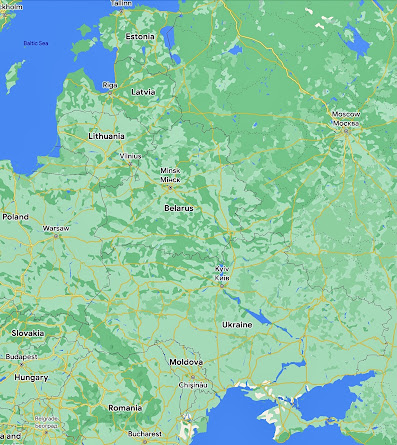
Other nations besides Ukraine are uncomfortably physically close to these events. NATO seems to have a new sense of common purpose, though it’s hard to predict how long it will last, and whether the next election cycles will change the postures of its core member states. But the most zealous members of NATO today are the relatively recent members from Eastern Europe—especially Poland and the Baltic States—who have eight centuries of experience in dealing with Moscow and who share a border with Russia. They have no illusions about the ex-KGB agent who currently occupies the bizarre throne of the New Muscovite-Russian-wannabe-Empire. And they are smart enough to realize that there is no "instant democracy" waiting to spring into existence in Russia if (when?) Tsar Vladimir is overthrown. If Putin has viable rivals, they are rivals to the throne. They will not change the trajectory of current Russian ambitions, and they may be even more ideological and more reckless.

Poland, Latvia, Lithuania, and Estonia already feel the heat from the breath of a monstrous emerging “world war.” They are not the only ones.

Nobody sees where it all might end. It would be cynical to claim that the military-industrial complex—always a reliable engine for economic stimulus in a country like the United States—might not mind a long and aimless war that enables them to manufacture weapons and make gobs of money from a government that always seems to have plenty on hand for such “necessities.” Where the government gets that money is a question that probably has answers too obtuse for it to explain to “us [we] the people.” Meanwhile, Russia might also be planning to outlast its opponents in a long stalemate… while continuing to say that they want to negotiate peace on their terms. We have already noted that their terms are less than ideal, but in reality the issues are much deeper than they are willing to admit.

Russia claims that it wants to be a regional power in a multipolar world; it wants to be “the center” of a wider realm that it envisions as its historic patrimony and responsibility (never mind that Russia’s “special military operation” to “liberate” Ukraine, or parts of Ukraine, has been carried out in an outrageously irresponsible manner). Neither history nor the present international situation, however, support Russia’s ambitions. Whatever may be the sins and machinations and schemes of powerful forces from the West, they do not warrant Russia indulging in a fresh grasp for power, particularly in the very places that have suffered under the iron grip of a prior Kremlin government until a little more than 30 years ago—a government that has never been held accountable for heinous crimes against the peoples it now wants to rule again.

Russia has a very particular problem. Moscow has a problem. The Kremlin has a problem. In the days when he was still facing down the monolithic Soviet Union, the great Alexander Solzhenitsyn saw the problem clearly (when he returned to post-Soviet Russia in the 1990s, he became somewhat confused [they were exceptionally confusing times for Russia]—but it was as a dissident, against the Soviet Union and then in his critique of the decadent West, that Solzhenitsyn attained his historic stature). In 1973, Solzhenitsyn declared that the Russia he loved—which was then the heart of a decrepit-but-still-grasping Soviet Communist MegaState—needed to renounce power. Russia needed to be healed before it returned to the global stage. It needed, as a nation, to pass through a period of "repentance and self-limitation," a looking-inward to discover and foster its constructive identity.

Repentance. Has anybody noticed that there has been no repentance for the crimes of the Soviet Union in the twentieth century? There are many reasons why the current world order is skewed, but it's worth noting that our international institutions are still based on the outcome of the Second World War. Our current agreements about international law, human rights, treaty-obligations, disaster relief, and a host of other cooperative efforts were born directly from the Grand Alliance of 1941-1945 that defeated Nazi totalitarianism and Imperial Japanese militarism, and then put on trial people who were perpetrators and collaborators in the immense violence carried out by these regimes. The intention was that people were going to be held accountable for war crimes and crimes against humanity. Even during the war, this alliance took to calling itself "The United Nations," and the institution that bears the same name today is an extension of what was born at that time.

One of these allies, however, was Stalin’s Soviet Union. Stalin was guilty of crimes against humanity on a scale approaching the level of Hitler. In 1932, he presided over an attempted genocide-by-forced-famine against the very people of Ukraine who today must once again fight for their right to exist. Stalin’s predecessors and successors perpetrated vast crimes as well, running a regime that ideologically subordinated the dignity of the human person and the real aspirations of communities and peoples to the pretenses of a totalitarian state. Russia was at the center of this state. We all now know the abhorrent truth about the Soviet Union. Yet Putin and his collaborators—having exchanged Soviet uniforms for Russian uniforms— play on their own people’s nostalgia for hegemonic power.

I don’t want Russia to be destroyed. I love Russia. Russia has its own deep human and Christian experience to share with the whole world. Russia has a mission in history. But the road ahead for the Russian people passes through penance and self-limitation, simplicity, love for the expansive lands already entrusted to them, and a humility in which they will find their real strength. Included in this is harmony and respect for their brother Slavic nations and the rest of the world. In these ways Russia will endure, even as the present world powers spend their energies on things that pass away.

But Russia will face catastrophe if its people choose to imitate the inhumanity of Stalin, thinking it might save them from the nihilism that surrounds them or the anxiety that feeds on their fears of irrelevance. If the present war becomes an extended global conflict or even a new “Cold War,” Russia will not be one of the powers that leads it. If Russia does not embrace a humble path, it will find itself humiliated by its new “limitless partner” to the south. If China props up Russia, it will do so on its own terms, as a mine for resources, a superhighway for its trade ambitions, and a passage to the new open ocean in the Arctic north.

The future can’t be predicted in detail, but in general it must grapple with the tensions and the unraveling of problems set in place by the past. I will have more reflections on this point and its relation to current-day events in another post coming soon. Stay tuned for that.