From the perspective of 2022, it goes without saying that hopes that the Armistice of November 11 was “the end of all wars” were naive. A century of wars was approaching—wars on a scale beyond anything people could have imagined. The Armistice was merely a temporary pause… and even in this respect it was only a pause for some.
For others it corresponded to the beginning (or the escalation) of further sufferings under the power of revolution and dictatorship, leading to decades of oppression, persecution, genocide. Fires were still blazing. Fire in the minds of men burned new ideologies to shape their ambitions to master the world—ideologies that aimed to remake humanity by imposing huge, unprecedented, all-pervasive schemes of social reorganization on vast numbers of the human population. Disconnected from real human experience, these ideologies preyed upon the uprootedness, instability, and disillusionment that arose out the the ashes of the Great War and its consequences.
Two forces emerged, both clothed in the mantle of Science: one was a pseudoscientific theory for constructing a new social hierarchy based on a bizarre system of racism meticulously set forth in shamelessly fabricated biological terms. The other was a pseudoscientific theory of radical “social equality” (which, in fact, sought to impose a program of comprehensive personal and collective slavery) based on the supposedly necessary historical dynamic of “dialectical materialism.” From the midst of the flames of these ideologies emerged two of the most violent dictators in the history of the world—two “monsters” in possession of gigantic power, megalomania, ruthlessness, and destructive genius.
Ideological fire soon ignited the fires of fresh conflict—at first, the master of the pagan racist state and his allies seemed to pour over the world, destroying millions of lives and committing genocide against a people beloved of God. To defeat this monster, the nations chose to make an alliance with the other monster, the fierce and cunning ruler of the dialectical materialist slave empire. Terrible technological tools brought unprecedented horrors, with not only military but civilian deaths on a cataclysmic scale. The nations negotiated with their monster ally, and the monster made promises and assurances and declarations, but they were all lies. Instead, he took over much of the territory lost by the first monster, and continued to foster “revolutions” all over the world.
After what has been called “World War II” (with Roman numerals), the world became in fact more divided and dangerous than ever. The human race, it seemed, placed its trust in the ever more horrific weapons it continued to develop. In “The Cold War,” the superpowers “deterred” one another from using stockpiles of quasi-apocalyptic thermonuclear weapons only through the “devil’s bargain” of Mutually Assured Destruction, in which the price of global stability was to hold vast populations of innocent civilians “hostage” to the threat of indiscriminate annihilation. Meanwhile, “hot wars” raged everywhere, fought with all kinds of smaller but still devastating weapons that were bought and sold all over the world.

Not surprisingly, historical (or pseudo-historical) claims are reasserted in many places, with their gods of blood, clan, tribe, and territory pitted against the power-worshipers of the dominant technocracy. Old and new hegemonies are grasping for “spheres of influence” as the latest project of “world (dis)order” has failed to deliver on its false promises, and continues to pillage the earth to serve the wealth and self-indulgence of its elites while stranding the multitudes in deserts of alienation.
And now, 104 years after Armistice Day, the truce stands broken again in Europe for the past nine months, as artillery blazes, guns fire, and bombs fall against a nation that has already endured so much of the terror of the past century.
We live in more than the shadow of “the Great War.” We are, in a certain sense, still fighting it. If we do not turn to God, we will never find peace.
The poppies are red in remembrance of people long dead, but also with fresh blood.

Christina was a pioneering YouTube artist for several years before her magnificent run in 2014 on North American mainstream television, making the finals of Season 6 of The Voice. She called her followers “Team Grimmie” and referred to them as “frands” (combining the words “fan” and “friend”). She loved her frands, truly, in a way that is hard to describe. It was an expansive love, a love without calculation, a gratitude for anyone and everyone who listened to her music.
She was a “regular girl” in so many ways, but with an extraordinary talent and a great heart. She gave and received love with a confidence that was willing to take risks, to reach out to strangers, to be radically vulnerable. And Christina would not want us to regard her brief life as merely a tragedy, because—as she professed humbly but unambiguously in moments that called for it—her whole life and everything in it belonged to Jesus Christ, and she lived everything for His glory.
Why does her faith and following of Christ make a difference here? From every natural human perspective and consideration, her death was a crime and a catastrophe, a cause of awful grief, a manifestation of the relentless violence that permeates our society and has only grown more open and brazen since her death. All of this is true, but it is not the final word on the meaning and value of Christina’s life.
Christina saw everything within the embrace of her belonging to Jesus, and in this light we can glimpse the beauty and the “heroism” of her love for her frands, and the passion with which she gave of herself in her music, hoping to inspire others, always expanding the reach of her love, and persevering in that love all the way to the end.

Then we set the clocks back this past weekend. On Monday the thermometer nearly reached 80! Balmy breezes, bare branches, colorful leaves, a few flowers, and sunset at 5:00 PM? What’s going on? Did the earth tilt in a different direction? This is planet earth, right?
Seriously it was a beautiful day to say “goodbye” to warmer weather. Even the flowers are perplexed, and in a few places they bloomed and competed with the leaves for attention. (See below.)
Alas, things will be set right soon enough. Frost is on the way.


Here we can see the possibilities of an iPhone in late 2022. Enjoy the show(s).

My own parents are now among the faithful departed, a reality that I am aware of every day. They have joined this important and very large group of persons whose bodily life in this world has ended, but who are still vitally "connected" to us in Christ's Body, the Church.
At the same time, I continue to think of, and pray for, all the faithful departed, the people of every race and nation who are being made ready by Christ, through the mystery of mercy that we call Purgatory, to enter into the fullness of God's life, to share His beatitude, to see Him face to face forever in perfect freedom.
How great must be this multitude! Often, we pray for "the souls in Purgatory who have no one to pray for them." I often wonder how many belong to this category because their own faith was a secret work of God's grace while they were on earth. I think of the five billion people in this world who are not Christians in any visible sense, the billions of people, adherents of the religions of the world, vast civilizations of people past and present who have a heritage rich in so many ways but lacking an explicit place for the Gospel as proclaimed and lived.
I believe that Jesus Christ is the sole mediator of salvation. Yet billions of people live their whole lives without ever hearing His name or having any real knowledge of who He is. Countless others know something about Him, but are confused by all sorts of images and ideas of what He represents, or have not had the opportunity (at least, not yet) to encounter His love for them, the way in which He has come into the world for them, and the fullness of all the ways He wants to give Himself to them.
Of course, Jesus calls His disciples to bear witness to Him in word and deed. We have encountered Him, followed Him, and come to know His love as the overflowing gift of God that “answers” all the longings and questions and perplexities of life, that corresponds to all the need and the searching of the human heart for meaning, for justice, for beauty, for a fulfillment that endures. We have been created to be sharers in God’s life, children of the Father in His Son, brothers and sisters of Jesus, united in the Holy Spirit. Christ’s love sets us free from sin and death, and makes us free to love God and find our happiness in this love. If we have the joy of loving God, then we will want to make Him known and loved by everyone. Every human person has the “right” to know the saving and transforming love that Jesus has for them particularly and personally, to know the whole scope of God’s plan in taking flesh, dwelling among us, dying and rising for us, staying with us. Christianity is missionary by its very nature, because Jesus belongs to everyone, and everyone is called to realize the truth of their humanity and their personality through a relationship with Him.

People who do not know about Jesus Christ are still loved immensely by God, and we can be sure that they are led by His grace. If they search for Him and follow what their conscience shows them to be His will, He leads them (in mysterious ways) to say "yes" to the Person of Christ who is present in their lives, and thus they can be saved by Christ and joined to the Church even if they have never heard of either. This must also be true of people who have "heard" of Christ and the Church, but do not understand them properly through no fault of their own.
Jesus, by becoming man, has united Himself in a certain way with every human being. The secret drama of every person's real life is their decision to say "yes" or "no" to Jesus Christ as He makes Himself present in their circumstances. Since Christ’s coming, there have been many people who have never heard of Him, but they have sought God's will, and have sought through the knowledge that was available to them to do what they thought God wanted of them. They love the good, and in that love God's grace is at work so that they can somehow encounter and accept the person of Christ through love even if they do not know His name.
If a person truly wants "God's will," then they want Christ even if they don't know it, because Christ is God's will, and Christ places that desire in them. Jesus Christ is what every human person is searching for. And so all those who truly search for the Mystery of life, and beg for that Mystery, will be led in a vital way to God's revelation of that Mystery: Jesus Himself. Thus, many who do not know "about" Jesus in a way that they can express or articulate, can still say "yes" to Jesus in their lives through love, through fidelity to the grace that God gives them, and through mysterious ways that we don't understand.
There are various theological theories about how this can happen, and I am not proposing any of them here. Nor am I saying that someone who recognizes the truth about Christ and the Church can reject it in favor of some other path that he or she prefers. If I am truly searching for the One who loves me, and then He shows Himself to me in Person and reveals His Name, how can I not accept Him, let myself be embraced by Him, and embrace Him in return? If fear or my own preferences were to prevail at this point, it would mean the failure of my search rather than its fulfilment.
What I want to point out is the simple fact that God’s grace is central to the life of every human person, and it has ways of working even in those whose connection to the Church cannot be seen by us. These countless multitudes of people, living and dying with Christ along obscure roads in this life, have now come to a full communion with His Church and a special fellowship with us, either in heavenly glory or in the purifying experience of Purgatory. How much these vast multitudes of unknown Holy Souls need our prayers! To help them is a special sharing of fraternal love and a beautiful work of mercy.


I apologize for the shaky quality of this video, but I hope that you will persist in watching, or at least listening to it. With this we say “goodbye” to October 2022.🍂🍁🍃
Today’s Gospel reading about Zacchaeus the tax collector reminded me of an article I wrote on his conversion in my column in Magnificat, published in January 2016. It is a story that vividly displays the gratuitous and transforming power of the encounter with Jesus Christ.


The origin of this portrait is a small and very grainy photograph. It was crafted with a variety of digital graphics tools, plus detailed work by hand. It preserves the original “red tinge” of the photo.
Chiara Badano was considered “the prettiest girl in town.” She was modest but not frumpy. She had a boyfriend at one point, and experienced heartbreak. She had trouble with math in school. She was an avid tennis player. She liked popular music (including Bruce Springsteen). She was a girl of her time, and a girl of deep faith. That faith grew immensely during her nearly two years of suffering from osteosarcoma, until her death three weeks short of her 19th birthday on October 7, 1990.
"I offer everything, my failures, my pains and joys to Him, starting again every time the Cross makes me feel all its weight. The important thing is to do God’s will. I might have had plans about myself but God came up with this. The sickness came to me at the right time... [and] now I feel like I am wrapped into a wonderful design that is slowly unfolding itself to me…. What a free and immense gift life is and how important it is to live every instant in the fullness of God. I feel so little and the road ahead is so arduous that I often feel overwhelmed with pain! But that’s the Spouse coming to meet me. Yes, I repeat it: 'If you want it Jesus, so do I'" (Blessed Chiara Luce Badano).

Chiara still needs her second “officially approved miracle” for canonization, although I wouldn’t hesitate to ask her prayers for anything, even little things (especially “little things”).


JJ Studios presents: “Impressionistic Autumn Scenes” by JJ (digital art from original photos, October 2022). 1 & 2.


The world learned that night, through the medium of television, that a confrontation between the two nuclear superpowers had reached the brink of World War III.
The Soviets insisted that their only interest was to defend Fidel Castro’s newly Communist Cuba from “imperialist invasion” by the United States. But this buildup was clearly beyond anything Cuba might have needed for its defense. It was a provocation, perhaps a gamble, by Soviet Premier Nikita Khrushchev to maximize the benefits of the U.S.S.R.'s presence in the Western Hemisphere. It was an attempt to gain an advantage in the weird standoff of the Cold War. One particular outstanding issue pertained to the Soviet leader’s frustration over the lack of a treaty between East and West Germany, and the consequent presence of "West Berlin" as an outpost of the NATO alliance in the midst of the Eastern Bloc. Perhaps Khrushchev was hoping that a military confrontation over Cuba could provide a pretext for seizing West Berlin by force.
But this would only have been one motive within a larger context that continues (at least in the background) to frame all consideration of warfare since 1945. The invention of "nuclear weapons" placed a whole new level of power — power that harnessed the energy of the core foundations of the material world as modern science understood it — into the hands of human beings, who could now choose to unleash its immense destructive capacities in warfare. The U.S.A. had already demonstrated the monstrous power of atomic bombs against Japan at the end of World War II. The ensuing generation saw the development of the much more powerful hydrogen bomb, and its voluminous proliferation in both the United States and the Soviet Union.
A strange paradox surrounded these weapons. They were so vastly, indiscriminately, and unpredictably destructive that the use of them in warfare, for any reason, seemed to be unthinkable. We might choose to unleash their power to serve our aims, but once unleashed, how could we hope to control it? Who could predict the physical and psychological effects that human beings would undergo during or after the unprecedented event of a multi-pronged thermonuclear attack? What manner of economic chaos and social disorder would remain for the survivors (assuming there would be any)? The short, medium, and long term impacts on whole human societies, countless millions of people, and the consequences for regional and global environmental health were beyond imagining.
Humans apparently saw the need to avoid ever using nuclear weapons. But how could we be sure that such a catastrophe could be avoided? This was a particularly poignant question for the U.S.A. and its allies, nations that at least in principle were politically free, open, and transparent in the way they were governed. The Free World advocated these political and social standards as the ideal, even if the realities of politics and statesmanship constantly failed to measure up to them. No such ideals hindered Soviet Communism; rather, it held as a creedal principle that political ends justified every means, including all manner of lying and deception. The post-World-War-II world, indeed, revealed that allied countries had been excessively credulous in their expectations of Stalin’s “honor” and their confidence in his promises. It seemed clear that trust was not a viable foundation for security in the atomic age. What options remained?

Ultimately this became a kind of "pact" that "kept the peace" during the years I grew up; or, at least, it kept peace between the U.S. dominated "First World" and Soviet Communism, while Third World populations endured dictatorships, revolutions, and proxy wars (in a wide variety of local circumstances we have scarcely begun to understand). It was called “Mutually Assured Destruction” (aptly abbreviated as “M.A.D.”). Somehow, this strategy became acceptable (or at least tolerable) to political leaders, even though it bound them up with maintaining, as at least a threat, the possibility of inflicting enormous, disproportionate, indiscriminate violence and destruction upon entire nations and their populations.
It was a harsh paradox: our world spoke in terms of becoming more united in peace, freedom, and understanding — while also generating escalation scenarios for total war and spending gigantic sums of money to stockpile weapons that were capable of destroying the human race. It was ultimately an implausible paradox, and in trying to stretch themselves to reconcile themselves to it, free nations became further alienated from the Christian humanism they still claimed (however vaguely) as their heritage.
In his speech that night, President Kennedy laid the foundations for the difficult exchanges between American and Soviet regimes over the next terrifying week. This led to the eventual Russian withdrawal of the nuclear missile bases from Cuba, gaining for a time a measure of “security” against the possibility of cataclysmic war. But the hidden cost was high, in terms of a hardening of the U.S.A.’s political willingness to “wager” on the immediate safety of millions of innocent human lives.
The apparent insufficiency of the “quarantine” in the days that followed very nearly led to a full scale invasion of Cuba by American forces. U.S. intelligence at the time, however, was deficient regarding the Russian military equipment already in place. Only after the fall of the Soviet Union 30 years later did the world learn that by October 1962 Cuba was already armed with smaller “tactical nuclear weapons” designed to be used in battlefield conditions. These weapons were more “limited” but still horrendous in their destructive capacities. The Cubans (and, therefore, the Russians) were prepared to “cross the nuclear threshold” to push back American forces invading Cuba. This could have triggered the protocols of “Mutually Assured Destruction,” bringing about an escalation of retaliative nuclear strikes that would have had its own bizarre logic. Both the U.S.A. and the U.S.S.R. had their larger (“strategic”) nuclear weapons aimed at major population centers filled with millions of innocent civilians who might die in a nuclear attack without even knowing that their country had entered a war. And the escalation would have continued…
In any case, the targeting of American strategic nuclear weapons toward the indiscriminate destruction of civilian population centers required President Kennedy to press the threat “to retaliate” to any nuclear attack initiated by the Russians. The U.S.A. in effect held the civilian population of the Soviet Union “hostage” in order to dissuade the Soviet Union from attacking American civilian populations (and vice versa). It was intrinsic to nuclear deterrence to put millions of non-belligerent civilians in danger of death, and in a crisis this danger had to be presented as a threat (in atomic new-speak terms, “a full retaliatory response”). Kennedy was a man of noble sentiments who aspired to do good, and who was personally appalled by the brutal “requirements” of this crisis. Yet he saw no way to escape the evils entailed except through cowardice. And he refused to stoop to cowardice, or subject his nation to what he could only perceive as a humiliating and dangerous appeasement. Thus, he endeavored to present the available options for this desperate crisis in noble terms (a nobility which means very little to today’s political discourse). But ultimately it was the tragic nobility, born of an atrophying society that was drifting far from the resources of its original inspiration in the Gospel’s testimony to the love of God and the dignity of every human person.
Sixty years later, we still drift - as we face new kinds of war and old threats of nuclear weapons - we drift in desperation, not knowing where our politicians want to take us (or why); or we drift like beggars in search of a renewed evangelical inspiration, a renewed wisdom in which we might find the courage and compassion to affirm the transcendence of human freedom, and to discover new ways of reconfiguring vast and potentially destructive material power into the energy of service to human persons, relationships, and communities.
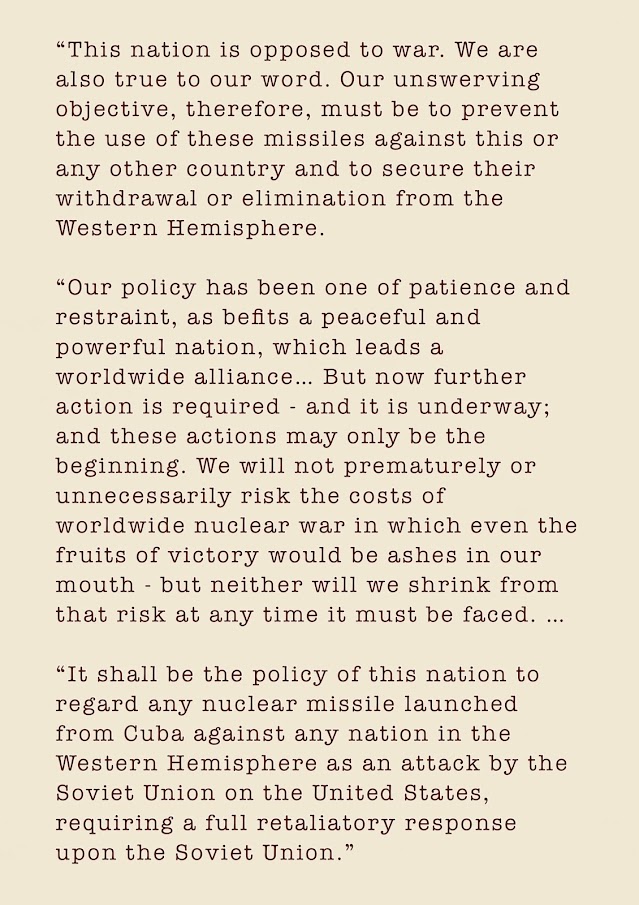
Words from JFK’s televised speech of October 22, 1962:


Today is the feast of Saint Luke the Evangelist and companion of Saint Paul during some of his missionary journeys. Luke is the author of both the Gospel of Luke and the Acts of the Apostles. Iconography in the Western Church identifies Luke with an ox (often even with wings).
This symbolism is based on the association of the four gospel writers with the “four living creatures” featured in the great visions of the Divine presence recounted in Ezekiel 1 and Revelation 4. In both visions, the “living creatures” have faces of a man, a lion, an ox, and an eagle. As early as Saint Irenaeus (second century) these faces were declared to be symbols of the evangelists. In the fourth century, Saint Jerome identified the “standard” references that are found in iconography and other sacred art thereafter: Matthew is the “man,” Mark is the “lion,” Luke is the “ox,” and John is the “eagle.” A variety of explanations are given in the accompanying homiletic tradition. It’s interesting to note the manner in which the four living creatures together have a cosmic significance, representing birds, wild and domesticated animals, and the human being (a “summary” of the whole animal creation). In the visions of both Ezekiel and John, they are extraordinary beings, with wings indicating the cherubim. Symbolically, the Evangelists can be associated with these heavenly images because they serve as Divinely inspired witnesses to the glory of God revealed in the life, death, and resurrection of Jesus Christ.
Why is Luke the ox? The general interpretation was that the ox is one of the animals of sacrifice, and Luke’s Gospel emphasizes Christ’s atonement sacrifice. Also, his Gospel begins (1:9) in the temple, where Zechariah the father of John the Baptist is serving as priest. It also ends in the temple (24:53), where the disciples gather to praise God after Jesus’s Ascension.
These associations may seem “forced” to us, but the ancient Church had a rich awareness of the interrelationship of symbolism throughout the Scriptures and indeed all of creation, where everything pointed toward the centrality of the Word Incarnate (typology expresses this most precisely in the Bible, but the typological “style” extend the imagination to an overall allegorical vision of the whole universe). This is grounded in the sense that God “made himself at home” at the center of his creation, dwelling with humans in our history and in the midst of our ordinary (even impoverished) circumstances, as Saint Luke makes clear when he tells us that the Lord was born in a stable, where Mary “wrapped him in swaddling clothes and laid him in a manger, because there was no room for them in the inn” (Luke 2:7).
Perhaps near that manger there was an ox… an ordinary ox on earth who for one night was in the presence of the definitive revelation of the Glory of God, dwelling with us as a newborn child, resting on the animals’ hay.
The images here are from medieval illuminated manuscripts, where Luke is either represented by the ox or is portrayed together with the ox.


Giussani grasped the dramatic character of human life, and the apparent “paradox” of human freedom: “Freedom is dependence upon God. It is a paradox, but it is absolutely clear. The human being – the concrete human person, me, you – once we were not, now we are, and tomorrow will no longer be: thus we depend. And either we depend upon the flux of our material antecedents, and are consequently slaves of the powers that be, or we depend upon What lies at the origin of the movement of all things, beyond them, which is to say, God.”
Pope Francis indicated the heart of Giussani’s charism in his words during the event in Rome where tens of thousands of the people of CL from all over the world gathered to commemorate his centennial:
“Father Giussani was certainly a man of great personal charisma, capable of attracting thousands of young people and touching their hearts. We can ask ourselves: where did his charism come from? It came from something he had lived in the first person: as a boy, at only fifteen, he had been struck by the discovery of the mystery of Christ. He had guessed - not only with the mind but with the heart - that Christ is the unifying center of all reality, he is the answer to all human questions, he is the realization of every desire for happiness, for good, for love, for eternity present in the human heart. The amazement and charm of this first encounter with Christ never abandoned him.
“As the then Cardinal Ratzinger said to his funeral: ‘Don Giussani has always fixed the gaze of his life and his heart towards Christ. He understood in this way that Christianity is not an intellectual system, a package of dogmas, a moralism, but that Christianity is an encounter; a love story; it is an event.' Here lies the root of his charisma. Don Giussani attracted, convinced, converted hearts because he transmitted to others what he brought within after that fundamental experience of his: the passion for man and the passion for Christ as a fulfillment of man. Many young people have followed him because… what he said came from his experience and his heart, so he inspired trust, sympathy and interest.”
~Pope Francis (at meeting with CL movement, October 15, 2022)
We’re having (mostly) beautiful weather this week. The green is still mostly green, though you can “feel” the changes starting to happen. (Our house is behind all those leaves in the first picture.🌳 In less than two months all those branches will be bare!❄️)
The red we see right now is from some lovely roses on the “repeat blooming” rose bushes in the neighborhood. Eventually we’ll see the bright red maple leaves.