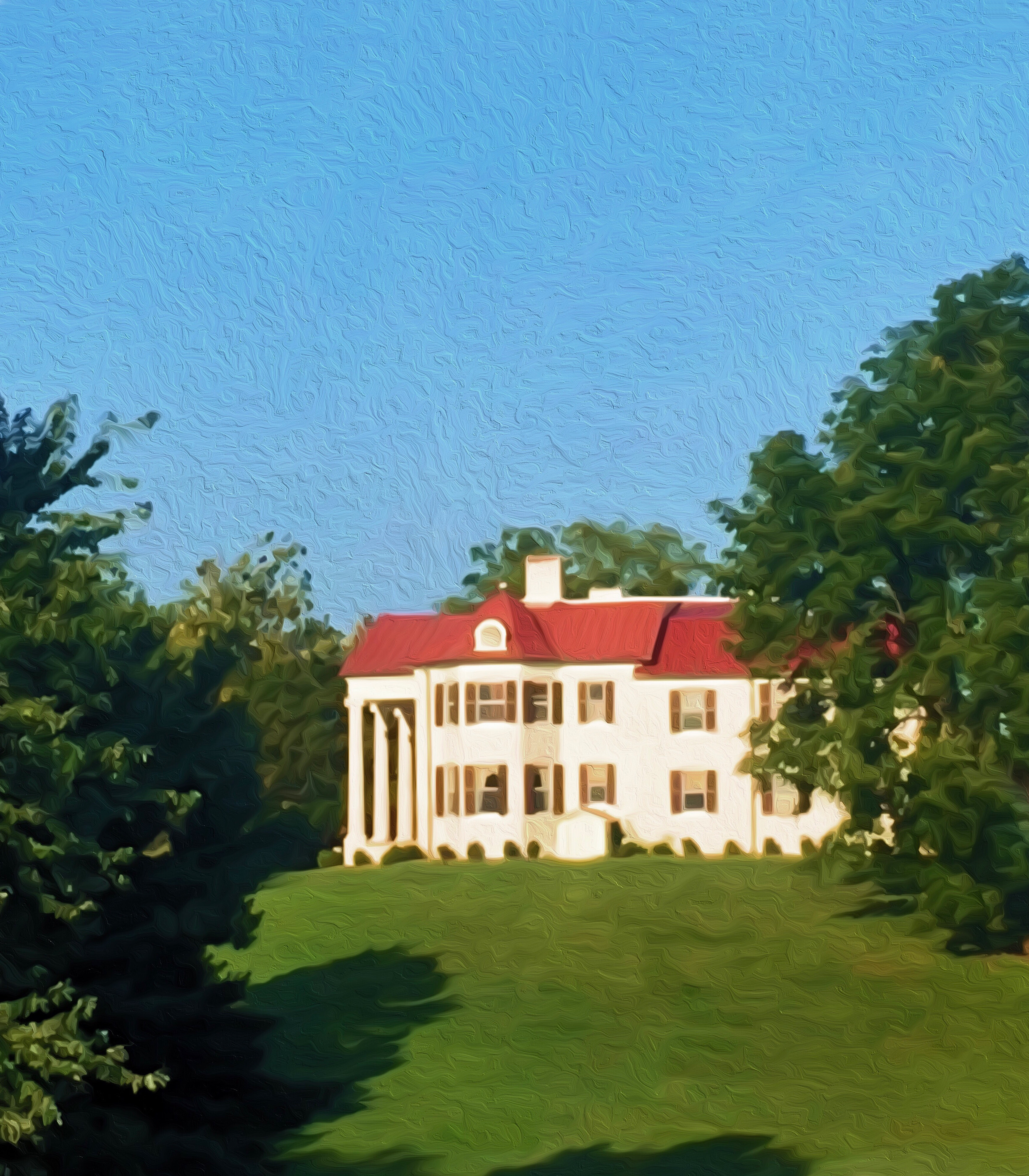
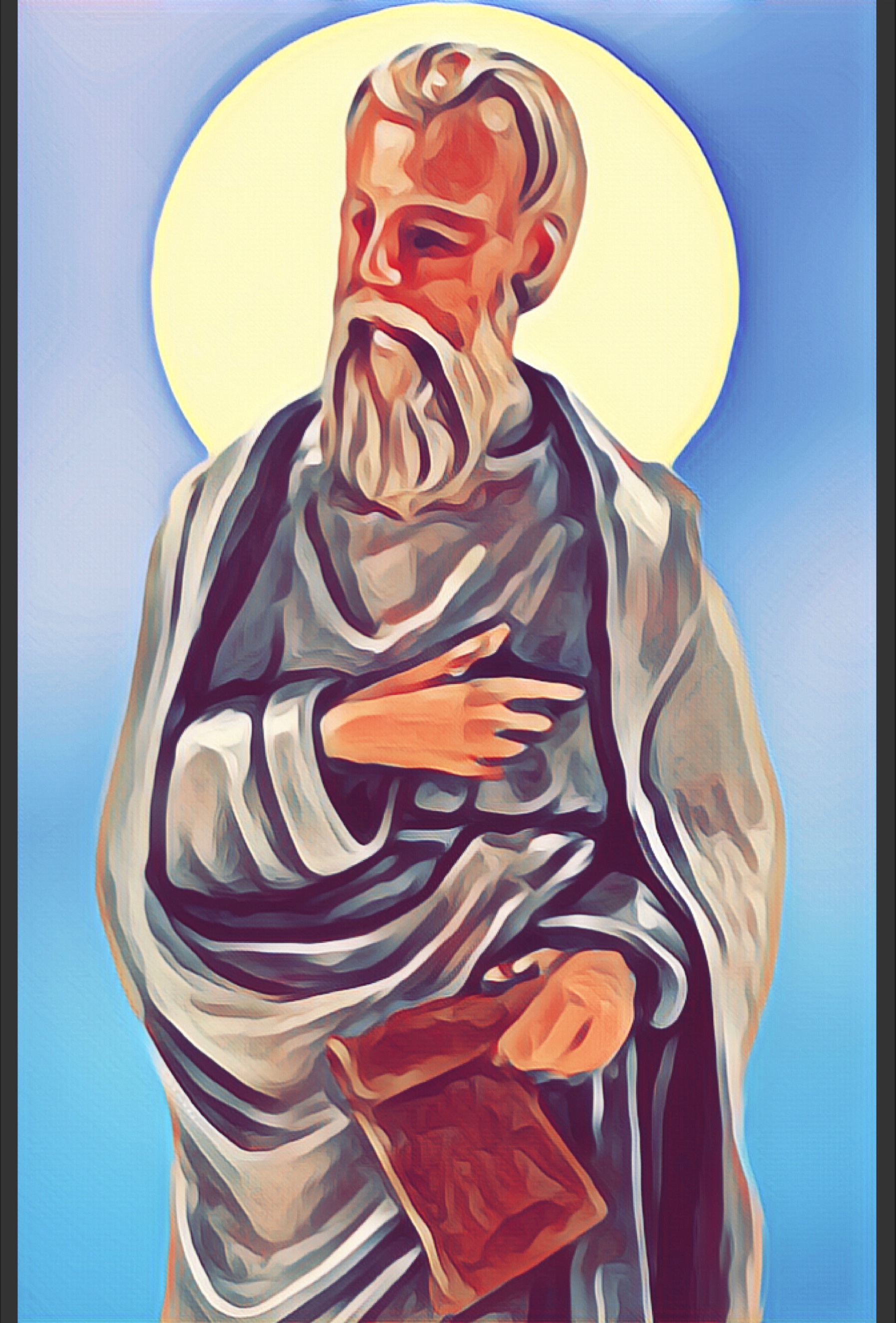
Music is a big part of my life. Up to around the age of 20, music was a potential career path. I was classically trained in cello with a private tutor and played in various orchestras and ensembles beginning at the age of 9 (see cartoon of JJ as a young man, playing the cello). A bit later, I taught myself to play guitar and bass, and I played in a rock band (a loud rock band) as well as a jazz orchestra and a dance ensemble. I played gigs with them, and even toured a little bit.
I also "wrote" (composed and played from memory) a series of original instrumental pieces for nylon-stringed "classical guitar." They were carefully crafted, and widely appreciated by those who heard them. I performed them many times in public during my college years, but always "by memory." Though I am fluent in reading and writing standard music notation for piano, cello, and orchestral instruments, I never learned how to play from sheet music for guitar. I knew the names of some chords, but otherwise I played guitar entirely by ear. I'm not even good with a chord chart.
Therefore, I never wrote down any of these somewhat complicated instrumental pieces, thinking - as young people do - that I would "always" remember how to play them. But a lot of life has come since them and taken me in different directions, and - though I haven't entirely abandoned my guitar - I no longer remember how to play any of my old songs.
Actually, I did make some provision for preserving my music way back in the early 1980s. At some point - somewhere in the neighborhood of 40 years ago - I recorded many (perhaps all) of these guitar pieces on a cassette tape (that was the only sort of productive media we had in those days). If I could listen to the recording of these songs, I probably would remember (or relearn) how to play them, although my hands are not as agile as they used to be. But I could remember them, at least. That would be great. The only problem is that (of course!) I don't know where the tape is.
I did try written music composition as well (with music sheets, a pen, and a piano to guide the musical notes) but not much ever came of that. And where is that sheet music today? Who knows!
I had some talent. Music could have been my life's work, but when I came to that proverbial "fork in the road" I chose the intellectual path, while keeping my creativity alive by writing poetry. (I have a substantial collection of poetry written over the course of more than thirty years; most of it is decidedly third rate, but there may be a few pieces worth passing along.) Pictorial arts were part of my childhood, and I have taken them up again using digital tools, along with photography, in recent years. Here I am still experimenting.
I am rusty with playing my instruments, but I still
love music and have not forgotten my education. I love
all kinds of music (which is
not to say that I think all forms of music are on the same level). Music, fundamentally, is the crafting and arrangement of
sounds so that they express an artist's creative intuition in an original, structured, interconnected sonic form. Sound is a mysterious thing. It has its own intrinsic proportions that are rooted in mathematics; the artist usually chooses to build upon these proportions. They are free to choose apparent dissonance in their work, but they better know what they are doing. It's always possible to construct more complex forms and open up new perceptions of beauty. But since music is communicative - since it presupposes the relationship with the
listener - it is appropriate that it be accessible to others (unless, of course, a composer is simply "playing with sound" for himself). Thus, music tends to emerge from traditions and styles, which musical artists take up as part of the "material" of their craft, which they reproduce or perhaps develop by marking it with their own original perception and skill.
But enough theory.
I still play my guitar, but it has been a long time since I have picked up my cello (yes, I do own a full-size cello, still in good condition, which might be the most expensive thing my parents ever bought for me when I was a kid). I am very much aware that "making music" (composing, recording, and even writing notes on paper) has ridden the new wave of technological explosion in media just like so many other things. As high school students, my friends and I used to pour over the pages of music store catalogues and discuss, admire, and dream about all the sophisticated (and usually big) gear that we would never be able to buy.
I had a second-hand electric guitar (an Ibanez Les Paul copy, pretty nice for a copy) and a second-hand (awful!) steel string acoustic guitar. I also had a second-hand amplifier that was huge. Today you can buy these little things that practically play the music for you, but my old amp could only do one thing, amplify. It did that very well and very loudly. I had a second-hand fuzz box and a second-hand wah-wah pedal, along with several tape recorders that by today's standards were poor quality (there weren't much even by 1980 standards). I paid for this stuff with money from a part-time job washing dishes in a local restaurant.
I was serious about my guitar playing; and I continued to improve my playing through college. Acquiring a classical (nylon string) guitar took my music in new directions. Meanwhile, I still had my very nice cello. I played the cello consistently through the days and weeks, the months and years of my life between the ages of 9 and 18. I was mostly an ensemble player, and I loved it. All through this time there were orchestras to play in (schools, community centers, even the "junior" city orchestra). But university shifted me into a different environment, with other opportunities. Meanwhile, I began to pursue seriously the academic life.
Music took a back seat, but it never disappeared entirely. In my teaching years, I acquired various instruments, but played them very seldom. When the kids reached a certain age, I passed many of them along to them. By the time I took up my "Media Studies Project" in earnest, the tech revolution was shifting into high gear. There were music programs (and, later, apps) like "Garage Band" that provided you with your own "studio" and all the instrumental sounds you had ever heard (and some that you hadn't heard). On the internet there was YouTube, of course, for everything, but more specifically for music there was SoundCloud and Bandcamp. Musicians were collaborating "remotely." We never saw these things coming forty years ago. Kids (including mine) took up these new modes of expression, but they all seemed too complicated to me. All these options, sheesh it's overwhelming!
The world in general has become a blizzard of easily accessible choices that can make our lives swell up and explode. Possibilities are good, but people also need criteria for focusing, so that they can commit themselves to certain possibilities and work for their realization. Otherwise, we are paralyzed by all the options. Perhaps we might turn into distracted observers, skimming over the surface of reality, overstretched by too much stuff - none of which we love in a meaningful way - and becoming jaded and cynical as time moves on.
It's very hard to be a young person in today's affluent world. No wonder people are so confused about "who they are." When "freedom" is defined as "having unlimited possibilities," how can freedom ever commit itself to love? Can freedom choose persons and tasks in such a way that freedom focuses us, that it secures decisions as commitments, not only in the face of external threats, but also as an anchor against the winds and waves of our own whims, urges, distractions, and emotional states which are shifting all the time inside us? Instead, people are told that they should commit themselves solely to "keeping-their-options-open" so that they will always be open to "the next new thing." For young people, this might seem alluring, because they haven't yet discovered that they can't construct their own material infinity that will guarantee that the energy of their still-newly-emerging desires can keep running on its own strength, without growing. The thrill of the search makes us never really want to find anything. Thus, we don't find anything.
The media explosion certainly feeds on this (lack of) dynamic. As in so many other facets of life, it becomes more chaotic as we become diminished; but it ensures that we keep buying stuff even as we become more and more exhausted by everything.
But if we have encountered the meaning of life, or at least if we are searching for it in earnest, then we do have criteria that focus us. We have commitments and relationships that focus us. If we remember the meaning of things in this world, we can take them up in constructive ways. We may get distracted, lost for a bit, forgetful, stupid. We may even wipe out. But we can find our way back, we can be drawn back; indeed, we have others who are looking for us. We don't need to do things alone.
Speaking of "distraction," I'm getting too broad (and too long) with this post, and I want to wrap up the "arts and music" topic that I hope to visit more often in this blog in the future. People have seen plenty of what I'm trying to do artistically with digital graphics. I have begun a project to once again write music using musical notation. I'm looking at a very simple beginning here: drawing out some melodic themes for solo cello (that are within my range of competence). There are some apps that allow you to use limited functions that are nevertheless very helpful for bringing together and storing needed materials in one compact "space" (i.e., the size of an iPad). That's something I can use.
I had forgotten how much I really love composing music, letting melodies and sonic frameworks take shape and develop.
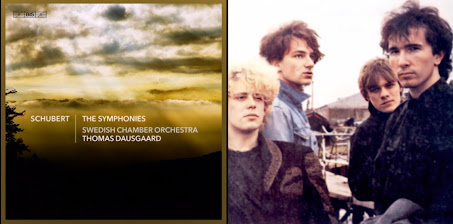
And, of course, I am listening to plenty of music. Sometimes I find new music, but generally I don't wander too far from the eclectic (many people might say "enormous and strange") constellation of styles I appreciate. Right now, I will comment on two of the things I've been listening to lately. First, there is a new recording of the Symphonies of Franz Schubert. The pared-down sound of a chamber orchestra probably gives us a more authentic rendering of the composer's original early-19th-century idea. Recall that Schubert was a younger contemporary of Beethoven. He died at the age of 31, only one year after Beethoven whose music had such a powerful influence on him (and everyone else who came after).
Schubert composed an enormous amount of music, and his talent was recognized during his lifetime, though he came to be appreciated as one of the "greats" only some years after his death. I always gravitate toward Symphonies, and the last two of Schubert's are especially grand. It's common to think that the two movements of the famous B Minor Symphony are a symbol of his tragic early demise (to typhus). The "Unfinished Symphony" is magnificent in what it gives us, and therefore understandably evocative of "what-might-have-been," but we can't let this distract us from its overall grandeur. This Symphony (generally numbered as the 8th) brings Schubert the orchestral composer decisively "out" from behind the long shadows of Beethoven and Mozart. Or, to put it another way, sometimes Schubert seems squeezed between Beethoven and Brahms, but his distinctive lyricism fills this work. It also fills the unusually long and very much "finished" 9th Symphony in C Major. These are the standouts, but I have enjoyed all of them. I find melodies from my childhood in the 3rd, the 5th, and the 6th Symphonies.
The recording pictured above is newly released (and thus it caught my attention). The Swedish Chamber Orchestra presents a consistent and competent rendering of the collection, demonstrating how the varied dynamics of orchestral works from this historical period can be performed and heard vividly and vigorously without requiring the massive orchestras that once dominated symphonic recording. Schubert, especially, deserves this more “intimate” presentation.
So much has been made possible by the tremendous advancement of recording technology in my lifetime. Even in classical music, studio production has begun to “move beyond” the effort to simulate a “live” performance, and has begun (perhaps only subconsciously in this genre) to realize that it contributes, in subtle ways, its own “interpretive artistry” to the recording. A recording is more that a mere “neutral medium” of music; it stands as a particular work-of-art in its own right - a collaboration in creativity that involves many contributing artists in various and diverse ways. On vinyl LPs and digital CDs, it was (and is) still possible to find that long printed list of contributors. I don’t know of anything similar in the streaming format, which is a problem that needs fixing. People appreciate being acknowledged for their work, even if its only in “the small print.” In any case, “bravissimi” to everyone who contributed to this lovely Schubert recorded presentation.
I have paired with the Schubert recording, in the picture above, something very... different. During my time in high school, there was something in music called "New Wave." The implication was that it was the latest "wave" from the U.K., but these Irish boys and their band got lumped into the category. Do you recognize who they are?
In 2022, there are two, maybe three, generations that take U2 for granted. They've just always been around, it seems. In the past decade, people started to get a little fed up with them (like "Why is this U2 album on my iPhone?" etc. if you even remember that). This is understandable, of course. These guys are, after all, older than me. What we must not forget, however, is how remarkable it is that they have stayed together and stayed creative for so long. What a catalog of innovative recorded music over the course of 3+ decades! I don’t like all of it, but I like a surprising lot of it. My "U2 Faves" playlist on Spotify is huge. But I have been rediscovering the particular quality of their earliest albums, Boy, October, and War. There are hints of the signature sounds to come, of that virtuoso simplicity placed so perfectly by The Edge's guitar, of that expansive dramatic voice that made Bono the best male pop singer in a long time (and one of the best ever). Generally, I prefer the higher ranges of the vocal register in popular music; which means I prefer female vocalists. There are not that many men who can credibly sing "up there," although - thanks to the microphone - "falsetto" is a more accessible vocal technique for some singers. Bono stays mostly within his "natural" range; he doesn't overdo higher notes, but uses them only when nothing else will do.
All in all, the Irish boys were still very young in these early albums. Edge starts a primitive form of rattling and humming in War. Bono's voice is developing into the convincing crooner he will become. In retrospect, early U2 sounds a lot like "New Wave" as I remember it in general. It's also quite good, with thoughtful if at times awkward lyrics. If you remember those days, you won't mind revisiting then. If you don't, you can educate yourself.😉
I didn't like the "New Wave" when it hit North American shores in the late70s/early 80s (I think I appreciate it a lot more today than I did at the time). In those days, I played mostly blues and rock on electric guitar, but the music I listened to was "Prog" - My friends and I particularly appreciated popular music that was way beyond our playing capacities (though I did eventually learn how to play Steve Howe's "Mood for a Day"... and have long forgotten how to play it). It was a special form of appreciation, I think, when you had some understanding of the inspiration, the energy, and the techniques of the music, but could also just be blown away by it, amazed by it. My headphones were full of the music of bands like ELP, Genesis, and Yes. Especially Yes. They had/have a kind of synthesis of rock and classical styles that sometimes goes over the top, but other times really works. By the way, this year marks the 50th anniversary of an album that was one of the definitive achievements of “Prog”: Yes’s epic masterpiece Close to the Edge. I will speak about that anniversary before the year ends. This album was a watershed not only for Prog as a genre, but for the whole future course of electronic recorded music. If you own a cheap electronic keyboard, let me tell you something: many of the colorful sounds that you can make on that keyboard with a simple presetting were laboriously invented by the creative blending of gigantic and unwieldy pieces of analog technology by these English lads fifty years ago. But even more importantly, I single out CttE because the music is beautiful.
Anything else? Well... shifting gears again, I want to shout out to Avril Lavigne, whose birthday was this week. She's 38 now. I
already wrote about [click here] the twentieth anniversary of her terrific debut album
Let Go. Still celebrating that! And I posted this on social media for her birthday, especially because I thought what she did here was fun. This could be called "the Twenty-Year Challenge."

Oh my, this musical journey has taken us from Schubert all the way to "
Na-na-na-na, na-na-na-na, yeah!" The analogous variety and scope of beauty is as diverse as the differences in the universe of being itself: the differences are
not in conflict with one another, but rather in harmony - just as a variety of flowers, shrubs, trees, and plants make up a forest or a garden. The “hierarchy of being” (and beauty) does not negate the
unique qualities of different
beings. There has never been anyone like Schubert. There is definitely no one like Avril.
I have also had a chance to catch up with what Avril is doing these days. She has moved away from the mellow look (and style) of her post-Lyme-Disease recovery album Head Above Water and has revived a different version of her mid 00s "punk-pop" look, complete with lots of leather, black boots, and orange streaks in her hair. She has been touring all over the place for her new album, which is entitled Love Sux. That doesn't sound very "encouraging," neither for love nor for the English language! (I'm laughing, actually.) Avril can go overboard in a number of directions, but her sense of humor, her feeling for the ironic, and her sincerity are very often in play. We must factor these into any effort to consider and appreciate what she’s trying to do.
At first glance, this album appears to be a set of mostly brief, loud, drum-and-guitar-driven, up-tempo songs in which Avril sings "eff you" to guys who have hurt her (and in one sense it is, quite literally, that). Drums and real guitars, I can go for that. They had begun to look like endangered species in pop music, where everything seems to be done by (often tedious) electronic tricks. The songs on this album are musically "catchy" (they stick easily in your mind, but pleasantly rather than annoyingly). They are not profound (nor are they intended to be). On closer inspection and listening, some of the songs are humorous, or are parodies on one's own or other people's dysfunctional behavior. Others express anger at what are, sadly, the stinky ways that so many men treat women in relationships. There are a couple of songs on another level, however, that have struck me. "Kiss Me Like the World is Ending" is a glowingly positive song where, once again, that implacable search breaks through for something that lasts forever, really forever. Again, something compelling in Avril’s vocalization takes it deeper than the words. The other song is "Avalanche," and it concerns me because I relate to the desperate feelings it expresses only too well: "Honestly, I can't shake it, shake it, shake it / Yeah, honestly, I can't take it / I say that I'm just fine, but I don't feel alright on the inside / I say that I'm okay, but I don't feel okay right now, no..." (that’s “nooo-ooo-hooo-woah”🎶).
I'm hoping this is a song based on past experience fighting the Lyme Disease dragon, and it may well be drawn from there. But it probably still comes back from time to time. So, Avril, just know that we hear you, sister. No shame, no surprises, we got your back, remember that. And you have my prayers.
Below is some digital portraiture of Avril, based on details from recent photographs and internet posts. She's one of the celebrities (I only work from images of ubiquitously public people, or - of course - myself) who is fun to present in this format of "digital sculpture" (which is what I'm inclined to call my attempts at these portraits) because she brings a lot of detail and color: all the hair and the highlights and the signature black eyeliner and the classic, prominent French-Canadian nose. I don't know if you notice this, but singers often have "prominent" noses. The nose is part of what makes the resonance of the voice, peeps.
In November, Avril goes to Japan for a week to perform five big concerts. They love her like crazy over there. She's like royalty in Japan. That week will be full like I can't imagine. It's going to be intense. Dear Avril, take care of yourself, please.🙏


.JPG)


.jpg)