Wednesday, July 12, 2023

Christina Grimmie and the YouTube Creative Revolution

There are so many dimensions of Christina Grimmie’s life that I have grown to know and love over the past seven years, as anyone who reads these “almost-monthly” tributes knows. But sometimes I forget to express sufficiently my appreciation for the fundamental talent—the gift, the “genius”—that pervaded her life, that she developed with relentless dedication, that first drew the support of her frands from every corner of the earth, and that continues to amaze and astonish me afresh every time I see and hear it.

The simple facts are: Christina was a brilliant and creative musician and songwriter, a groundbreaking, innovative, and charismatic performing artist, and—above all—a great singer. But she also had the singular distinction of putting all of this into a “package” and communicating it through a new form of media when that interactive audiovisual media platform was still young and malleable, when its possibilities were still being discovered and invented.

YouTube was (and remains) the largest and most flexible “space” for the ongoing revolution that is flipping the whole dynamic of the relationship between the viewer and the screen—a dynamic that had dominated audiovisual media for half a century, which for my generation (the “late boomers” who never knew a world without ubiquitous TV) spanned our whole lives. It was like people hardly noticed the change as it was taking place. They started “watching” YouTube, and soon discovered that they could comment on the videos by opening their own YouTube account, and this account empowered them to post their own videos if they wanted to. Even if the vast majority of people remained “viewers” and didn’t “broadcast” their own videos to what rapidly became a global public audience, they could not avoid realizing that a new horizon had been opened. 

In the first decade of the 21st century YouTube turned every viewer into a potential broadcaster. After 50 years of “watching TV,” it took me some time to realize that, suddenly, I had been invested with my own personal television station with the potential to reach anyone in the world… for free! Like most people, I didn’t have the skill or the time to make much use of it. But the younger generation adapted spontaneously and began to produce innovative content. YouTube—almost “accidentally,” without anyone realizing what was happening—connected creative people to the whole world in a way that was unprecedentedly simple and inexpensive. It was so easy to share videos on YouTube that kids could do it. So, they did.

Mostly, they did it for fun. Some also daydreamed wildly of being “discovered” by a rich and famous entertainment-industry-“gatekeeper,” taken under his or her patronage, and launched into superstardom. It was still a crazy dream 15 years ago, but it did seem slightly less impossible than before.

The daydream of being discovered—in itself—was an old and inextinguishable daydream in the minds of generations of youth. My band mates and I “dreamed” in the ‘70s of being “discovered” and becoming famous. Both myself and my fellow guitarist could take turns shredding epic leads (actually, we were pretty good). But none of us could sing. If only we’d had a “Christina Grimmie” at our high school! But it wasn’t meant to be, and in any case none of us were sufficiently driven by our daydreams in this regard. We were happy enough having a nerd-fest pouring over the latest music equipment catalogues and “dreaming” of owning a stack of Marshall amps and all the latest sound-altering gadgets. 

After my own youth had passed, I continued to pay attention to the music scene, and I noticed the increased possibilities of sharing music through recorded media: quality cassette recording made “demo tapes” possible, and video tapes widened the sphere wherein one could seek an audience. Tapes could be copied and distributed through the mail. A simple demo tape might catch the attention of a person with bigger “connections” who might get it to a music manager who might pass it around until, maybe, an A&R developer at one of the many record labels in the vastly enlarged music industry took an interest in it. This could lead to a recording contract and, with determination and a lot of luck, eventual superstardom… which was the only way to spread your music around the world and build a global base of committed fans who appreciated and supported it.

Worldwide popular music success was necessarily linked to celebrity status, with all the vainglory, pressures, expectations, anxieties, isolation, and self-alienating and destructive behavior this status frequently entailed. Music needed new outlets, new ways expression that enabled the artist to remain in control of his or her craft.

Although I took up the teaching and academic profession and it remains the primary focus of my professional activities, I have also been immersed for most of my life in many facets of music. I have been on both sides of the stage in concerts of diverse genres. I was classically trained on the cello, and taught myself electric and acoustic guitar. I learned to read musical notation and wrote instrumental music (and I’m trying to revive those efforts). I have also participated in the tremendous expansion of media and technology for musical performance and recording that has taken place during the span of my own lifetime. From “stereophonic” vinyl records to cassettes to CDs to iPods to Spotify and streaming audio, from “concert films” and documentaries to multi-camera-angle television broadcasts to MTV to concert DVDs of outstanding quality, from basic musical instruments (which in themselves are the fruit of centuries of craft and technical refinement) to analogue electronic augmentation (I had a “transducer” in the 1970s to amplify my cello) and the complex, huge, and amazing versatility of the analogue Synthesizer (1960s-70s) to the increasing sophistication and digital transformation of the portable electronic keyboard… I could go on and on…

In any case, I knew that the outlets for musical creativity (and other forms of creativity) were bound to expand in the wild explosion of interconnectedness that the internet was spreading like fire in the global village. We were already seeing this phenomenon (with regard to the written word) in social media as the years passed in first decade of the 21st century. Blogs were everywhere. I began blogging in 2006, although my early ventures didn’t last. This present blog, however, has endured. 

But I was blindsided by YouTube. When it first appeared, it seemed like just another way to watch videos. By the time my adolescent kids started showing me what was happening with YouTube creators, it had already been going on for some time and already had established artists. Only in retrospect did I see how it all began and how it grew.

Mainstream highly-produced music videos by pop stars grabbed most of the attention of music audiences and got the most “views” in the beginning—for that matter, they still do today. But people began to post their own videos, playing music and singing from their own bedrooms (and, sometimes, bathrooms—because of the superior acoustics there). This often began with the sense that only a small circle of friends would be watching them sing cover songs karaoke-style. But from the beginning, remarkably talented people stood out and drew larger audiences. At first, YouTubers were as surprised as everyone else to see their videos “take off,” to get encouragement and comments from people from distant places, and to accumulate more views than they ever imagined possible.

Among these creative pioneers was a 15-year-old girl from Marleton, New Jersey, named Christina Grimmie. In the Summer of 2009 she began recording cover songs in her room with a laptop and a webcam. What was rare about Christina from the start, however, was not only her singing quality but also the way she interpreted each song, arranging her own “stripped down” versions for piano and then accompanying herself live on her electronic keyboard. Even with relatively primitive recording equipment, Christina put enormous work into crafting performances that were perfect (or nearly perfect) from start to finish. Her agile, beautiful voice and her unique arrangements captivated people in those first days. I try to imagine how astonishing it must have been to go through a bunch of different videos and suddenly stumble upon this girl expertly playing her piano and singing like an angel songs that you had heard “on the radio” (or wherever) before but that you had never heard in the form Christina Grimmie had given them. She brought her own sense of beauty to the songs she played and sang in that room, in front of a poster of Sonic the Hedgehog.

She was a regular kid—with no promotion, no overhead, no tricks—creating beautiful new renditions of popular songs and broadcasting her videos directly on to your screen. I can only imagine what it must have been like to see her in those days, when the videos that (thankfully) we can still watch in her archives were posted fresh—for the first time—entirely unique in comparison to any of the other content surrounding them. It must have been a cause for wonder. It certainly inspired other young artists who came after her to take the risk of sharing their best music, to take the new media platform seriously, to “aim high” in their artistry.

Of course, it wasn’t long before Christina was noticed by people who could help her advance her music career in more conventional ways. She gained everyone’s attention in those few unforgettable weeks in 2014, on Season Six of The Voice (broadcast in the USA on “old-fashioned” network TV). Her singing became more expansive and more passionate as she gained experience and her voice began to mature, and as she expanded the repertoire of her own original songs. During those final two years, her music became more inspiring, comforting, thrilling, evocative, luminous, and soul-shaking. Still she stayed with her YouTube channel and continued her series of inimitable cover songs. She had frands all over the world, and met some of them face-to-face in tours and performances in Europe, Singapore, the Philippines, and the USA. Her voice and her talent were at the level of once-in-a-generation by the time she was 22 years old. I tremble when I imagine how great she might have become. For anyone who is an artist, or a human being, the awful tragedy of Christina Grimmie’s death seven years and one month ago is an enduring sorrow. We will not see or hear the likes of her again in these times (even if we are sustained by the hope to be with her again in God’s kingdom, where all sorrows will be turned to joy).

Still, she left a creative legacy that remains foundational for music and media in our time, and—undoubtedly—for the times to come.

Tuesday, July 11, 2023

The Story of “Young Saint Benedict”

On this beautiful July 11th—the feast of Saint Benedict—I knew I had more to offer than experiments with digital graphics or colorful renditions of the “proper prayers” for the liturgical celebration. I decided to reproduce the my column in Magnificat from March 2015 (more that eight years ago) on the “conversion” of Saint Benedict. As you will see, this is a different kind of “conversion,” as Benedict was raised a Catholic Christian and remained faithful to his baptism. This is the story of  Benedict’s deeper conversion—we might call it his “vocation story” (and every vocation prompts a more profound, interior conversion).

Saint Benedict’s “flight to the desert” was a radical response to a grace which he hardly understood at the beginning, but which began to be realized by his fidelity to the prompting of the Holy Spirit and the guidance from brothers in Christ to whom he was entrusted along the way.

The column is below. As you see, also, I did not neglect the JJStudios virtual workshop. I have rendered (above) a visual “interpretation” of Saint Benedict in his later years, when he was Abbot of the Monte Cassino. I also have placed today’s (very rich) proper prayers in colorful settings. Perhaps these efforts remotely approach something like “beauty” in the widest and most expansive analogical sense of the term.😉

Nevertheless, let me share the fruits of my own primary and professional labors, in the medium of words from my monthly column (which tells a new story every month from December 2013 to the present):

Indeed!

And here are the prayers for today:

Thursday, July 6, 2023

Escalation in the Ukraine War: Can We Find “Paths of Peace”?

Some sectors of opinion have expressed frustration at Pope Francis because he doesn’t seem to be more “Pro-Ukraine” in the ongoing war. However, not only would such temporal partisanship serve no practical purpose. It would also hinder the Pope from carrying out his essential role for Christian peoples and for the whole world.

Francis has recognized that the Ukrainian people have a right to defend themselves. He has expressed his awareness of and solidarity with them in the immense suffering that has been inflicted upon them. He is not speaking here (see below) as a diplomat trying to broker some sort of inadequate compromise that ignores the requirements of “a just and stable peace.” As a Pastor, he must encourage peace because he knows that God will give the gift of peace to those who convert to Him and seek ways to love one another. The inherently reckless trajectory and desperation of intractable wars—especially modern technologically destructive wars—wreak havoc on a huge scale, radically destabilize the international order, tend to spiral out of control more and more, and sow the seeds of vengeance and resentment between peoples that lead to further wars. The Pope is therefore emphasizing that every morally possible means that might contribute to building peace must be given attention and consideration, in order to move toward bringing about a just and equitable conclusion to this conflict with its increasingly wanton and large-scale destruction. The explosion of the Nova Kakhovka dam, for example, has not only put homes and lands throughout the region underwater—see top picture—but it is also an environmental catastrophe much larger than many of us in the West appreciate. The time and cost (even the possibility!) of recovering the land for habitation and restoring its prior terrestrial vitality are incalculable. The fact that this was almost certainly the fault of Putin’s Russian forces cannot be forgotten (nor can anyone afford to ignore the danger that the massive Russian-controlled Zaporizhzhia nuclear power plant might be deliberately damaged—sending toxic radiation on west winds over Ukraine, Poland, Germany, and other parts of Europe in a disaster that would make 1986 Chernobyl look small by comparison). .

International law points to the duty to impose punishments, insofar as it is possible, on the perpetrators of these war crimes according to justice in the service of peace (not, however, as a tool for revenge by the victors). But wars often brings their own “rough justice” (or vengeance) against those who commit crimes within them. At present, it seems that Putin no longer has stable control over his own armies, especially the large “contract forces” of the Wagner group. Their recent march toward Moscow was not “defeated” but rather “called off” by Wagner’s own leader, Yevgeny Prigozhin. Wagner troops remain in their camps. If Putin is ultimately overthrown, he is likely to be replaced by someone more reckless and dangerous.

Meanwhile, wars are fought between human persons. Even the Russian leaders are persons. The Ukrainians are (and will be) challenged immensely by the need to look upon their enemies as persons—with the dignity they ineradicably possess as persons—even as the Ukrainians use military force in their efforts to liberate their country and rescue their own people. Only the grace of Christ can empower them to face this challenge and sustain this “inner non-violence” that is the radical foundation of true peace. And then there are Ukraine’s Western (undeclared) “allies,” some of whom want to avoid risking their own super-comfortable materialist-saturated lifestyles and choose instead to give Ukrainians weapons and money according to their own agendas; there are undoubtedly many agendas at work here—not in a conspiratorial way, but haphazardly—fraught with inner tensions and known only to those who are driven by them. Such is the dynamic of chaos, power, internal divisions, and alienation that results from “the idolatry of money.” As for our respecting the dignity of persons in this conflict and everywhere else in the world, we in the West need to resolve our own unprecedented level of confusion about human realities, our reductionist identity politics, our callow disregard for vulnerable and powerless people from whom we have nothing to gain for ourselves, and our bewildering hyper-excessive, thoughtless, heartless lifestyles, so that we can renew and cultivate our understanding of what it means to be a human person.

Human persons are suffering because of this war. Channels of dialogue between human persons must be sought out and opened up, however small they may be. So many circumstances in war are uncontrollable, and even those who strive to use force with justice and restraint to defend themselves need also to talk to persons who represent the other side. They must remember the humanity of the actual persons they fight—often helpless young conscripts—who are being used (even coerced) to do the dirty work of brutal and incompetent leaders. This is a heroic posture to maintain; it is a spirit of “inner non-violence” that must be held firmly even (especially!) when it becomes necessary to use external force. Modern warfare so easily loses the sense of restraint and honesty in the use of “proportionate means,” and pushes forward technological weapons that are designed to prioritize “efficiency” over respect for the human dignity of the adversary. That dignity must not be violated, even when the enemy doesn’t seem to deserve such respect. It remains a matter of honor for those who truly wish to serve their homeland by defending and rescuing their compatriots. When there is failure here, it should be followed by sorrow, humility, repentance, and a renewed dedication to the difficult task of loving one’s enemies even in the fight—to keep one’s honor and to be ready always to seek ways toward peace. 

The channels of dialogue must therefore remain open to the humanity of the others, with readiness to allow space for change, for repentance, for new perspectives, for a willingness to engage in honest conversation. They also must be ready for the possibility that suddenly “the other side” might be led by different persons with different aims. Their aims may remain violent, but their rationales, their grudges, their grievances, their personal and social wounds may be very different. Firm, frank, open-hearted dialogue is the only way to learn who these person are, on “the other side,” how they may be changing, and what new possibilities may open up. 

The point of dialogue is above all not negotiating compromise but building (however slowly and painfully) mutual understanding. It is a small, seemingly powerless “instrument” through which people can actively “love their enemies” and sow seeds for interpersonal relationships. This is not achieved by naïveté but by hard work that only God can make possible. Societies and cultures, as well as particular people, must not “return evil for evil,” but trust in God and work relentlessly to “overcome evil with good” (see Romans 12:17-21). Seeking true dialogue engages people in the works of mercy, and mercy is what is needed to bring fully human healing to war-torn places.
 
We all need to remember these things, even if there aren’t any easy answers for how to bring about a just peace. Vladimir Putin and his government unleashed this war, but all of us must seek peace, pray for peace, be converted for peace, make sacrifices for peace, and look beyond our own selfish interests for the sake of a peace that has any chance of being real.

Pope Francis says these words quoted below because they are true. And he is speaking not only to Russia, nor only to Russia and Ukraine, but to all of us in a world where we can no longer afford not to work together, where we must recognize one another as neighbors—brothers and sisters—even if we’d rather not. The possible dangers are too great for us to just wave banners and look upon this conflict like it’s a game (and be proud of ourselves for backing the “winner”).

Here are the Pope’s recent words: 

All wars are in fact disasters, utter disasters: for peoples and families, for children and the elderly, for people forced to leave their country, for cities and villages, and for creation, as we have recently seen following the destruction of the Nova Kakhovka dam… The tragic reality of this apparently interminable war requires a common creative effort on the part of all to envision and create paths of peace, in view of a just and stable peace.

What stands in the way of peace is ultimately the bitter root that we carry within us: greed, the selfish desire to pursue our own interests at the personal, community, national and even religious levels.

The remedy is the conversion of hearts, renewing them with the love of the Father,”
the Pope emphasized. The achievement of true peace requires a gracious and universal love that is not confined to our own group.

Wednesday, July 5, 2023

“How Many Fireflies?”

At nearly 9pm it’s still light. I’m not sure of the number. But there are more than we can see in this video. They are all around as it gets dusky.

Can you guess? Look closely!🙂

Monday, July 3, 2023

After Two Years, I Still Miss My Mom

Today marks the second anniversary of my mother’s death. We pray for her, entrusting her to the goodness and mercy of God. May the Lord Jesus give her eternal life.

I know that “in death, life is not ended, but changed.” My parents are nearer to me than I realize, yet with my eyes of this world I can’t see them, and my ears can’t hear them. I miss them in these days of the mysterious journey of my own life. 

Time is so fragile. I can’t see the new steps that lie before me. Sometimes I wish I could talk to my parents, to ask them how to grow old, how to let go, how to become simple. I move forward with a sense of obscurity, but also with hope. May the One who is Infinite Love embrace us all in his mercy.

Sunday, July 2, 2023

A “Catholic Uncle” in the British Royal Family?

Not many people know that the world-famous man who will one day become King of England has an ancestor who is “on the path” to sainthood in the Catholic Church, who was declared “Venerable” in 2021.


The early 19th century conversion story of George Spencer (later known as Father Ignatius Spencer)—the youngest son of the 2nd Earl Spencer of the Althorp estate—is noteworthy for all people of England and the United Kingdom. Father Ignatius is the great-great-great-great uncle of William, current Prince of Wales and heir to the British throne, a relation that passes through William’s mother, the late Princess Diana, daughter of the 8th Earl Spencer. Althorp in Northamptonshire is one of the most historically and culturally significant “Great Houses” of England, and the Spencers remain among England’s highest aristocratic families. In the first decade of the 19th century, George Spencer grew up in the same house that would be—in the latter part of the 20th century—the home of then-“Lady Diana Spencer” and the scene of her difficult childhood in a broken family. After her tragic death, she was buried on the estate in 1997.

Stay tuned to my monthly article series in Magnificat magazine for the remarkable details of this journey to the fullness of Catholic faith by Prince William’s ancestral uncle (coming to Great Conversion Stories in February 2024).

In thus introducing George (Ignatius) Spencer, I am not seeking to draw him into the whirlwind of cheap journalism that surrounds the British royal family, nor do I desire merely to scrutinize the pedigree of today’s largely symbolic British aristocracy. The Venerable Ignatius Spencer was profoundly dedicated to promoting prayer for Christian unity in his native land, and surely he continues to intercede for this great grace even to this day from his place within the Communion of Saints that unites us through all the generations of history. This is the fundamental basis of his significance, and of the value of his “story.”

Nevertheless, I am not one to neglect an apparent “coincidence” when it appears in the history of our faith. As someone who hopes and prays ardently that Anglicans and their rich Christian heritage will be drawn into full communion with the Catholic Church, I value any connection I can find that links the pioneers of the ongoing “Catholic movement” that began in the early 19th century with current British persons who hold exemplary ceremonial public offices. It was, after all, a King who separated England from Rome 500 years ago. It might seem like a miracle would be needed for the full conversion, renewal, and ecclesial reunion of the remnants of Anglican Christianity in today’s England. 

But I believe in miracles. And it doesn’t hurt to pray for them.

Saturday, July 1, 2023

Saint Junipero Serra: Faithful to His Mission

July 1st is the feast day celebration of Saint Junipero Serra, who remains the patron saint of California and one of the crucial saints for all the people of the United States of America, even (perhaps especially) for those who have slandered and attacked him in recent years.

Father Serra is a saint; we know this from the Holy Spirit’s guarantee that insures the veracity of a formal canonization by the Church. Certainly, Father Serra was a man shaped by his times and constrained by the limitations of the evangelizing methods available to him in 18th century Spanish America. But this only makes his heroic dedication to the spiritual and temporal welfare of the indigenous peoples more remarkable. 

In spite of a painful physical disability that made him virtually lame, Serra traveled thousands of miles on foot up and down the coast and the mountains from San Diego to the Bay Area during the last 14 years of his life (1770-1784), establishing mission communities, serving his people, and defending them tirelessly against the powers of the military forces and the colonists who would have otherwise pushed the natives to the ground without a thought. 

Becoming a saint does not mean never making mistakes, or always enacting miraculously visionary judgments and having perfect solutions to every complicated problem. Father Serra knew he was a sinner, but he had a passion for the glory of Christ and he allowed the grace of the Holy Spirit to transform him by leading him from the comforts of his home and his university professorship in Mallorca to serve Christ in His poor brothers and sisters on the other side of the world. He became a saint by persevering in following Christ and fulfilling his vocation, with a humility that the millions who have come to California in the past two centuries and live from the wealth of its land would do well to admire.

Our family made many journeys to the California Missions in our younger days, when we visited Eileen’s parents in California. But it’s been eleven years since the last time we all traveled to California together—eleven years since the last time I was there. I miss California! The tall redwoods and the dry sea air always seemed to rejuvenate me.

Saint Junipero Serra no doubt continues to have a special solicitude for the people who live in California today: such multitudes of people—the few remaining descendants of the indigenous inhabitants (many of whom continue to foster their own historical identity in relation to the Missions that were homes to their forebears) as well as Anglos, Hispanics, African-Americans, Asian-Americans, and others whose ancestors came (or have come themselves) from all over the world—and with every one of them in need of the Gospel and the experience of a new encounter with the love of God in Jesus Christ.

Wednesday, June 28, 2023

Saint Irenaeus: The Harmonious Melody of Creation

Today is the feast of the great Saint Irenaeus, Bishop and Doctor of the Church from the late second century. His response to the gnostic heresies of the time resulted in more than a polemic. It articulated a profound early theology of the Trinity, the creation of the world by God, and the reality of the incarnation, death, and resurrection of Jesus Christ, the Word made flesh.

Here is a text of Saint Irenaeus that I would like to share for today’s feast:

“Created things, in their great number and diversity, fit beautifully and harmoniously into the creation as a whole. And yet, when viewed individually, they appear discordant and opposed to each other, just as the sound of the lute makes a single harmonious melody out of many and opposite notes by means of the intervals between them. The lover of truth must not be deceived, therefore, by the interval between the different notes, nor imagine that this note was the work of one artist and author, and that note due to another… He must not forget that one and the same Artist was responsible for the wisdom, justice, goodness, and munificence of the whole work. And those who listen to the melody ought to praise and glorify the Artist, and admire the tension of some notes, appreciate the relaxation in others, enjoy the moderation of those between the two extremes… Recalling that some things are symbols, they will consider what it is that each thing points to and what causes it. But they will never alter the rule, nor stray from the Artist, nor abandon faith in the one God who made all things, nor blaspheme our Creator. When someone fails to find the cause of all that he is investigating, he should recall that man is infinitely inferior to God. Man, you are not uncreated, and you have not existed from eternity with God, as His own Word has done. No, by His overflowing goodness you received the beginning of your existence, and have gradually learned from the Word the dispositions of the God who made you.”

~Saint Irenaeus, Against the Heresies II:25 (2-4)

Tuesday, June 27, 2023

The “Golden Rule” Challenges Us

Do to others whatever you would have them do to you. This is the law and the prophets” (Matthew 7:12).

Here we have quite a succinct statement from Jesus regarding how we should treat one another. We know from other statements (see e.g. Matthew 22:36-40) that Jesus preaches the intrinsic and inseparable relationship between the love of God (“the greatest and the first commandment”) and the love of neighbor as one’s self (the “second” commandment, which is “like” the first). Later, in His final teaching to His disciples, Jesus reveals the profundity of this integration: “I give you a new commandment: love one another. As I have loved you, so you also should love one another. This is how all will know that you are my disciples, if you have love for one another” (John 13:34-35).

We are challenged to get up every morning and go forth and really love our neighbors, to actually care about the people who are given to us within the fabric of daily life with an attention and affection that corresponds to how we regard ourselves. This is much harder than we imagine it to be. Still, most of us try to fool ourselves into thinking we’re “pretty good” at it. But we’re not.

The good news is that Jesus has loved us first. His love empowers us to grow in love for one another, if we remember Him, if we ask Him for His mercy, if we live from His love, trusting in His love.

Sunday, June 25, 2023

Jesus says, “Love One Another”—Do We Listen to Him?

We Catholic Christians are called to live in communion, to regard one another as brothers and sisters. By His death and resurrection, Jesus has reconciled us to the Father and made us His brothers and sisters—called to live a new life, the hope of eternal life that begins to transform us here and now by the power of the Holy Spirit who enables us to love God and to love one another. 

But does this reality make any difference in our understanding of who we are and how we live our lives?

All too often, we judge the significance of our daily lives not according to Christ’s redeeming love, but rather according to the dominant mentality of our society and its conflicting ideologies. We conceive of ourselves as radically alone and “autonomous,” with the power to pick and choose who we want to be according to our own preferences. We control our relationships with others according to our own measure. Perhaps because we are Christians we recognize that we are supposed to share our lives in some sort of fashion. So we gather together to worship God, and maybe we try to "help" one another every so often. But ultimately we go back to our own inner shells, to being alone.

Or perhaps we belong to a “group” that affirms our ideas and engages in activism on behalf of good causes. Yet even this way of being "together” can easily degenerate into a dialectic of loneliness and invasiveness, in which we inevitably clash with one another, engage in power struggles, or distance ourselves from one another. We hold on—radically—to our self-definitions, our inner walls, our self-determined limits, our places of hiding.

Even if we wear our “Catholicism” large and loud, and conceive of ourselves as courageous defenders of the truth, we can still end up isolated, alienated, unhappy, loveless, and alone. This happens insofar as we forget about Jesus, insofar as we forget about the Holy Spirit. This forgetfulness can happen even when there's lots of talk about Jesus and the Holy Spirit and the Church and the Eucharist and the sacraments and community and the dignity of the human person and all the rest. It's easy to "domesticate" these words into our vocabulary and forget about the mysterious, intimate, concrete realities they signify.

We need Jesus. He is present, drawing us to Himself, calling us to follow Him. We need to recognize our total, complete dependence on Him. We need to allow His Spirit to move our hearts and open us up to the wisdom of the God who at this very moment is the Source of our very selves, and who alone generates our true identity and capacity for fulfillment in freedom and love. Otherwise we will remain imprisoned in the darkness of our own solitude, and our efforts to be together will fail, resulting only in superficial groups offering temporary distraction from our loneliness or belligerent partisan entities that try to “fix society” but only end up contributing to its whirlwind of violence.

It’s important, of course, that we help one another discern what is right and what is wrong. But it’s easy to reduce the Church in our own minds to nothing more than a fraternal organization for moral improvement. Is that enough? Do you want to belong to a group of people who just correct your behavior and call you “brother” or “sister,” but forget the real Jesus, and therefore don't really, actively love you? That's not the life of the Church. That's manipulation. That's the dynamic of a fundamentalist sect. It's just another form of power imposing itself upon the weak.

Without Jesus emptying Himself on the cross out of love for sinners, for each one of us, for every human person, without Jesus and His love to the end... what are we? Nothing!

With Him, and depending completely on Him, trusting in Him, we really live the mystery of the Church. We are His presence in the world. This is our vocation, and this is what He wants so ardently, for us and for others, because He wants to love. We have to turn to Jesus (again and again) and beg Him to renew this vocation in each one of ourselves, our families, and our friends. We have to beg that the Holy Spirit will make this new life grow in us, change us, transform us—taking up all the weakness and the fear, opening up all the selfishness.

When we talk about our relationships within the Church, we use these terms: "brothers and sisters" and "members of a body." Why? Are we just being nice? Why these metaphors, or even better, are they just metaphors? The Church is our Mother. Baptism is a new birth. In the Eucharist, Jesus is substantially present—body, blood, soul, and divinity—because He wants to be with us, He wants to stay with us, He wants the infinite love of His redemptive sacrifice to nourish us and build us up in this new life of communion with God and with one another. Jesus has made us brothers and sisters and more, members of His "mystical" body (and "mystical" means real, but in a mysterious way beyond our understanding). Thus incorporated into Christ's body, we are members of one another.

We are Christ’s light in the world only if we love one another as He has loved us. We are called to live this witness to Him so that others may encounter Him through us and discover the healing and transforming love He has for each of them and for every human person.

Thursday, June 22, 2023

Celebrating 27 Years of Marriage

Some important anniversaries are approaching in the coming weeks and over the course of the Summer. I begin by saying “Happy 27th Wedding Anniversary” to my beloved wife, Eileen Janaro!

Monday, June 19, 2023

Our Suffering Gives Us Compassion For One Another


Here’s a vlog from beautiful Virginia after 8:30 PM on a June evening. It’s nice to enjoy what still seems to be unusually cool air for this time of year. Please forgive my slow speech; I’m not feeling very well lately, but the “brain fog” hasn’t been too dense (still, I’m frustrated with the way it slows me down).

Eh… It’s not so bad. A small thing. The whole world is burdened and heavy-laden with so many different kinds of suffering in body and in spirit. We can offer our small pains in union with Christ’s Heart, and help one another in ways  beyond anything we know. We can also stand as mysterious instruments of Christ’s saving love, remembering Him and crying out to Him on behalf of those who do not understand their suffering, those who are at war within themselves, those who inflict pain on themselves and others, those who are desperate and discouraged and in darkness. We all know something of what it’s like to be in that kind of pain because we are all sinners.

May the infinite mercy of God transform every kind of human anguish into prayer, into a cry that recognizes itself (by His grace) as an expression of our total need for Him. In this recognition we discover everything else—our own need for healing and forgiveness, our need for reconciliation, our need to make peace with our brothers and sisters and look upon them with compassion.

Sunday, June 18, 2023

I Still Miss My Dad

Dear Dad, after four years I still miss you. May the Lord receive you into His glorious embrace. Help me to be strong and loving to my own family and all those entrusted to me. #FathersDay


Ultimately, I’m full of gratitude. We had a happy Father’s Day. I was blessed to be surrounded by my family, including this “little muffin.”☺️

I look forward in hope to that Day when we will all be together, forever, with the One who is the Father of us all, in a New Creation where every tear will be wiped away…

Saturday, June 17, 2023

A Heart Full of Maternal Love

Mary, our Merciful Mother. Where would we be without her? 

When all else is plunged into darkness, when life is confusing and overwhelming, when we don’t know what to hold onto, there remains this Mother’s love, this Heart that draws close to us and gives us maternal tenderness even when we don’t know it: when all we hear is our own cries and all we feel is our own agony. 

A mother’s care is not always appreciated or even noticed by those who benefit from it, but it changes their experience, and hopefully they can look back years later and see how a mother’s tenderness carried them through the perils (as well as the joys) of growing up. The women who gave birth to us (or adopted us with the openness of maternal commitment) have been essential to us, and they have loved us even if they themselves are flawed people—even if they may also have harmed us in some ways. There are always people who can welcome, care for, and make a difference to those who are wounded; many of these people are also women who are dedicated doctors, nurses, healthcare workers, physical therapists, caregivers, social workers, psychologists, counselors, teachers, or other professionals whose work is centered on attention to the human person. In principle (and increasingly in practice) the whole world of human achievement is open to women. Perhaps, in time, women in society may help shape ideals of achievement and success in ways that are more personalistic and communitarian, more patient and collaborative, more sustainable, less belligerent, more kind

Women are the great protagonists of hospitality, builders of environments where healing and works of mercy flourish. And now that we have reached the moment in history when women’s dignity is being recognized in its fullness, and as women rightly take up positions in every place in society, we all can have a great hope for the future: that women will bring their special “maternal” magnanimity, tenacity, and tenderness everywhere, so that this gigantic, technologically explosive, conflicted, alienating world might be “humanized” in new ways. Women will be leaders in building a civilization of love that places the gift of the dignity of the human person at the center of social life. 

This is a hope we must stir up even now, even in these difficult times of tumultuous change. We are living in the midst of a baffling, turbulent period, taken up into the ambivalent emergence of a new global epoch full of the exponential increase of human power, bringing raw new opportunities and unimaginable dangers. We need the strength of women, if the world is not to perish. The great women of our time have already begun a work that—if it is to take shape at all—may take many generations and endure many setbacks: the work of building a civilization of love. 

The Blessed Virgin Mary is always working, and she works with her maternal solicitude for the realization of the whole human vocation, which is that we become brothers and sisters of her Son. We are all her children. I have no hesitation in speaking “universally” here, because Mary is the mother of each and every one of us. She nurtures, fosters, encourages, and accompanies each one of us “in the Spirit”—in the beginning, growth, and fulfillment of our unique and personal vocation according to God’s definitive GIFT (His grace) that decides the real, ultimate meaning of existence, of every event in history, every thing, and every one of ourselves. The Word of the Father—through whom and for whom all things have been created—took flesh in the Virgin Mary’s womb, through the unbounded freedom of Mary’s “yes” to God’s wise and loving plan. He was “born of the Virgin Mary.” By virtue of His humanity, He who is God—He who is the Person of God the Son, begotten by God the Father from all eternity in the Mystery of the Trinity—He assumed our human nature as His own (Christ is true God and true man); He entered our history and “took flesh” specifically by becoming Mary’s Son. She is therefore affirmed in ancient Christian tradition and teaching as “Mother of God,” Theotokos. And her motherhood accompanied her Son Jesus to the cross with a love joined to His love for us in His redeeming death which is our salvation. 

Many Protestant Christians and others are perplexed by the Catholic (and Orthodox) appreciation of the Blessed Virgin Mary as our Mother. Nevertheless, the problems and misunderstandings that people have about Mary do not put her off. People sometimes refer to their difficulties by saying, “I have a ‘problem’ with Mary.” To which I am inclined to respond (without being glib or dismissive), “Don’t worry. You may have a ‘problem’ with Mary, but Mary does not have a problem with you.” Mary is a real person, with a real human heart that embraces each one of us. Her motherhood is a fact. Certainly, we wonder about this, and want to understand how it coheres with (and even springs from) the fact that Jesus Christ is the one and only Savior and the source of all redeeming grace. Catholic teaching is abundantly clear on this point (which is succinctly expressed in the Catechism, nn. 963-975). Yet, while endeavoring to explain in greater detail the role of Mary in our lives and clear up many misconceptions about what Catholics believe, we cannot deny that there is a mystery—a beautiful, gratuitous mystery—to Mary’s unique and universal “spiritual maternity.” She transfigures—and thereby also fully vindicates—the fundamental human significance of motherhood and maternal love. 

Therefore, we have no reason to fear Mary. She is the greatest of mothers. She loves and cares for all her children. What a joy it is that we can always turn to her. She is close to each one of us, and all the ardor of her Son’s redeeming, healing, and transforming love burns in her all-holy, Immaculate Heart. 

Mary is the Mother who will never fail us. She will bring us to Jesus and make us know Him more intimately. She will walk the path with Jesus even with those who don’t realize she’s doing it, and—I hope—with many many others who don’t yet realize that it is Jesus that they really seek and love through their many-faceted endeavors to adhere to the Mystery of reality and fulfill their destiny. And Mary will enlighten us along the way, in whatever we are called to accomplish and endure in this life, to live as children of the Father, as brothers and sisters of Jesus: as her children. She will show us, in simple, humble ways, how to lay the foundations for a civilization of love.

Blessed Virgin Mary, Mother of God, Theotokos, All-Holy, Merciful Mother, we entrust ourselves to the strength and tenderness of your Immaculate Heart.

Friday, June 16, 2023

Jesus, Meek and Humble of Heart

“Come to me, all you who labor and are burdened, and I will give you rest. Take my yoke upon you and learn from me, for I am meek and humble of heart; and you will find rest for yourselves. For my yoke is easy, and my burden light” (Matthew 11:28-30).

Tuesday, June 13, 2023

Saint Anthony of Padua, Pray For Us!

Buona Festa di Sant’Antonio di Padova!

My Dad was Walter Anthony Janaro, as is my brother. Dad seemed more drawn to Anthony as his patron saint. No one in the family could ever remember how a German name like “Walter” made its way down to Naples and the Neapolitan Janaro family (though it was also my paternal grandfather’s name, and perhaps had precedents before that). There is a “Saint Walter” around in European history (at least one), but the Janaros don’t know much about him except that he was from somewhere north of the Alps.

I suspect the name “Walter” has long history with our clan, dating back to the days when Italy was “just” a peninsula that saw many diverse ethnicities on its shores, who came as pilgrims to see of Rome and—at various times—rulers after the fall of the Western Roman Empire.

On the other hand, “Antonio” needs no explanation as an Italian name. For 800 years, this early Franciscan saint has been known and loved by the Italian peoples of every region on the peninsula where he preached and served for most of his life in the 13th century (though Antonio himself came from Coimbra in Portugal).

His feast day is June 13.


Saturday, June 10, 2023

Seven Years Later: Thank You Christina Grimmie

It has been seven years since Christina Grimmie was called home to God. It was a moment like so many other moments in the life of the 22-year-old singer, musician, and YouTube pioneer: a moment in which she stretched out her arms to “welcome a stranger” at an open meet-and-greet after a concert in Orlando, Florida on the night of June 10, 2016. Her final gesture was an offering of unconditional love.

Dear, dear Christina… I wish I had known you better in this world. It was only after being stunned the next morning by the news of an awful tragedy — and seeing the incredible outpouring of sorrow and tribute from so many people on Twitter, including some of the most famous people in the music industry — that I really began to pay attention to all that you had given in your brief life: all the amazing music and all the ardor of your great heart that continually reached out to encourage and inspire people.

Dear Christina, seven years ago you were taken from this world, and I stand in solidarity with all those who continue to mourn or feel the pains of grief (especially your Dad, your brother, family, friends, and all the “frands” of Team Grimmie who were so precious to you). Yet for me, personally, this day marks not only sorrow. Seven years ago, your witness began to change my life. In a gradual but steady way during that Summer of 2016, you became a great inspiration to me. And over the past seven years, you continue to grow more important to me, and more relevant to my life. 

You continue to “help” me to see meaning in my suffering, and encourage me to trust in God even when terrible things happen. You have awakened my heart to a hope for the younger generations (including my kids’ generation) that I didn’t have before. You have helped me to see that the future of our society is not without hope, that the light still shines in the darkness, in deep places of darkness that I thought it couldn’t penetrate. I can’t point to any particular video or song or gesture and say “there it is; that’s what makes Christina Grimmie different — that’s what makes her so special” in this personal sense (musically it’s a different story — musically you were prodigious, incredible, a legend, but that’s obvious to anyone who will listen). But it’s the “whole Christina” who is extraordinary as a person: it shines through in your whole self, not only your faith, generosity, and openness to people, but also in the countless small gestures and tenderness that we can still revisit in your YouTube and social media archives.

You had many great talents and outstanding qualities, but you were also funny, vulnerable, and genuine in your struggles to become a fully grownup woman (just like my own daughters—each in her own way—are doing now). You worked very hard on your music and in mentoring young people. You were never self-absorbed, and never fake. You were confident in your craft but also self-effacing in your overall attitude, and always full of gratitude. Above all your faith shaped you, it was the joy in all you did, it was the impetus that was transforming all your concerns into a vocation to love and give yourself, to go deeper, to love the Lord and others (especially your frands) radically, beyond the “limits” of ordinary human love. And I think that extraordinary love moved you and was with you in the end…

Christina Grimmie, you were a human being, deeply human but also different — by which I mean “different” in a way that points toward what my own heart yearns for: you loved greatly, you gave of yourself and welcomed and affirmed others with such vitality, because you had a powerful awareness of the immenseness of God’s love for you in Jesus Christ, and of God’s love for everyone. That’s what struck me about you, and after watching many videos and reading many posts it finally got through to me, that your life was suffused with an extraordinary, even heroic, quality.

Because of you, Christina Grimmie, I am a little less afraid of my own death. I am a little less afraid to open my arms and welcome whatever God offers me each day, to welcome each moment with love.

Thank you, Christina. Thank you for everything.

Thursday, June 8, 2023

He is Always Patiently Working in Our Lives

Jesus is really at work in our lives. We believe this in faith. We believe in His particular love for each one of us and for every person. 

He is present in this moment, and—whatever circumstances we may be facing—He is using them as elements of a truly personal dialogue with us. 

God became man in order to seek out each one of us; He has personalized the whole, vast, apparently random and chance-filled universe. He takes all the multitudes of forces that come together and make up the situation of reality at any given moment, and fashions them—from all eternity—into a love song that He wants to sing to each of us personally. 

There are no "coincidences" in real life. In the ultimate truth of things, which has to do with their place in God's plan, no event is insignificant; no situation we find ourselves in can be called "meaningless," because God in Christ has chosen to dwell in this world, and to shape everything into the possibility to discover Him through love, through joy, through suffering freely embraced, through sharing His mercy. 

It is not just in some distant, far-off way that we long desperately for God, while otherwise passing-the-time in this world enduring our apparently aimless and insignificant lives. God has come to us, to dwell with us (mysteriously but really) in every circumstance so as to call us to recognize His presence, to draw us to Himself—even through the greatest obscurities, afflictions, humiliations—and to evoke from us the response of confidence and love. 

He is here, with us, shaping everything into a path for our steps. At the heart of the experience of life there is this marvelous dialogue that uses everything for its language. As Saint Thomas Aquinas said, "the universe is a word between God and the soul."

Monday, June 5, 2023

The Trinity: “God Himself is an Eternal Exchange of Love”

Thus the Father, the Son, and the Holy Spirit testify that they are in no way disunited in power, even though they are distinguished in persons, because they work together in the unity of the simple and immutable substance. How? The Father creates all things through the Word, who is his Son in the Holy Spirit; the Son is he by whom all things are perfected in the Father and the Holy Spirit; and the Holy Spirit is he by whom all things flourish in the Father and Son, and so these three persons are in the unity of inseparable substance; but they are not indistinct among themselves” (Saint Hildegard of Bingen, Scivias).

Yesterday was the Solemnity of the Holy Trinity, and here is Saint Hildegard (the 11th century Benedictine abbess declared a “Doctor of the Church” by Pope Benedict XVI) seeking—like so many others had tried before and would continue to try—to ponder the “luminous darkness” of this most august mystery and find words to speak of His glory that have some meaning for us.

I find the Catechism most helpful here:

“God's very being is love. By sending his only Son and the Spirit of Love in the fullness of time, God has revealed his innermost secret: God himself is an eternal exchange of love, Father, Son and Holy Spirit, and he has destined us to share in that exchange” (CCC 221).

Sunday, June 4, 2023

Tiananmen Square: China Still Censors the Truth


🕯#NeverForgetTheTiananmenSquareMassacre

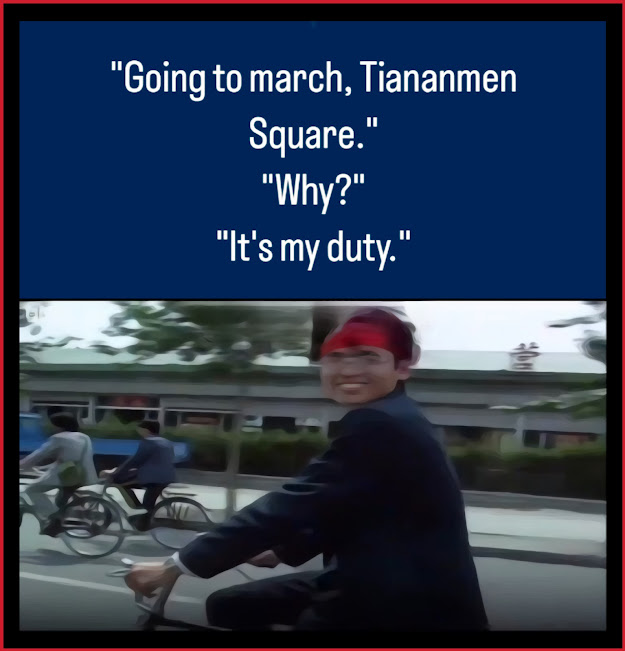
In 1989, nearly all the vehicles on the streets of Beijing, China were still bicycles. But on June 4, 1989, the streets were filled with tanks and armored personnel carriers. On that dark day, the Chinese Communist PartyState invaded its own national capital to crush defenseless students who were gathered in Tiananmen Square to plead with their government for human freedom and for respect for the dignity of every human person. Thousands died that day, including fleeing students who were shot in the back. Today the CCP still blocks and censors all information related to June 4, 1989 from their own people in mainland China.

Hong Kongers held huge memorial candlelight vigils in memory of the protestors on June 4th every year until 2021. Under the new CCP-dictated “National Security Law,” however, they have been banned. Holding candles in a park, apparently, is now defined as an “attempt to subvert State Power.” Meanwhile Hong Kong’s own protest heroes and heroines remain in jail, and some await final conviction and sentencing for the “shocking, State-subversive crime” of demanding political guarantees of recognition and respect for their humanity and their children’s humanity.

We must never forget. May God have mercy on China, and on the whole world.

Saturday, June 3, 2023

The “Special Genius” of Uganda’s Martyrs

June 3rd commemorates the 22 Catholic martyrs of Uganda (Kingdom of Baganda, East Africa, 1886). They were canonized during the Second Vatican Council on October 18, 1964. The original “canonization icon” is hard to find in a high resolution photo. I have a beautiful, large, framed print of this image, and it was on my wall in my office (I think), but that was long ago, and—like so many other things—I don’t know where it is right now. Probably in storage — I have maybe a dozen or so books/icons/objects/etc in storage that are priceless to me; the problem is that they are buried in truckloads of ABSOLUTE JUNK, stored in several different places. In addition to having OCD (which is managed but never cured), I also just like to keep stuff, but I’m also absent-minded and disorganized.

Anyway, the original icon is full of African and universally Christian symbolism, and is very striking. I have attempted to “tune up” an originally tiny photo from the internet; much is lost, but perhaps some sense of the beauty comes through.

At the canonization, Pope Saint Paul VI pointed to the ideal of evangelization that—in bringing people to Jesus— also communicates “a new form of vitality which tends to release the spiritual powers and latent talents of the local population and so set people free, helping to give them a mature power of self-determination, and enabling them to express more fully, in their own idiom of art and culture, the special genius they have.”

Thursday, June 1, 2023

Justin Martyr: The First “Christian Philosopher”

By the second century Saint Justin Martyr—whose feast is observed on June 1—had already taken up the exposition of the harmony between reason and faith. As a philosopher, Justin stressed that Christianity was the fulfillment of everything that was true and good in the thought of the ancient Greeks, whose intellectual heritage had been adopted by the Rome of his day.

Justin was born about the year 100 a.d. As a young man he became a seeker after wisdom—literally a “philosopher,”—and he traveled from his native Palestine to Ephesus where he studied under both the Stoics and the Platonists. Fascinated by the Stoic doctrine of the immanent and pervasive presence of the Divine logos giving rationality to the whole cosmos, and also by the Platonist understanding of the natural kinship between the soul and the Transcendent Good, Justin was nevertheless dissatisfied by incompleteness of the philosophic quest. 

He was also amazed by the remarkable courage and joy of the Christian martyrs he had seen dying for Christ while he was still a pagan. This admiration, along with the guidance of a Christian friend, led him to read the Scriptures. He soon discovered that Jesus Christ was the fullness of Wisdom, who had become incarnate in order to communicate the whole truth to man. Christ was the Goodness and Beauty sought by the Platonists, and the Divine Logos sought by the Stoics.

Justin converted to Christianity, but he continued to wear the "cloak" of a philosopher. He traveled to Rome where he opened a philosophical school that attracted numerous disciples. Finally, as his name indicates, he suffered martyrdom in Rome in the year 165.

Justin taught that Christianity was the fulfillment of philosophy and the correction of its errors. The philosophers had discovered portions of the truth, on account of the Divine Logos who enlightens the intellect of every man. But because they did not perceive the whole of the Logos—the whole of the Divine Wisdom—they contradicted one another and fell short of the full truth. Jesus Christ, however (said Justin) is the "Whole Logos" incarnate, manifesting in his flesh the fullness of the Divine Wisdom and making this Wisdom accessible not just to philosophers but to everyone. 

Thus, Saint Justin concluded, Christian revelation is "more noble than all human teaching." It alone is the complete truth. In his Second Apologia, he states, "Whatever has been spoken aright by any men belongs to us Christians, for we worship and love, next to God, the Logos which is from the unbegotten and ineffable God... For all those writers were able, through the seed of the Logos implanted in them, to see reality darkly. For it is one thing to have the seed of a thing and to imitate it up to one's capacity: far different is the thing itself, shared and imitated in virtue of its own grace" (II Apology, ch. 13).

Justin the Christian philosopher also emphasized something that no philosopher had ever stressed before: the meaning of history. Since the fullness of Divine Truth had become incarnate as a man in history, Justin concluded that the whole of human history had been a preparation for Him. This was clear enough in the case of the Jews; one could demonstrate that their prophecies were fulfilled in Christ. However, Justin was equally certain that philosophy had been given by God to the Greeks in order to prepare them for the Gospel. Justin saw the Incarnation as the center of God's plan for all of history, a plan that was destined to be fulfilled in the resurrection of the body and the renewal of all creation.

In presenting Christianity as the fulfillment of the philosophic quest of the Greeks, Saint Justin Martyr did not invent new speculations of his own, but sought to convey faithfully what God had really accomplished in history. We should not be surprised, therefore, that even in the middle of the second century Saint Justin would place great emphasis on tradition.

Because Christianity is an adherence to a man in history—to the things he said and did and to the society he constituted—it was crucial from the very beginning to receive and hand-on faithfully the authentic testimony of those He sent forth to bear witness to His name. Thus the measure of genuine Christian thinking and the anecdote to every poisonous distortion of the Christian message could only be fidelity to the apostolic tradition. In his famous account of early Christian liturgical and sacramental practice, Justin indicates that it was already common practice in the middle of the second century for the "memoirs of the Apostles" to be read at the Eucharistic celebration (See I Apology, ch. 67).

It is beautiful to begin the month of June by commemorating the “first Christian philosopher”—the first of a long line of philosophers who acknowledge that human reason (and all of reality) finds its fulfillment in Jesus Christ.